Link Building Prices in 2026: What Quality Backlinks Really Cost

Navigating link building prices in 2026 can feel like walking into an unpriced market. One provider quotes $300 a month for "guaranteed authority links," while another demands $10,000 upfront for a single digital PR campaign. If you are trying to budget effectively while building organic domain authority, understanding what backlinks actually cost—and why those costs vary so wildly—is critical to protecting your revenue and search engine rankings.
In this comprehensive guide, we unpack real market pricing data, break down hidden outreach expenses, and reveal how modern search algorithms (and AI engines) evaluate backlink ROI.
Key Takeaways
| Metric / Category | Budget / Cheap ($50–$150) | Mid-Tier ($250–$600) | High-Tier / PR ($750–$2,000+) | Automated Distribution Platforms |
|---|---|---|---|---|
| Typical Domain Rating (DR) | DR 10–30 | DR 40–60 | DR 65+ | DR 50–80+ |
| Organic Monthly Traffic | < 500 visitors | 1,000 – 10,000 visitors | 10,000+ visitors | Verified contextual traffic |
| Primary Method | Link farms, automated spam, PBNs | Niche edits, manual outreach, guest posts | Data-led Digital PR, journalistic quotes | Multi-channel network publishing |
| Risk of Google Penalty | High (Algorithmic devaluation) | Low to Moderate | Extremely Low | Minimal (White-hat editorial) |
| Best Suited For | Testing disposable sites | Growing SMB websites | Enterprise brands & competitive niches | Scaling SaaS & modern digital brands |
How Much Does Link Building Cost in 2026? (Link Building Prices Overview)
The average cost to secure a single quality backlink ranges from $300 to $1,000+, depending on the site's authority, traffic, and editorial standards. However, looking strictly at single-link pricing obscures how budgets are consumed behind the scenes.
Data from Backlinko reveals that 66.3% of web pages have zero backlinks pointing to them. This stark reality explains why acquiring authoritative links gives brands an outsized organic ranking advantage.
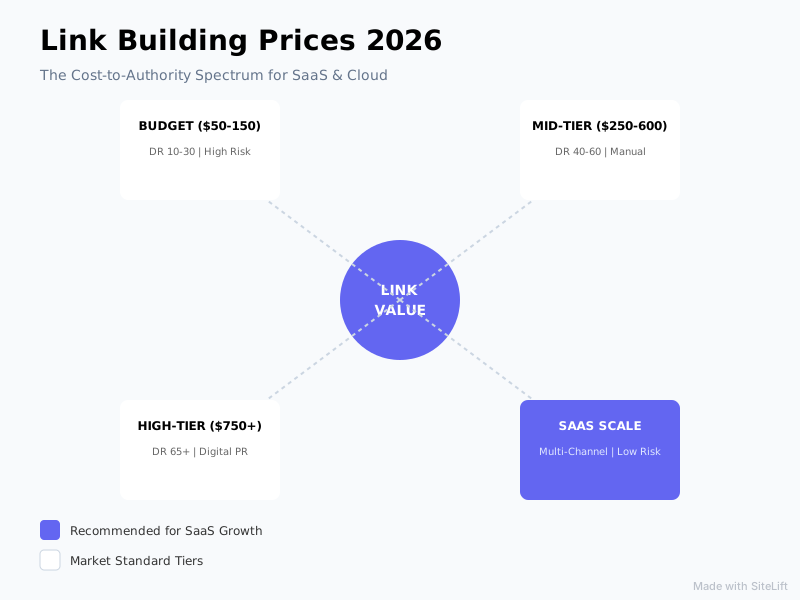
Infographic by SiteLift
Average Cost Per Link by Authority Tier (DR 30 to DR 80+)
Not all authority metrics are created equal, but Domain Rating (DR by Ahrefs) and Domain Authority (DA by Moz) remain standard proxies for price negotiation:
- Low Authority (DR 20–35): $100 – $200 per link. These placements often exist on smaller blogs or regional publication sites with low organic traffic.
- Mid-Tier Authority (DR 40–60): $300 – $600 per link. Typically represent real niche publications, active blogs, and established mid-sized businesses with steady organic search visits.
- High Authority (DR 65–79): $700 – $1,200 per link. Placements appear on recognized publications, top-tier industry blogs, and established news outlets.
- Elite Authority (DR 80+): $1,500 – $3,500+ per placement. Driven primarily by high-tier digital PR campaigns, primary research reports, or exclusive brand coverage.
According to Ahrefs, the average cost of buying a paid guest post link from a site outreach study is $361.44, excluding internal content creation expenses. When content production costs are factored in, real placement costs increase significantly.
Link Building Cost Breakdown: Where Does Your Budget Go?
When paying an agency or building an internal link acquisition engine, your budget is rarely spent just on site publishing fees. A typical link building cost breakdown looks like this:
- Prospecting & List Building (15%): Software subscriptions, data scraping, and manual qualification of prospective domains.
- Personalized Cold Outreach (25%): Email infrastructure, inbox warmups, copywriting, and dedicated outreach strategists.
- Content Creation (30%): Hiring experienced niche writers to craft guest posts, data studies, or editorial pitches that meet publication standards.
- Publisher Fees & Administrative Overheads (30%): Direct editorial compensation, project management, and quality assurance auditing.
What Are the Most Common Backlink Pricing Models?
Choosing the right partner requires navigating distinct backlink pricing models. Depending on your internal resources, one payment structure will deliver vastly superior ROI over another.
Monthly Agency Retainers vs. Pay-Per-Link Pricing
Most traditional link building agencies structure their services around monthly retainers or fixed per-link fees:
- Monthly Retainers ($3,000 – $15,000+/month): The agency commits to delivering a set strategy, digital PR campaign, or a target range of link placements each month. Retainers provide predictable cash flow for agencies and allow for long-term creative assets. Research from Siege Media, featured on Search Engine Land, indicates that high-tier digital PR campaigns typically require a monthly investment ranging from $5,000 to $15,000+.
- Pay-Per-Link Models ($250 – $1,000+/link): You pay strictly for deliverables that meet predefined metrics (such as target DR and organic traffic thresholds). While transparent, this model can encourage providers to favor easily acquired placements over strategic contextual links.
To learn more about comparing agency billing structures, read our breakdown on decoding SEO agency fees.
In-House Link Building vs. Outsourced Link Building Costs
Building an in-house outreach team gives you complete control over brand messaging, but the outsourced link building cost equation often shifts dramatically when accounting for corporate overhead.
In-House Team Annual Expense:
- Senior SEO Lead: $90,000
- Content Specialist: $60,000
- Outreach Specialist: $50,000
- Outreach Tools & Databases: $12,000/yr
Total Annual Cost: ~$212,000 (Yielding ~15-20 links/month)
Outsourcing to a dedicated service or platform eliminates employee benefits, management strain, and software stack overheads, making it easier to scale budgets up or down dynamically.
Performance-Based and Hybrid Pricing Structures
Performance-based models charge clients only after a link is indexed and verified by third-party tools. While enticing, ensure performance agreements explicitly define strict traffic, niche-relevance, and indexation requirements to prevent agencies from fulfilling contracts using low-quality spam domains.

White Hat Link Building Rates: Understanding Link Building Prices Across Vendors
Understanding how white hat link building rates are established helps prevent you from overpaying for mediocre coverage—or underinvesting in critical business niches.
Low-Cost ($50–$150) vs. High-Tier ($300–$1,500+) Backlinks
Cheap links almost always rely on private blog networks (PBNs), automated link-insertion scripts, or directory spam. These links provide zero editorial oversight and often trigger Google manual actions or algorithmic devaluation.
Conversely, premium outreach involves human negotiation, manual content tailoring, and strict editorial review by established webmasters.
Pro Tip: Never evaluate a backlink vendor based solely on Domain Rating. Always verify that target domains receive active, non-branded search traffic from your target geographical regions.
Domain Rating, Niche Relevance, and Organic Traffic Metrics
Industry research from Moz highlights that contextual relevance and actual domain traffic matter far more to search algorithms than raw domain metric scores.
A link from a DR 45 specialized software blog with 5,000 monthly target visitors often drives more search authority than a link from a generic DR 75 web directory with no organic traffic.
Content Production and Personalized Outreach Overheads
Quality writing is the single biggest operational cost in ethical link building. Crafting high-converting guest posts or authoritative industry commentaries requires domain experts.
If a provider charges $100 per link, it is statistically impossible for them to be paying for expert copywriting, outreach labor, and editorial verification while maintaining a operating margin.
To see what software stack powers top outreach campaigns, view our guide to the best link building tools.
How Is AI Search and Generative Engine Optimization (GEO) Changing Link Value?
Search engines no longer rely strictly on traditional hyperlink crawlers. AI discovery engines—such as Perplexity, ChatGPT, and Google's Gemini—evaluate online authority using generative AI retrieval models.
Traditional SEO vs. Generative Engine Optimization (GEO):
[Traditional SEO]  --> Hyperlinks + PageRank + Anchor Text --> Google SERP Rank
[GEO & AI Search]  --> Entity Mentions + Co-occurrences + Unlinked Citations --> AI Answer Synthesizer
Why Authority and Brand Citations Matter for AI Engines
Large language models (LLMs) synthesize answers based on verified brand citations across trusted digital properties. A high-authority editorial mention acts as a grounding reference point for AI systems when recommending product solutions to end users.
This means that secured links on recognized publications now double as direct inputs for AI search visibility.
Automated Publishing Networks vs. Traditional Link Outreach
Traditional cold email outreach faces falling response rates due to AI spam filters and widespread email fatigue. Modern digital teams are shifting toward automated content distribution pipelines and curated publisher networks.
Rather than spending weeks pitching cold inboxes, platforms facilitate direct contextual distribution across vetted properties.
If you manage a modern software product, learn how automated pipelines scale domain growth in our complete guide to SaaS link building.
How Can You Avoid Link Building Scams and Low-Quality Networks?
As budget allocations for organic search rise, suspicious web networks designed solely to harvest backlink fees have proliferated.
Red Flags of Toxic Link Farms and PBNs
Before approving vendor invoices, check target link destinations for these common warning signs:
- "Write For Us" Navigation Links: Sites with prominent advertising sales footers or submission forms usually exist solely to sell outbound links.
- Irrelevant Category Sprawl: A single blog publishing articles on casino sites, local plumbing, real estate, and crypto software is a compromised link farm.
- Sudden Traffic Drops: A dramatic loss in organic traffic indicates an active search engine penalty or algorithmic devaluation.
Key Criteria to Audit Link Vendors Before Purchasing
Protect your domain authority by requiring every backlink vendor to meet these audit criteria:
- Strict Indexation Guarantee: Links must remain indexed by Google for at least 12 months.
- No Nofollow or Sponsored Tags (Unless Specified): Ensure links pass standard editorial PageRank equity.
- Clean Outbound Link Ratios: The publishing domain should not output thousands more outbound links than it receives incoming domain authority.
Why Manual Cold Outreach Is Overrated—and Overpriced
From an editorial perspective, traditional manual outreach is ripe for disruption.
For years, search marketers believed that sending 5,000 cold emails to unsuspecting webmasters was the only "authentic" way to build links. The reality? Over 95% of cold outreach emails land in spam or get deleted immediately. Agencies pass those massive inefficiency costs directly to clients in the form of inflated link building prices.
You shouldn't have to pay for an agency's 98% email failure rate.
The future of authority growth lies in direct, automated publishing and curated distribution networks. When content pipeline tools handle layout, publishing, and indexing automatically, human talent can focus entirely on high-level strategy and product innovation.
Scaling Your Organic Authority on Autopilot
Understanding link building prices allows you to make informed investment decisions that compound search equity over time. But manual cold outreach is no longer the only path to high-authority rankings.
If you are ready to eliminate manual cold emails and agency retainers, explore how SiteLift transforms organic traffic growth. SiteLift operates as an autonomous SEO platform that generates high-converting content, distributes it across a curated premium network, and updates rank tracking in real-time.
By automating the publishing pipeline, your website builds domain authority and captures organic search market share without demanding continuous manual management.
— sitelift.io
Frequently Asked Questions About Link Building Costs
How much should a business spend on link building per month?
Most growing small-to-midsize businesses spend between $2,000 and $5,000 per month on link acquisition to maintain momentum against competitors. Enterprise brands in highly competitive spaces like SaaS, fintech, or law often spend $10,000 to $25,000+ monthly on comprehensive digital PR.
Why are high-DR backlinks so expensive?
High-DR backlinks (DR 70+) command premium prices because they require substantial resources to earn. High-authority publications maintain strict editorial editorial standards, demand expert-level content, and reject commercial spam pitches, requiring specialized PR talent or trusted publisher relationships.
What is the difference between pay-per-link and monthly agency retainers?
The pay-per-link model charges a fixed rate per live link delivered based on pre-set quality metrics (e.g., $400 for a DR 50+ link). Monthly agency retainers charge a recurring monthly fee ($3,000–$10,000+/mo) for a dedicated team to manage strategy, content production, outreach, and asset creation continuously.
Is buying backlinks safe according to search engine guidelines?
Google's Spam Policies explicitly state that buying links to manipulate search rankings violates their guidelines. To mitigate risk, brands should avoid low-quality link farms and focus on acquiring contextual editorial mentions, authentic digital PR placements, or using automated content distribution systems that adhere to white-hat editorial standards.
Can automated platforms help lower outsourced link building costs?
Yes. Automated publishing and SEO platforms significantly reduce the operational overhead associated with prospect research, cold outreach, and content management. By replacing manual outreach labor with software automation, businesses can acquire high-authority coverage at a fraction of traditional agency retainers.
Topics Covered:
- link building prices
- link building cost breakdown
- backlink pricing models
- white hat link building rates
- outsourced link building cost
More from SiteLift

White Hat Link Building Techniques That Still Work for Google and AI Search
Discover 5 proven white hat link building techniques that earn top Google rankings and AI search citations. Master ethical link building today.

Ecommerce Link Building: Scale Product Authority and Revenue on Autopilot
Master ecommerce link building. Learn how to secure product page backlinks, execute digital PR, fix redirect leaks, and automate your store authority.

Crawling in SEO: How Google and AI Bots Discover and Rank Your Pages
Master crawling in SEO. Learn how Googlebot and AI scrapers discover pages, compare indexing vs crawling, and optimize your crawl budget.