Decoding SEO Agency Fees: Hourly Rates, Retainers, and Automated Alternatives

Navigating seo agency fees often feels like buying a black-box service where two different vendors quote $1,500 and $15,000 per month for what appears to be the exact same scope of work. If you have ever stared at a proposal wondering why agency pricing varies so drastically—and whether you are actually paying for results or account management fluff—you are not alone.
Understanding how agencies price their work is crucial for maximizing your budget and achieving a positive return on organic search. From hourly consulting rates to standard monthly retainers and modern autonomous publishing software, this guide breaks down current industry benchmarks, uncovers hidden agency overhead, and helps you determine the most cost-effective path forward for your business.
Key Takeaways
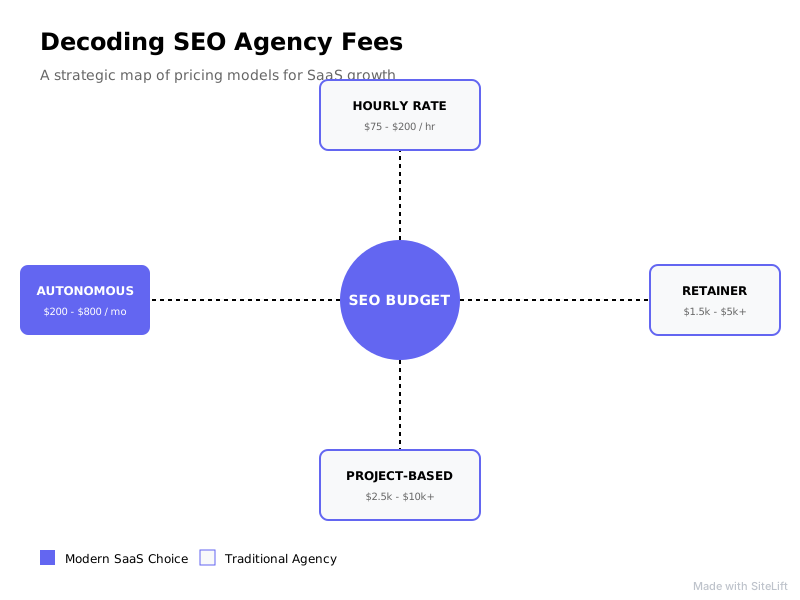
| Pricing Model | Average Cost Benchmark | Primary Deliverables | Best Suited For |
|---|---|---|---|
| Hourly Rate | $75 – $200 / hour | Technical audits, specific consultations, one-off fixes | One-time troubleshooting & advisory |
| Monthly Retainer | $1,500 – $5,000+ / month | Content production, link building, strategy, reporting | Traditional hands-off management |
| Project-Based | $2,500 – $10,000+ per project | Site migrations, comprehensive audits, site builds | Fixed-scope tactical overhauls |
| Autonomous Platform | $200 – $800 / month | Continuous content generation, auto-publishing, AI visibility | High-velocity growth & automated scaling |
What Are the Standard SEO Agency Fees and Pricing Models?
When evaluating search marketing partners, you will encounter four primary pricing structures. Understanding this pricing models comparison helps you align vendor capabilities with your operational budget.
       TRADITIONAL AGENCY COSTS              AUTONOMOUS ALTERNATIVE
+------------------------------------+    +---------------------------+
| Monthly Retainer ($1,500 - $5,000+) |    | Autonomous SEO Platform   |
|  ├─ Account Managers (30%)         | vs |  ($200 - $800 / month)    |
|  ├─ Status Meetings (20%)          |    |  ├─ 100% Direct Execution |
|  └─ Manual Execution (50%)         |    |  └─ Zero Meeting Overhead |
+------------------------------------+    +---------------------------+
Hourly Rates vs. Project-Based Pricing
For one-off deliverables like a technical audit or a complex site migration, agencies frequently bill hourly or quote flat project fees. According to extensive research by Ahrefs, $75 to $100 per hour is the most common hourly rate charged by search marketing professionals globally, though premium agencies in major metros routinely charge upwards of $200 per hour.
Project-based pricing packages these hourly estimates into a predictable invoice. Typical one-time projects range from $2,500 to $10,000+, depending on site architecture size and the depth of technical remediation required.
Monthly Agency Retainer Costs Breakdown
The vast majority of search marketing relationships run on recurring monthly billing. Data published by Search Engine Journal indicates that standard agency retainer cost structures for small-to-medium businesses (SMBs) fall between $1,500 and $5,000 per month, while enterprise contracts easily scale past $10,000 monthly.
In fact, research shows that 74.71% of SEO professionals charge a monthly retainer for their services. This model offers agencies stable recurring revenue and gives clients continuous access to strategy, content creation, and technical optimization.
Performance-Based and Value-Based Pricing Models
A smaller subset of agencies operates on performance or value-based pricing. Here, seo agency fees are tied directly to agreed-upon key performance indicators (KPIs), such as top 3 keyword rankings, organic revenue growth, or qualified lead generation.
While appealing on paper, performance pricing carries strict caveats. Agencies often insist on high setup fees to hedge their risk, or they target low-difficulty, low-intent keywords to hit performance triggers quickly without driving real revenue.
What Key Factors Determine How Much SEO Services Cost?
Two companies requesting search engine optimization will rarely receive identical proposals. Several operational and market dynamics dictate where your quote lands on the pricing spectrum.

Scope of Work, Technical Complexity, and Content Needs
A corporate website with 50 pages requires far less technical upkeep than an e-commerce store with 100,000 SKU variants and dynamic faceted navigation. Similarly, if your strategy requires publishing 20 high-quality, long-form articles every month, content production costs will dominate the invoice.
If you are trying to understand geographical variations in pricing, read our breakdown of search engine optimization cost in the UK for localized benchmark data.
Agency Reputation, Seniority, and Geographic Location
Where an agency is based heavily influences their billing rates. A boutique firm based in San Francisco, London, or Sydney carries significant overhead—including physical real estate, executive salaries, and client success teams—that gets factored directly into your contract.
Conversely, offshore or regional agencies may offer lower rates, but they often lack the industry vertical context or English content quality necessary to drive meaningful conversion rates in competitive markets.
Industry Competition and Keyword Difficulty
Ranking for high-intent commercial terms in industries like SaaS, fintech, or legal services requires massive domain authority and continuous, high-volume publishing. To build keyword momentum in these high-stakes niches, agencies must spend heavily on manual outreach, expert writers, and deep technical monitoring, which dramatically increases monthly retainers.
Pro Tip: Always ask prospective agencies for a transparent line-item breakdown showing exactly how many hours go toward content production versus project management and reporting meetings.
How Do You Calculate SEO Investment ROI Across Different Models?
To evaluate whether your seo agency fees are justified, you must look past simple rank tracking and evaluate net revenue impact against total cash outlay.
Infographic by SiteLift
Measuring Time-to-Value in Agency Relationships
Traditional agency onboarding typically consumes the first 30 to 60 days of a contract. During this window, you pay full retainer rates while the agency conducts discovery, audits your tech stack, and develops a roadmap. Actual content production and indexation often don't begin until month three.
This lag inflates your initial investment before a single new organic visitor arrives. Calculating time-to-value means accounting for these "dead months" where cash outlay is high but search presence remains static.
Evaluating Agency Retainer Cost Against Revenue Growth
To compute your organic seo investment ROI, track customer acquisition cost (CAC) and customer lifetime value (LTV) generated specifically through non-paid search channels.
$$\text{SEO ROI (%)} = \left( \frac{\text{Organic Gross Profit} - \text{Total SEO Outlay}}{\text{Total SEO Outlay}} \right) \times 100$$
Where Total SEO Outlay includes:
- Direct monthly agency retainers or software licenses
- Internal team hours spent reviewing agency deliverables
- Third-party tooling, indexers, or design resources required by the agency
If your agency charges $4,000 per month ($48,000 annually) and generates $120,000 in gross profit from organic channels, your net return is 150%. However, if internal approval bottlenecks add $15,000 in lost staff hours, your real ROI drops significantly.
Uncovering Hidden Overhead: Account Management and Deliverables
A major hidden cost of traditional agencies is the tax on your internal bandwidth. Weekly status calls, back-and-forth email chains over content briefs, and monthly slide-deck presentations consume valuable hours from your marketing director or founder.
When analyzing automated SEO service costs, many brands realize they spend up to 20% of their total contract value just talking to their agency about work rather than having work executed.
Automated Alternatives vs. SEO Agency Fees: Cost Efficiency Compared
The search industry is undergoing a structural shift. Advances in generative AI and automated publishing platforms have created a new category: autonomous growth engines that replace manual agency execution at a fraction of the cost.
The Emergence of Autonomous SEO Platforms
Autonomous platforms remove human bottlenecks by handling keyword discovery, content drafting, technical schema optimization, and multi-channel syndication through automated code pipelines. Rather than waiting three weeks for an agency copywriter to produce a single article, automated software continuously publishes search-optimized content directly to your Content Management System (CMS).
TRADITIONAL AGENCY WORKFLOW (Slow & Expensive)
Keyword Research → Writer Draft → Edits → Account Manager Review → Client Review → CMS Upload → Publishing
[Time elapsed: 14-21 days per article | Cost: $300-$500 per article]

AUTONOMOUS PUBLISHING PIPELINE (Fast & Scalable)
Intent Mapping → Algorithmic Draft → Automated Optimization → Direct CMS Push → Instant Indexing
[Time elapsed: Real-time autopilot | Cost: Included in flat platform fee]
Cost Breakdown: Traditional Agency Retainers vs. Automated Solutions
Comparing a traditional $3,000/month human retainer against an autonomous system illustrates dramatic cost savings:
| Expense Category | Traditional Agency Retainer | Autonomous SEO Engine |
|---|---|---|
| Monthly Direct Fee | $3,000 – $5,000 / mo | $200 – $800 / mo |
| Setup & Onboarding | $1,500 – $3,000 (1-time) | $0 – $200 (Instant setup) |
| Internal Management Time | 10–15 hours / month | < 1 hour / month |
| Publishing Volume | 4–8 articles / month | 30–120+ articles / month |
| Effective Cost per Article | $375 – $750 / piece | $5 – $20 / piece |
This high level of automated seo cost efficiency allows companies to compound traffic rapidly without swelling their payroll or agency budgets.
Scaling Content Generation, Distribution, and AI Engine Visibility
Search is no longer confined to traditional Google text links. Today, prospective customers search on Perplexity, ChatGPT, and AI-driven answer engines.
According to research from Gartner, search engine volume is projected to drop 25% by 2026 due to conversational AI chatbots. This trend forces businesses to publish structured, highly authoritative content at scale so AI engines can parse and cite their site. Modern software automates this broad distribution, ensuring your brand stays visible across both search engine results pages (SERPs) and AI answer engines.
For an in-depth operational comparison, read our guide on replacing traditional B2B SEO agencies with modern workflows.
How to Choose the Right SEO Model for Your Business Goals?
Selecting the optimal growth model depends on your internal technical resources, growth goals, and willingness to manage manual workflows.
                  +-----------------------------------+
                  |  Do you have complex custom code  |
                  |  remediations on legacy tech?     |
                  +-----------------+-----------------+
                                    |
                    +---------------+---------------+
                    |                               |
                   YES                              NO
                    |                               |
                    v                               v
        +-----------------------+       +-----------------------+
        | Consider Specialized  |       | Do you need 10x content |
        | Engineering Agency    |       | scale & speed to rank |
        | or Technical Expert   |       | target keywords fast? |
        +-----------------------+       +-----------+-----------+
                                                    |
                                    +---------------+---------------+
                                    |                               |
                                   YES                              NO
                                    |                               |
                                    v                               v
                        +-----------------------+       +-----------------------+
                        | Use Autonomous Platform|       | Standard Low-Velocity |
                        | (e.g., SiteLift.io)   |       | Freelancer / Agency   |
                        +-----------------------+       +-----------------------+
Assessing In-House Resources and Bandwidth
If your team includes a dedicated technical web developer and a full-time managing editor, an external agency may end up duplicating effort. However, if your internal team is stretched thin, expecting them to review agency briefs, edit drafts, and handle manual CMS uploads will create severe bottlenecks.
Decision Matrix: Agency vs. Automated Software
Use this quick framework to align your strategy with your budget:
- Choose a Specialized Agency if: You have a bespoke, enterprise-level technical stack with custom legacy code that requires manual hands-on development work, or if you need crisis PR management.
- Choose an Autonomous SEO Platform if: Your primary objective is rapid traffic growth, expanding keyword footprint, dominating AI visibility, and eliminating expensive monthly retainers and approval overhead.
- Choose a Freelancer if: You only need occasional advisory help or one-off tactical audits without ongoing execution.
Pro Tip: Many fast-growing SaaS brands and e-commerce stores use a hybrid model: they run an autonomous platform like SiteLift to handle high-velocity content production and technical distribution on autopilot, while reserving high-cost agency consulting strictly for high-level brand strategy.
Why Speed and Autopilot Execution Win in Modern SEO
In my years analyzing organic search channels, I have seen far too many businesses burn tens of thousands of dollars on agency retainer contracts that yield little more than PDF decks and endless status updates.
The underlying problem with standard agency models isn't a lack of smart people—it's that human workflows simply cannot keep pace with modern search requirements. When an agency takes three weeks to write, edit, format, and publish a single piece of content, your competitors are already index-scaling dozens of targeted pages.
By removing manual friction, software-driven pipelines compound domain authority at a rate human teams cannot replicate. If your goal is to dominate search rankings and secure visibility in conversational AI engines without lighting money on fire, shifting budget toward automated execution offers superior margin, faster time-to-market, and measurable compounding ROI.
— sitelift.io
Scale Your Search Growth on Autopilot
If you are ready to stop paying inflated retainers for slow content cycles, explore how sitelift.io transforms organic search.
As an autonomous SEO and AI visibility growth engine, SiteLift generates target-focused content, publishes directly to your CMS platform, builds contextual network distribution, and tracks keyword velocity in real time. It delivers a complete publishing pipeline designed to compound your traffic hands-free.
Frequently Asked Questions About SEO Agency Fees
How much does a typical SEO agency cost per month?
A typical monthly retainer for a small-to-medium business ranges between $1,500 and $5,000 per month. Enterprise-level agencies handling complex international sites or aggressive e-commerce builds often charge between $10,000 and $25,000+ monthly.
What is the average hourly rate for an SEO agency?
According to industry benchmarks, the standard global hourly rate ranges from $75 to $100 per hour for standard implementations. Premium agencies, high-level technical consultants, and US-based executive strategists typically bill between $150 and $300 per hour.
Why are traditional SEO agency retainers so expensive?
Traditional retainers must account for significant human overhead. When you pay a $4,000 monthly fee, a large portion covers non-execution costs, including account management salaries, strategy presentation meetings, agency software licenses, and physical overhead, rather than direct content and technical execution.
How does automated SEO software compare in cost and performance to an agency?
Automated platforms usually cost $200 to $800 per month, representing an 80-90% cost reduction compared to standard agency retainers. In terms of performance, autonomous engines publish content faster and maintain continuous optimization without human delays, driving higher traffic velocity per dollar spent.
How long does it take to see ROI from SEO services?
With traditional agencies, initial ROI typically takes 6 to 12 months due to slow onboarding, manual review cycles, and delayed publishing schedules. Autonomous platforms reduce this timeline significantly by accelerating publishing speed and indexation, often generating measurable keyword momentum within 60 to 90 days.
Topics Covered:
- seo agency fees
- agency retainer cost
- seo investment ROI
- pricing models comparison
- automated seo cost efficiency
More from SiteLift

SEO Conversion Optimization: How to Turn Organic Search Readers into Paying Customers
Learn how to turn organic search visitors into paying customers with this step-by-step SEO conversion optimization guide. Optimize your CTAs and UX.

How to Choose SEO Audit Companies That Deliver Actionable Automation Roadmaps
Stop paying for static PDFs. Learn how to choose SEO audit companies that deliver developer-ready, automated roadmaps to scale your organic traffic.

What Defines High-Quality Content SEO in Google’s AI-Driven Search Era?
Discover what defines high-quality content SEO today. Learn how to optimize for Google's AI Overviews, master E-E-A-T guidelines, and outrank generic copy.