Is an Automated SEO Service Better Than a Traditional Agency? A Cost-Benefit Analysis

For many European businesses, an automated SEO service now covers far more than technical audits or rank tracking. Modern platforms can research keywords, create content, publish it through a CMS, distribute it across relevant websites and monitor keyword momentum continuously.
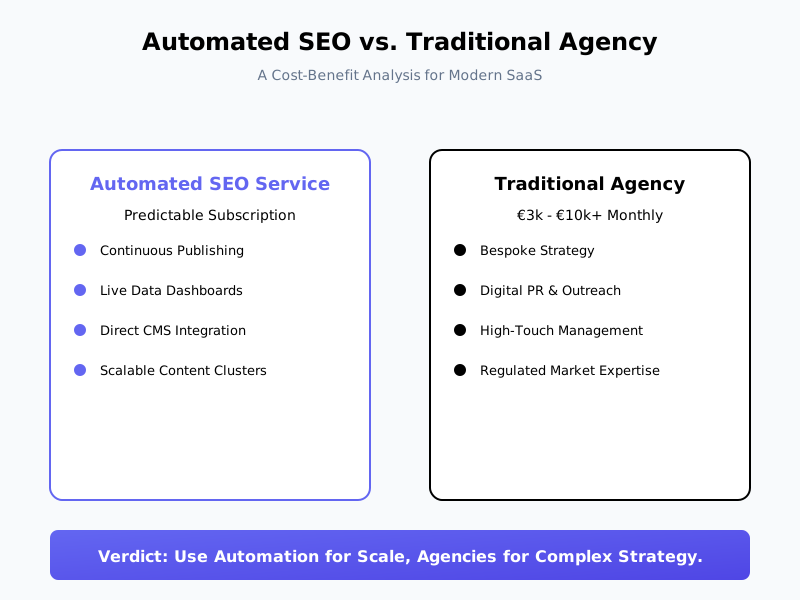
That changes the commercial question. The comparison is no longer “software versus a junior copywriter”. It is autonomous search growth versus a traditional agency retainer of €3,000–€10,000 per month.
My view is straightforward: automation is usually better for repeatable SEO execution, while agencies remain valuable for complex strategy, digital PR and regulated markets. The strongest model for most start-ups, scale-ups and e-commerce brands is a carefully supervised automated search engine optimization system—not a large monthly retainer with a long list of deliverables.
Key takeaways: automated SEO service or traditional agency?
| Factor | Automated SEO service | Traditional SEO agency |
|---|---|---|
| Monthly cost | Usually a predictable software subscription | Commonly €3,000–€10,000+ in Europe |
| Publishing speed | Continuous, programmatic workflow | Limited by briefs, approvals and team capacity |
| Keyword research | Automated clustering and prioritisation | Manual research, often delivered monthly or quarterly |
| Content production | Scales across topics and markets | Higher-touch, but slower and more expensive |
| CMS publishing | Can be connected directly to WordPress and other CMS platforms | Often requires client-side implementation |
| Reporting | Live dashboards and keyword momentum | Monthly or quarterly reports |
| Digital PR | Limited unless paired with outreach services | Stronger for bespoke media relationships |
| Best fit | Scalable content, SaaS, e-commerce and multi-market growth | Complex positioning, reputation and regulated industries |
The potential ROI of automated SEO comes from three areas: lower operating cost, faster time to market and a larger number of useful pages published consistently.
An automated platform does not make quality irrelevant. It makes the production system more efficient, leaving people to focus on positioning, review and commercial decisions.
What is an automated SEO service versus a traditional SEO agency?
Defining automated search engine optimization and AI publishing pipelines
An automated SEO service is an integrated software system that executes several parts of the organic growth process programmatically. Depending on the platform, that may include:
- Keyword discovery and search-intent analysis
- Topic clustering and content planning
- AI-assisted drafting and optimisation
- Internal linking and metadata generation
- CMS publishing and formatting
- Link or content distribution
- Rank, indexing and traffic monitoring
- Content updates based on performance data
This is different from an automated audit plugin, which may identify broken links or missing metadata but does not execute the complete workflow.
The more useful concept is an AI publishing pipeline. It connects research, production, publishing and measurement into one repeatable system. Instead of waiting for an agency to send a monthly spreadsheet, the pipeline can move from opportunity to published asset in a matter of hours or days.
That is the foundation for hands-free SEO growth. “Hands-free” does not mean abandoning oversight. It means removing repetitive coordination work from the process.
How traditional SEO agencies function in the modern market
A conventional agency typically begins with an audit, a discovery phase and a strategy document. The account manager then coordinates specialists such as:
- SEO strategists
- Content writers
- Editors
- Developers
- Outreach specialists
- Reporting and account-management staff
This model can produce excellent work, particularly when the team understands the client’s market. However, it often creates a chain of dependencies. A keyword brief may take a week, content approval another week, and a development ticket several more weeks.
Agencies also tend to sell capacity and expertise by the month. A €5,000 retainer might include strategy calls, technical recommendations, four articles, link-building activity and reporting. The deliverables can be useful, but the client is still paying for meetings, project management and unused capacity.
Key operational differences: speed, control and scale
The clearest distinction is operational throughput.
An agency has a finite number of writers and strategists. An automated system can process hundreds of keyword variations, generate content briefs and publish approved assets without adding another account manager to the project.
Automation also provides more consistent control. Templates, brand rules, keyword exclusions and publishing schedules can be applied across every market. That matters to a European company operating in English, German, French, Spanish and Dutch.
Human judgement remains essential for sensitive claims, brand tone and local cultural nuance. The winning system combines automation for repeatable execution with human review for decisions that carry reputational risk.

What does an automated SEO service cost compared with an agency?
The true cost of European agency retainers
Across Western Europe, SEO retainers for small and mid-sized businesses commonly sit between €3,500 and €8,000 per month for ongoing content, technical maintenance and reporting. More comprehensive programmes can reach €10,000 or more, particularly when multiple markets, digital PR or enterprise development work are included.
UK pricing often falls in a similar range, roughly £3,000–£8,500 per month, depending on agency reputation and scope. Pricing data varies by country and service mix, so these figures should be treated as working benchmarks rather than a universal tariff. The Statista digital advertising and marketing industry data provides useful context on the scale and commercial structure of the wider market.
A typical €5,000 monthly retainer might result in:
- Four to eight long-form articles
- A monthly technical audit
- A strategy or reporting call
- A handful of link placements
- Recommendations for the client’s development team
That can be a sensible investment when the agency is genuinely strategic. But if the business needs 20, 30 or 50 new pages per month, the cost rises quickly.
The cost structure of an autonomous AI publishing pipeline
An automated SEO platform usually works on a subscription model. The business pays for access to software, publishing capacity, integrations, distribution and reporting rather than a fixed number of agency hours.
This changes the economics in two ways:
- Marginal production cost falls as publishing volume increases.
- Output becomes more predictable, because it is not tied to a writer’s availability.
For example, a €1,000 monthly platform that publishes 20 well-targeted pages has a software cost of approximately €50 per indexed page before internal review time. A €5,000 agency producing eight pages has a direct content cost of about €625 per page, excluding any additional implementation or link-building fees.
Those figures do not prove that software content is automatically better. They show why the ROI of automated SEO can be compelling when a business has enough relevant topics to cover.
Evaluating hidden overhead: management time, revisions and delays
The invoice is only part of the cost. Traditional campaigns often create hidden overhead through:
- Briefing calls and status meetings
- Repeated feedback rounds
- Delayed approvals
- Copy rewrites
- Developer hand-offs
- Manual publishing
- Spreadsheet reporting
- Coordination across languages and markets
If a marketing manager spends 15 hours per month managing an agency, that time should be included in the calculation. At an internal cost of €60 per hour, the overhead is another €900 per month.
An automated search engine optimization workflow can reduce this administrative burden, provided the platform has reliable CMS integration and clear approval controls.
Pro Tip: Calculate cost per indexed, commercially relevant page—not cost per article. A page that attracts qualified visitors and supports a sales funnel is more valuable than a cheaper page that never earns visibility.
Comparing ROI on a practical basis
A simple model can help:
SEO ROI =
(Incremental gross profit from organic traffic − SEO investment)
÷ SEO investment
Track these inputs separately:
- Monthly software or agency cost
- Internal review and management hours
- Number of pages published
- Number of pages indexed
- Organic clicks and qualified leads
- Assisted conversions and revenue
- Time from keyword selection to publication
For early-stage campaigns, revenue may not appear immediately. In that case, measure leading indicators such as impressions, indexed pages, ranking distribution and non-branded clicks.
Research frequently cited by HubSpot found that businesses publishing 16 or more blog posts per month received around 3.5 times more traffic than businesses publishing zero to four posts monthly. The HubSpot blogging frequency research is older and should not be treated as a guarantee, but it illustrates a practical point: consistent volume is difficult to achieve with a manual agency workflow unless the budget is substantial.
Can automation outperform human SEO strategists on performance and quality?
Content velocity across multiple European regions
A traditional agency may publish four to 12 articles per month for a mid-market client. An automated pipeline can support a much higher cadence, especially when content follows repeatable formats such as:
- Product comparisons
- Location pages
- Use-case guides
- Industry explainers
- Integration pages
- Frequently asked questions
- Supporting articles for commercial landing pages
The advantage becomes more pronounced across European markets. A company entering France, Germany and Italy does not need three entirely separate planning systems. It can identify equivalent search intent, localise the content and maintain common brand standards.
That said, translation is not localisation. A German buyer may expect more technical detail, while a French audience may respond better to different examples and phrasing. Automation should provide market-specific instructions rather than simply translating an English article word for word.
Technical remediation and CMS integration
A capable automated SEO service can connect with a CMS and streamline tasks such as:
- Creating draft or published pages
- Adding title tags and meta descriptions
- Applying headings and structured formatting
- Building internal links
- Maintaining publication schedules
- Monitoring indexing status
- Identifying declining pages for updates
This is especially valuable for lean SaaS teams without a dedicated SEO developer. However, businesses should verify how integrations handle permissions, rollback, staging environments and accidental publication.
A sensible setup starts with draft mode, a defined approval process and restricted user permissions. Once quality is proven, selected content types can move to automatic publication.
Optimising for Google and generative AI search
SEO is no longer limited to blue links. Buyers increasingly ask tools such as ChatGPT Search, Perplexity and Google’s AI features to summarise products, compare providers and recommend solutions.
This emerging practice is often called Generative Engine Optimization (GEO). It overlaps with traditional SEO but places more emphasis on:
- Clear, factual answers
- Strong topical coverage
- Consistent brand information
- Authoritative citations
- Structured content
- First-hand expertise
- Easy-to-extract definitions and comparisons
No platform can guarantee inclusion in an AI-generated answer. Search systems change frequently, and visibility depends on relevance, authority and the quality of external information.
The Google Search Central guidance on helpful, reliable, people-first content remains the right baseline. Content created with AI is not automatically a problem; low-value, manipulative or inaccurate content is.
A platform that monitors keyword momentum and brand mentions more frequently than a quarterly agency audit can identify shifts sooner. That is useful for both standard search and emerging AI visibility, although the measurement methods are still developing.
Quality, compliance and GDPR
European companies should assess an automated SEO service as a SaaS vendor, not merely a content tool.
Before onboarding, ask:
- Where is customer and user data stored?
- Does the provider use client data to train models?
- Which subprocessors handle data?
- Is a Data Processing Agreement available?
- Can data be deleted on request?
- Are access controls and audit logs provided?
- Does the tool publish only with explicit permissions?
The European Commission’s GDPR data protection principles provide the relevant regulatory framework. SEO platforms generally do not need personal customer data to generate content, so the safest approach is to minimise the information shared with them.
Quality controls matter just as much. Use a human review layer for medical, financial, legal and safety-related content. Automation should accelerate production, not invent evidence or make unsupported claims.
When should you still hire a traditional agency?
Complex digital PR and high-tier media relations
Agencies remain stronger when the goal is genuine editorial coverage in major publications. Building relationships with journalists, developing newsworthy campaigns and managing sensitive outreach requires judgement that software cannot reproduce reliably.
If your growth plan depends on national press, analyst relations, conference visibility or a major product launch, a specialist PR agency may justify its fee.
Bespoke enterprise strategy for regulated industries
Highly regulated companies often need a more customised operating model. Financial services, healthcare, insurance and public-sector organisations may require:
- Formal approval workflows
- Legal and compliance review
- Subject-matter expert interviews
- Detailed evidence trails
- Market-specific regulatory interpretation
- Crisis and reputation management
An automated SEO service can still handle research, production and monitoring, but it should operate inside a carefully designed governance system.
The hybrid approach: automation with in-house oversight
For many European businesses, the best answer is hybrid:
- Use software for keyword discovery and content planning.
- Automate drafting, formatting and CMS workflows.
- Keep a knowledgeable person responsible for factual review.
- Hire specialists for PR, technical migrations and strategic repositioning.
- Review performance monthly rather than manually managing every page.
This avoids the two extremes: paying an agency to perform repetitive production work, or publishing unchecked AI content with no editorial ownership.
My editorial view: automation is underrated, but not magic
I think the biggest mistake in this debate is treating SEO as one task. It is a system made up of research, production, distribution, technical implementation and measurement.
Traditional agencies are often excellent at the first and last strategic layers. They can understand a market, challenge a weak proposition and create a credible campaign narrative. But they are expensive when used primarily as a content production department.
An automated SEO service is particularly attractive when a business has:
- A broad addressable market
- Hundreds of relevant search opportunities
- Several products or use cases
- Multiple European markets
- A functioning CMS
- Someone available for light editorial oversight
I would not use automation to replace every senior SEO decision. I would use it to remove bottlenecks and increase publishing consistency. That is where hands-free SEO growth becomes commercially meaningful: the system compounds a large number of small, relevant improvements while the team focuses on product and customers.
Pro Tip: Start with one market and one content cluster. Measure indexing, rankings, qualified clicks and conversions for 60–90 days before expanding into additional languages or product categories.
How should you choose the right growth model?
Summary matrix: agency versus automated SEO service
Choose an automated SEO service when you prioritise:
- Predictable monthly costs
- High publishing velocity
- Multi-market content production
- CMS automation
- Live keyword monitoring
- Lower cost per indexed page
- A lean internal marketing team
Choose a traditional agency when you need:
- High-level brand strategy
- Digital PR and media relationships
- Crisis communications
- Complex technical migrations
- Specialist regulated-industry expertise
- Senior consultancy and stakeholder management
Choose a hybrid model when you need both scalable execution and expert oversight.
How to benchmark your potential ROI of automated SEO
Before signing up, establish a baseline:
- Record current organic traffic and conversions.
- List existing rankings by market and language.
- Calculate the current agency and internal management cost.
- Identify 50–100 realistic keyword opportunities.
- Estimate the value of one qualified organic lead.
- Set a publishing and review cadence.
- Compare results against your existing agency output.
Do not judge the programme solely by total traffic. European businesses should track qualified traffic, demo requests, trial sign-ups, sales-assisted conversions and revenue by market.
Launching a hands-free SEO pipeline
A practical rollout looks like this:
- Connect the CMS with controlled publishing permissions.
- Define target countries, languages, audiences and exclusions.
- Create brand, legal and editorial guidelines.
- Build topic clusters around commercial priorities.
- Publish an initial batch of high-intent pages.
- Monitor indexing, rankings and engagement.
- Refresh pages based on keyword momentum.
- Expand only after quality and conversion signals are positive.
SiteLift is designed around this end-to-end model: targeted content generation, distribution through a curated network, CMS integration and real-time keyword tracking. For a start-up or scale-up that wants to test automation without hiring a full SEO department, it is a practical place to assess the workflow.
FAQ
What is an automated SEO service?
An automated SEO service is software that automates multiple stages of search optimisation, including keyword research, content planning, AI-assisted writing, CMS publishing, distribution and performance tracking. It is more comprehensive than an audit plugin or rank tracker.
Can an automated SEO platform completely replace a traditional agency?
Not in every situation. Automation can replace much of the repetitive execution work, but agencies remain valuable for digital PR, crisis management, complex migrations, senior strategy and highly regulated industries. A hybrid approach is often the most sensible option.
How does automated search engine optimization improve ROI compared with agency retainers?
It can improve ROI by lowering production and management costs, increasing publishing frequency and reducing the delay between identifying a keyword opportunity and publishing a page. The impact should be measured through cost per indexed page, qualified organic traffic, leads and revenue—not output volume alone.
Is AI-generated content safe from Google search quality penalties?
AI-generated content is not automatically penalised. Google’s guidance focuses on whether content is helpful, accurate, original and created for people rather than produced solely to manipulate rankings. Businesses should fact-check content, add genuine expertise and avoid publishing large volumes of thin or repetitive pages.
How quickly can an automated SEO publishing pipeline generate organic traffic?
Initial indexing may happen within days or weeks, but meaningful rankings commonly take several weeks to several months. The timeline depends on domain authority, competition, technical health, search intent and content quality. Early impressions and indexing are useful signals, but commercial results require consistent publishing and measurement.
— SiteLift Editorial Team
Article generated by SiteLift
Topics Covered:
- automated seo service
- automated search engine optimization
- ROI of automated SEO
- AI publishing pipeline
- hands-free SEO growth
More from SiteLift

Decoding SEO Agency Fees: Hourly Rates, Retainers, and Automated Alternatives
Uncover real SEO agency fees, from hourly rates and $3,000+ monthly retainers to cost-effective automated platforms. Maximize your organic ROI.

SEO Conversion Optimization: How to Turn Organic Search Readers into Paying Customers
Learn how to turn organic search visitors into paying customers with this step-by-step SEO conversion optimization guide. Optimize your CTAs and UX.

How to Choose SEO Audit Companies That Deliver Actionable Automation Roadmaps
Stop paying for static PDFs. Learn how to choose SEO audit companies that deliver developer-ready, automated roadmaps to scale your organic traffic.