Local Link Building That Actually Moves the Map Pack in 2026

If you have spent any time trying to break into the top three spots of the Google Map Pack recently, you already know that traditional outreach playbooks do not cut it anymore. Local link building has shifted dramatically over the past few years. A DR 80 backlink from a generic national tech blog simply will not carry the same weight for a regional business as a DR 20 link from a local high school sports league or a nearby city news outlet.
Geographic relevance and physical proximity now sit at the center of Google's local ranking algorithms. If your link profile lacks physical context, your business will struggle to move the needle in geo-targeted search results.
Here is a quick snapshot of how modern tactics stack up when your goal is dominating the local 3-pack:
Strategy Summary: Map Pack Impact vs. Execution Effort
| Link Acquisition Tactic | Primary Signal Type | Execution Effort | Map Pack Ranking Impact |
|---|---|---|---|
| Hyper-Local Sponsorships | Geographic Proximity & Community Entity | Low | High |
| Local Digital PR Campaigns | High-Authority Editorial & Geo-Relevance | High | Very High |
| Structured Local Citations Links | NAP Consistency & Base Trust | Medium | Moderate (Baseline) |
| Google Business Profile Links (Optimized) | Direct Entity Alignment | Low | High |
| Co-Marketing & Local Partners | Contextual Topical & Geo Alignment | Medium | High |
What Is Local Link Building and Why Is It Critical for the Map Pack in 2026?
Local link building is the targeted process of acquiring contextual backlinks from websites that carry high geographic relevance to a specific city, neighborhood, or metropolitan region. Unlike broad off-page SEO—which prioritizes raw domain metrics like Domain Rating (DR) or Domain Authority (DA)—localized link acquisition prioritizes where a link comes from geographically and how tightly connected that referring source is to your physical service area.
When Google decides which three businesses to highlight in the local Map Pack, it evaluates three primary pillars: relevance, distance, and prominence. Backlinks directly feed the prominence and relevance factors, telling search engine crawlers that your business entity is vetted and trusted within a defined area.
       [ Local Link Signal Pyramid ]

                 /  Local PR  \
                / & News Outlets \       <-- High Authority Geo-Context
               /------------------\
              / Local Sponsorships \     <-- Hyper-Local Proximity
             /   & Community Hubs   \
            /------------------------\
           / Structured Citations &   \  <-- Essential Foundational Trust
          /  Niche Regional Directories \
         ----------------------------------
How Local Backlinks Signal Geographic Relevance to Search Algorithms
Google processes search queries by evaluating entity relationships. When a user searches for a service "near me" or within a specific ZIP code, search algorithms look for signals that tie your digital footprint to that exact geographic coordinate.
When a city chamber of commerce, a regional morning newspaper, or a local youth soccer association links to your domain, they transfer geographic entity context. Search engines extract co-occurring location entities—such as neighborhood names, street references, and nearby landmarks—from the surrounding text. According to Whitespark's Local Search Ranking Factors report, link signals represent one of the top competitive differentiators for Google Map Pack rankings.
If your website only receives links from generic software blogs or global guest post networks, Google receives zero verification that your physical location actually serves the local community.
Traditional Link Building vs. Hyper-Local Backlink Acquisition
Traditional link building focuses heavily on metric accumulation. Marketers traditionally chase guest posts on sites with high Domain Authority, aiming for wide contextual topical alignment.
Hyper-local backlink acquisition flips this formula upside down:
- Topical vs. Spatial: Traditional SEO demands strict topical alignment (e.g., a hardware blog linking to a software tool). Local SEO accepts broader industry overlaps provided the spatial proximity is tight (e.g., a local bakery linking to a local accounting firm's community drive).
- Metric Weight: A backlink from a city blog with a DA of 18 often carries significantly more weight in the Map Pack than an un-targeted DA 70 link with zero local footprint.
- Anchor Text Context: Local link acquisition leverages geo-modified anchor text (such as "plumbers in Austin TX" or "downtown legal consultation") within localized body text to solidify map rankings.
According to research from Moz, domain authority combined with localized anchor relevance accounts for a significant portion of organic local search visibility, directly influencing how Google maps entity proximity to local query intent.
How Do You Build High-Impact Local Citations Links?
Foundational trust begins with structured business directory listings. While directory links alone will rarely push you to position one in a hyper-competitive metro market, incorrect or missing local citations links will actively suppress your Map Pack rankings.
+------------------+     +-----------------------+     +--------------------+
|  Audit Existing  | --> | Clean Inconsistent    | --> | Submit to Tier-1   |
|  Citations & NAP |     | Aggregator Listings   |     | Hyper-Local Hubs   |
+------------------+     +-----------------------+     +--------------------+
Auditing and Cleaning Up NAP (Name, Address, Phone) Data across Directories
Search engines inspect structured data listings to verify your NAP (Name, Address, Phone number) identity across the web. If your business location is listed as "Suite B" on one platform and "Ste 2" on another, or if older phone numbers persist on legacy business indexes, search crawlers encounter conflicting signals.
To conduct a systematic citation audit:
- Extract Existing Records: Pull your active citations from major aggregators (Data Axle, Neustar Localeze, Foursquare).
- Flag Inconsistencies: Search for variance in business name spelling, street abbreviations, local area codes, and website URL structures (HTTP vs. HTTPS, www vs. non-www).
- Suppress Duplicates: Submit suppression requests for duplicate listings on tier-one directories like Yelp, YellowPages, Bing Places, and Apple Maps.
- Align Target URLs: Ensure your citations link directly to the exact landing page associated with that physical location, rather than burying location signals under generic redirects.
Identifying High-Authority Hyper-Local Directories and Niche Platforms
Once your base aggregators are standardized, move beyond standard web directories. The value lies in hyper-local and niche-specific platforms that competitors overlook:
- Regional Business Alliances: Local Merchant Associations, Downtown Business Improvement Districts (BIDs), and regional trade groups.
- Niche Industry Directories: Specialized vertical portals (for example, state bar association directories for legal practices or regional medical boards for healthcare providers).
- Community Portals: Neighborhood-specific news blogs, community center notice boards, and municipal library resource guides.
Pro Tip: Use advanced search operators to uncover local directory submission pages in your target city. Queries like site:.gov "business directory" [City Name] or "[City Name]" inurl:directory frequently yield high-authority, low-noise local backlink targets.
When scaling your directory footprint, focus on depth and accuracy rather than sheer volume. A clean list of 40 accurate, geographic-specific citations far outperforms 500 low-quality links generated by spammy automated scripts. For legal service providers looking to build authority, taking a structured approach to link building for lawyers can yield significant returns in hyper-competitive legal sub-niches.

What Is Local Digital PR and How Does It Earn Authoritative Geo-Links?
If citations build your baseline, local digital PR drives the competitive breakthrough required to conquer high-density search markets. Local digital PR involves earning high-authority editorial coverage and backlinks from regional media outlets, local journalists, and community publications.
Research from BrightLocal shows that over 60% of local SEO professionals consider localized digital PR and sponsorships to be their most effective link acquisition tactics for moving the Map Pack.
       [ Local Digital PR Flywheel ]

                 +-------------------+
                 | Local Data Story  |
                 +---------+---------+
                           |
                           v
                 +-------------------+
                 | Regional Press    |
                 | Media Pitching    |
                 +---------+---------+
                           |
                           v
                 +-------------------+
                 | Geo-Contextual    |
                 | Editorial Links   |
                 +---------+---------+
                           |
                           v
                 +-------------------+
                 | Map Pack Ranking  |
                 | Acceleration      |
                 +-------------------+
Sponsoring Local Events, Non-Profits, and Community Organizations
One of the cleanest ways to acquire hyper-local backlinks is by investing directly into your physical community. Sponsorships create mutually beneficial relationships while generating editorial or partner links that Google highly values.
Target local sponsorship opportunities such as:
- Youth Sports Teams & Leagues: Little League, local soccer clubs, and high school athletic boosters usually feature dedicated sponsor pages linking directly back to local supporters.
- Charity Events & Food Drives: Local non-profit organizations frequently recognize local corporate sponsors on their website event listings.
- Community Festivals & Meetups: Annual city events, farmers' markets, and cultural festivals often link to vendor and sponsor websites.
When coordinating a sponsorship, request that the organization link to your specific location page rather than a generic homepage, and confirm that the link is indexable by search engines.
Pitching Regional Newsrooms with Unique Local Data and Stories
Regional news stations, city magazines, and local digital newspapers are constantly searching for timely, relevant stories anchored in their immediate area. Instead of pitching national news hooks, package localized data.
Consider these proven local digital PR hooks:
- Localized Economic Surveys: Collect and publish data on local spending habits, regional wage growth, or city-specific real estate patterns.
- Community Impact Projects: Run a charitable donation matching drive or provide free services for local veterans, releasing the results through a targeted local press release.
- Expert Commentary on Local Issues: Position your team as subject matter experts who can break down complex regional regulatory changes or city developments for local journalists.
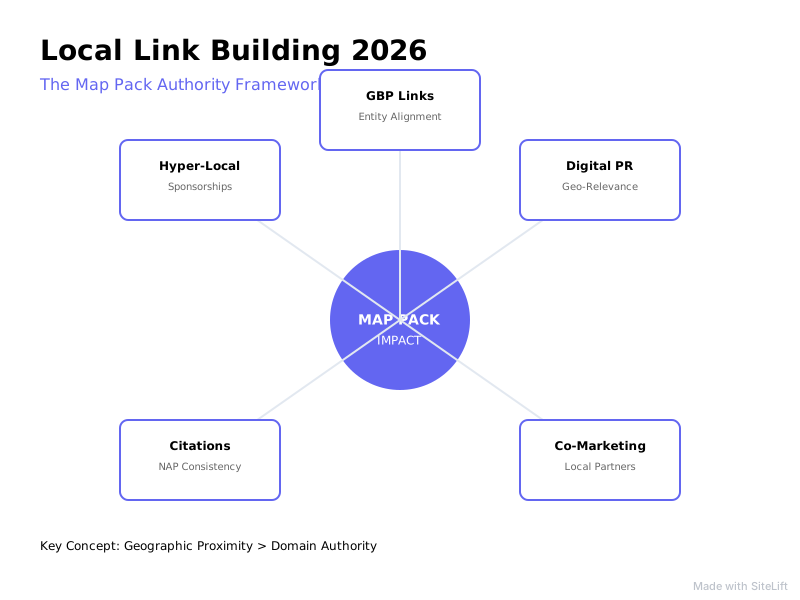
Infographic by SiteLift
How Can Multi-Location Brands Scale Local SEO Links Across Multiple Markets?
Managing local SEO for a single store requires consistent effort. Managing it for 50, 100, or 500 physical locations across multiple states or countries demands a systematic, scalable process. Multi-location SEO links require clear URL routing and structured campaign frameworks to avoid diluting link authority across disparate domains.
Optimizing Google Business Profile Links and Location Landing Pages
The connection between your Google Business Profile (GBP) and your website URL structure is critical. Every GBP listing should point directly to its corresponding, fully optimized location landing page—not your root domain.
[ Google Business Profile: Chicago ] ---> https://example.com/locations/chicago/
[ Google Business Profile: Austin  ] ---> https://example.com/locations/austin/
[ Google Business Profile: Seattle ] ---> https://example.com/locations/seattle/
To maximize link equity distribution across your multi-location hierarchy:
- Dedicated Location Pages: Ensure every store or office has a unique, indexable URL containing clear schema markup (
LocalBusinessJSON-LD), localized content, and embedded Google Maps. - Targeted Link Building: Direct local backlink campaigns (such as city-specific sponsorships) straight to the matching sub-page URL. This passes maximum geo-relevance directly to the landing page associated with that market's GBP listing.
- Internal Equity Flow: Structure your internal linking hierarchy so location pages pass contextual authority back up to regional hubs and main category pages.
Building Scalable Multi-Location SEO Links Through Strategic Partnerships
Scaling localized outreach across dozens of markets requires leveraging local operators, store managers, or regional partners. Central corporate marketing teams cannot effectively manage grass-roots relationships in every market without a clear framework.
- Provide Sponsorship Playbooks: Equipping local managers with pre-approved budgets and clear guidelines for securing local community sponsorships allows team members to quickly execute opportunities on the ground.
- Leverage Co-Marketing Initiatives: Partnering with complementary, non-competing businesses near each location (such as a local gym partnering with a regional health food brand) enables co-branded local promotions that naturally earn backlinks on partner sites.
- Automate Outreach Operations: Transitioning away from manual, location-by-location outreach toward automated local publishing pipelines simplifies the distribution of localized assets across multiple regions. If you are comparing operational paths, review our comparison of a Local SEO Agency vs Autonomous Publishing to see how modern brands scale authority without proportional overhead costs.
For brands expanding internationally, adopting an automated local SEO strategy ensures that localized content, citations, and profile links maintain high standards across multiple regulatory environments and languages.
What Are the Most Common Local Link Building Mistakes to Avoid?
Local link acquisition presents unique traps. Tactics that work in global e-commerce or SaaS SEO can trigger filter penalties or fail completely when applied to geographic Map Pack ranking strategies.
+------------------------------------+------------------------------------+
|         High-Impact Tactic         |            Costly Mistake          |
+------------------------------------+------------------------------------+
| Hyper-local city sponsorships      | Buying 1,000 automated spam links  |
| Regional news data pitches         | Exact-match geo anchor over-use    |
| GBP-matched location page links    | Pointing all links to root domain  |
| Clean, manual directory outreach   | Unverified duplicate NAP entries   |
+------------------------------------+------------------------------------+
Over-Relying on Generic, Unvetted Web Directories
One of the fastest ways to waste budget—or suppress your rankings—is purchasing bulk "500 Local Citation Packages" from unvetted link sellers. These services typically blast your NAP details onto low-quality, automated directory sites that search engines actively ignore or flag as spam networks.
Instead, prioritize quality over bulk output. A handful of indexable, human-curated local links from established regional businesses will reliably outperform hundreds of low-tier directory listings on dead domains.
Mismanaging Geo-Targeted Anchor Text and Contextual Signals
While geographic anchor text is powerful, over-optimizing your anchor profile will trigger algorithmic penalty filters.
Avoid repetitive exact-match anchor text:
- Unnatural Pattern (Avoid): "best personal injury lawyer austin tx" repeated across 80% of your incoming backlinks.
- Natural Pattern (Recommended): A balanced mix of branded terms ("Smith Law Firm"), partial-match terms ("Smith Law in Austin"), topical variations ("legal services"), and plain URLs.
Pro Tip: Let the page content carry the heavy geographic weight while keeping backlink anchor text natural. When the surrounding paragraph text clearly establishes the city, state, and service context, Google picks up the local relevance without needing aggressive keyword-stuffed anchor text.
Why Pure Domain Authority Metrics Lie in Local SEO: Our Perspective
In traditional search optimization, digital marketers are conditioned to worship high Domain Authority. We are trained to treat third-party metrics like Moz DA, Ahrefs DR, or Semrush AS as the ultimate arbiters of a backlink's value.
In local search, this reliance on national authority metrics creates a massive blind spot.
We frequently analyze local Map Pack top performers who hold a modest domain profile yet dominate their local market. Why? Because search engines prioritize spatial proximity and community entity validation over broad domain metrics when satisfying localized user intent.
A backlink from a regional farm bureau or a neighborhood elementary school library page carries an authentic spatial signature that a national magazine link simply cannot replicate.
If you want to move the Map Pack in 2026, stop chasing vanity authority scores on global sites. Shift your focus toward building deep, defensible geographic relevance within the exact zip codes your business targets.
Automating Your Local Authority Building
Scaling localized content, tracking geographic ranking signals, and building location-based trust across multiple markets requires continuous execution. Manual outreach and manual location page management quickly become bottlenecks as your footprint grows.
Platforms like SiteLift streamline this process by deploying an autonomous SEO pipeline designed to compound search visibility. By automating localized content generation, optimizing target destination pages, and monitoring real-time keyword momentum, businesses can establish consistent organic authority across all their target markets on autopilot.
Frequently Asked Questions
How does local link building differ from traditional link building?
Local link acquisition focuses primarily on geographic relevance and physical location proximity, whereas traditional link building prioritizes broad domain authority and general topical alignment. While traditional SEO targets high DR national sites, local SEO prioritizes community partners, regional press outlets, and local business directories to signal location authority to search algorithms.
Do local citations links still matter for ranking in the Google Map Pack?
Yes, local citations links remain a foundational trust signal for Google Map Pack rankings. While citations alone may not push your business to the top spot in highly competitive markets, accurate and consistent NAP data across trusted directories verifies your business entity's physical location and protects against ranking suppression caused by conflicting location data.
How many local backlinks do I need to rank in the top 3 on Google Maps?
There is no fixed target count, as link volume requirements depend heavily on market population density and competitor strength. In smaller suburban markets, 5 to 10 high-quality hyper-local backlinks (such as local news features or community sponsorships) may be sufficient to reach the top three. In major metropolitan areas, maintaining a competitive position often requires continuous acquisition of localized digital PR links and ongoing profile optimization.
How can multi-location businesses build local links at scale without duplicating effort?
Multi-location brands can scale authority by establishing standardized sponsorship frameworks for local store managers, creating distinct location-specific landing pages tied directly to each Google Business Profile, and deploying automated SEO publishing tools like sitelift.io to distribute localized content assets across all regional markets consistently.
— sitelift.io
Topics Covered:
- local link building
- local citations links
- google business profile links
- local digital PR
- multi-location seo links
More from SiteLift

White Hat Link Building Techniques That Still Work for Google and AI Search
Discover 5 proven white hat link building techniques that earn top Google rankings and AI search citations. Master ethical link building today.

Ecommerce Link Building: Scale Product Authority and Revenue on Autopilot
Master ecommerce link building. Learn how to secure product page backlinks, execute digital PR, fix redirect leaks, and automate your store authority.

Crawling in SEO: How Google and AI Bots Discover and Rank Your Pages
Master crawling in SEO. Learn how Googlebot and AI scrapers discover pages, compare indexing vs crawling, and optimize your crawl budget.