Local SEO Agency vs Autonomous Local Publishing: Which Scales Faster?

Scaling a multi-location business is a thrilling milestone, but it almost always exposes a massive operational bottleneck: local search visibility. Traditionally, the default move has been to hire a traditional local seo agency to manage listings, build citations, and write regional content. However, as search behavior shifts and markets become more competitive, fast-growing brands are realizing that manual agency workflows simply cannot keep pace with modern demand.
According to research from Google, "near me" mobile searches have grown by over 136% year-over-year. This surge in local intent means that if your locations are not visible the exact moment a customer searches, you are handing market share directly to your competitors.
To capture this traffic, businesses face a critical choice: do you scale your local search engine optimization through a traditional agency, or do you deploy an autonomous local publishing system?
This head-to-head analysis compares these two models across deployment velocity, cost efficiency, and search performance to help you determine which model will scale your brand faster.
At a Glance: How They Compare
Before diving into the detailed evaluation, here is a high-level comparison of how a traditional local SEO agency stacks up against autonomous local publishing platforms like SiteLift.
| Evaluation Metric | Traditional Local SEO Agency | Autonomous Local Publishing |
|---|---|---|
| Setup & Onboarding Time | 4 to 12 weeks | 24 to 48 hours |
| Primary Workflow | Manual account management & manual writing | API-driven automation & programmatic SEO |
| Scalability | Linear (costs and time double as locations double) | Exponential (scale to thousands of locations instantly) |
| Monthly Cost per Location | $300 – $1,500+ | $10 – $50 |
| GBP Optimization | Manual dashboard updates | Real-time Google Business Profile Help Center API sync |
| Content Generation | Hand-written, slow-to-deploy blog posts | Hyper-targeted, programmatic local landing pages |
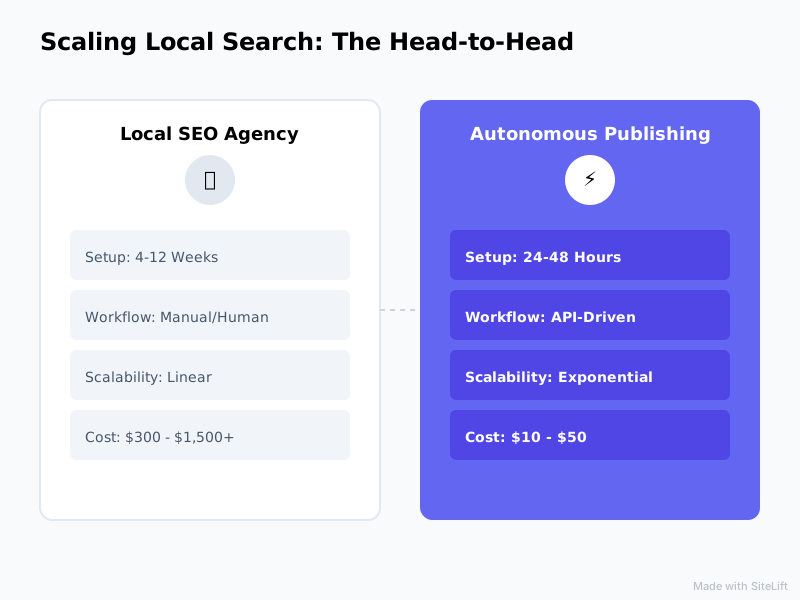
Infographic by SiteLift
Why Scaling Local Search Engine Optimization is the Ultimate Growth Bottleneck
To understand why traditional scaling models break, we have to look at how local search engine optimization works at scale.
The Traditional Agency Model vs. Modern Autonomous Publishing
The traditional agency model is fundamentally built on billable hours and manual labor. When you sign with an agency, a team of account managers, copywriters, and SEO specialists manually audits your website, builds local citations, and drafts content location by location. If you have five locations, this is manageable. If you have 50 or 500, this manual workflow becomes an expensive, slow-moving bottleneck.
In contrast, autonomous local publishing leverages programmatic SEO and artificial intelligence to deploy hundreds of optimized local landing pages instantly. Instead of waiting months for an agency to write 50 local pages, an autonomous platform builds, optimizes, and publishes those pages in minutes, matching search intent across every zip code you serve.
Understanding the Search Intent of Multi-Location Brands
Modern consumers do not search broadly; they search specifically. They do not search for "best commercial cleaning service"; they search for "commercial cleaning service in downtown Austin."
To capture this traffic, you need dedicated, highly localized landing pages that load instantly, feature hyper-local schema markup, and align perfectly with your Google Business Profile. If your local search engine optimization updates take weeks to go live because of agency approval bottlenecks, you lose the ability to capture real-time market demand.
Evaluation Criteria: How We Compare Agency Services vs. Autonomous Systems
To determine which model is superior for your business, we evaluate both options against four core pillars of local search success.
1. Speed to Market and Deployment Velocity
How quickly can you launch optimized pages and capture search traffic in a new market? In organic search, speed is a compounding asset. The faster your pages are indexed, the faster they build authority and rank.
2. Cost Efficiency and ROI at Scale
What is the total cost of ownership (TCO) per location? We analyze whether your marketing spend scales linearly (more locations = proportionally more cost) or exponentially (more locations = lower cost per unit).
3. Content Quality and Local Relevance
Can automated systems produce content that feels genuinely local and helpful, or do you need a human writer to ensure quality? This is critical for meeting Google's helpful content guidelines.
4. Management of Google Business Profile and Local Citations
How does each model handle off-page signals? According to Whitespark's Local Search Ranking Factors study, Google Business Profile signals remain the single most important ranking factor for local pack visibility.
Furthermore, data from BrightLocal shows that 98% of consumers read online reviews for local businesses, highlighting the critical nature of local search visibility and active citation management.
Option 1: Partnering with a Traditional Local SEO Agency
For over a decade, hiring a specialized agency was the only viable path to local search dominance.
The Benefits of Bespoke Strategy and Human Oversight
The primary advantage of a local seo agency is human touch and tailored strategy. A great agency does not just look at search data; they understand your unique brand voice and can coordinate offline PR campaigns with your online presence.
If you have highly complex local service offerings that require deep industry compliance, a human team can manually review every line of copy before it goes live. They can also manually claim and clean up messy, duplicate local citations across obscure directories that automated tools might miss.
Agency Workflow:
Client Request ➔ Account Manager ➔ SEO Strategist ➔ Writer ➔ Editor ➔ Client Approval ➔ Developer ➔ Live Page (Weeks)
The Bottlenecks: Manual Citation Building and High Retainers
The downside of this model is its inherent lack of scalability. Because agencies rely on human hours, their pricing models are highly restrictive.
When you scale from 10 locations to 100, an agency cannot simply work ten times faster. They must hire more staff, which means your monthly retainer scales linearly.
Additionally, manual citation building is notoriously slow. If your business hours or phone numbers change, an agency employee must manually log into various directories to update them—a process prone to human error and delays.

Option 2: Deploying Autonomous Local Publishing
Autonomous local publishing represents a paradigm shift in how multi-location brands approach organic growth.
How Automated Local Search Platforms Work
Platforms like SiteLift replace manual agency workflows with a fully automated publishing pipeline. Instead of managing a team of writers, you input your core business data, target locations, and brand guidelines.
The software then automatically generates high-quality, localized landing pages that are optimized for both search engines and users. These platforms integrate directly with your CMS, publishing and updating content on autopilot.
Autonomous Workflow:
Data Input ➔ AI Engine ➔ Automated Page Generation ➔ Real-time API Sync ➔ Live Page (Minutes)
Programmatic Local Citations and Instant Page Generation
Through official API integrations, autonomous platforms connect directly to your Google Business Profile. If you update your hours, services, or contact details in one central dashboard, those changes propagate across your entire web footprint instantly.
By leveraging automated local search technology, these platforms also handle local citations programmatically. They submit your business data to major data aggregators and directories simultaneously, ensuring 100% NAP (Name, Address, Phone) consistency without the wait times of manual submission.
Pro Tip: When evaluating autonomous platforms, ensure they build on a Premium Distribution Network to naturally pass domain authority and trust to your newly generated local landing pages.
Head-to-Head Comparison: Local SEO Agency vs. Autonomous Publishing
To truly understand which model scales faster, we must look at the direct operational and financial trade-offs.
Analyzing the Total Cost of Ownership (TCO)
Let's look at the numbers. Imagine you are a growing franchise or service business with 100 locations.
- The Agency Model: A typical local seo agency will charge a minimum of $500 per month per location to manage local citations, optimize your Google Business Profile, and write local content. For 100 locations, your monthly spend is $50,000.
- The Autonomous Model: A platform like SiteLift operates on a software-as-a-service model. Even with advanced programmatic page generation and API integrations, the cost per location typically drops to under $30. For 100 locations, your monthly spend is roughly $3,000.
Over a year, the autonomous model saves you over $560,000 in marketing overhead—capital that can be reinvested into product development, paid media, or physical expansion.
Performance Comparison Matrix
| Feature | Local SEO Agency | Autonomous Publishing | Winner |
|---|---|---|---|
| Speed to Scale | Slow (Months to deploy 100+ pages) | Instant (Hours to deploy 1000+ pages) | Autonomous |
| Cost per Location | High ($500+ / mo) | Low ($10 - $50 / mo) | Autonomous |
| Data Accuracy | Subject to manual data-entry errors | Guaranteed by programmatic API sync | Autonomous |
| Strategic Consulting | High-touch, custom business advice | Software-driven, algorithmic optimization | Agency |
| Algorithm Adaptation | Manual audits required after updates | Automated local search updates applied instantly | Autonomous |
Why Programmatic Local Content is Wildly Underrated
Historically, SEO purists scoffed at automated content, arguing that only a human writer could capture the nuance of a local neighborhood. But this perspective misses how modern search engines actually process local queries.
Google’s primary goal for local search is to provide searchers with fast, accurate, and highly relevant structured information. A user looking for "emergency roof repair in Portland" does not want a 2,000-word narrative essay about the history of Portland's architecture. They want to know:
- Do you serve my specific zip code?
- Are you open right now?
- What are your reviews like?
- How do I contact you?
Autonomous publishing platforms excel at structuring this exact data. By combining natural language generation with real-time structured data (schema markup), autonomous systems build pages that are structurally superior to what a manual writer can produce in a text editor. They deliver perfect search engine optimization hygiene on every page, every single time.
Pro Tip: Always verify that your local landing pages utilize dynamic schema markup. This allows search engines to instantly read your business hours, geocoordinates, and service offerings directly from the page's HTML.
Which Model Scales Faster? Use-Case Recommendations
Neither solution is a one-size-fits-all. The right choice depends entirely on your current scale, growth velocity, and operational structure.
When to Choose a Traditional Local SEO Agency
You should partner with an agency if:
- You have fewer than 5 physical locations and do not plan to expand rapidly.
- Your local business relies heavily on offline PR, local event sponsorships, and highly customized local networking.
- You require a dedicated consultant to sit in on your internal marketing meetings and guide your high-level brand positioning.
When to Choose Autonomous Local Publishing
You should deploy an autonomous publishing platform if:
- You are a multi-location franchise, a directory site, or a SaaS platform looking to dominate search across dozens or hundreds of regions.
- You need to deploy hyper-targeted local landing pages at scale without hiring an army of copywriters and developers.
- You want to eliminate high agency retainers and transition your marketing spend from manual labor to scalable software.
- You want your Google Business Profile listings and on-page content to remain in perfect, real-time synchronization.
Embracing the Future of Local Search
The manual era of SEO is drawing to a close. Brands that rely on human-heavy agencies to scale their local search engine optimization are finding themselves outpaced by competitors leveraging automated local search platforms.
By automating the tedious work of page creation, local citations management, and Google Business Profile updates, you free up your team to focus on what matters most: running your business and serving your customers.
If you are ready to stop paying high agency retainers and start scaling your organic traffic on autopilot, explore how SiteLift can transform your local search presence. With an autonomous publishing pipeline designed to compound your authority and visibility, SiteLift helps you dominate local search and AI engines without the manual overhead.
— sitelift.io
Frequently Asked Questions
What is the difference between a traditional local SEO agency and automated local search platforms?
A traditional agency relies on manual human labor to audit sites, write content, and build citations, which scales slowly and costs more. Automated local search platforms use software, APIs, and programmatic SEO to instantly generate local landing pages, sync listings, and manage citations across hundreds of locations simultaneously.
Can autonomous local publishing platforms manage my local citations accurately?
Yes. In fact, they are often more accurate than manual agency updates. Autonomous platforms use direct API integrations and programmatic syndication to push your NAP (Name, Address, Phone) data to major directories and data aggregators instantly, eliminating human data-entry errors.
How does automated local search engine optimization impact my Google Business Profile rankings?
Automated local SEO improves your Google Business Profile rankings by ensuring your on-page local content matches your GBP details perfectly. By programmatically updating your business hours, services, and local schema markup, you send strong, consistent signals to Google's local algorithm.
Is autonomous local publishing safe from Google's spam updates?
Yes, provided you use a high-quality platform. Google’s spam updates target low-quality, duplicate, and unhelpful content. Modern autonomous platforms like SiteLift generate highly structured, valuable, and localized landing pages that directly answer user search intent, fully aligning with Google's helpful content guidelines.
Topics Covered:
- local seo agency
- local search engine optimization
- google business profile
- local citations
- automated local search
More from SiteLift

International Organic Expansion: Scaling Global SEO Without Massive Agency Retainers
Execute international search expansion with proven technical steps, automated localization, and cross-border growth tactics. Start scaling today.

The Modern Guide to White Label SEO: Automating Client Success at Scale
Learn how to scale your agency with white label SEO. Discover automated fulfillment, content marketing, and reporting strategies that maximize profit.

Why B2B SaaS Brands Are Replacing Traditional B2B SEO Agencies with AI Workflows
Stop paying retainers for stale reports. See how AI workflows drive b2b lead generation, automate content pipelines, and outperform traditional b2b seo agency models.