The Truth About Guaranteed SEO Services: Red Flags and Real Ranking Predictability

If you've ever shopped for SEO help, you've seen the pitch: guaranteed seo services promising page-one rankings in 30 days, risk-free. It sounds perfect, especially when organic traffic feels unpredictable and agency retainers feel expensive.
But here's the uncomfortable truth I've learned after years in this industry: no one can control Google. Anyone who says they can guarantee a specific ranking is either misunderstanding how search works — or hoping you do.
In this guide, I'll break down why ranking guarantees are a red flag, how to spot sketchy tactics before they hurt your site, and what real, predictable organic traffic actually looks like in 2026.
Key Takeaways
| Promise vs. Reality | Red Flag to Watch For | What Predictability Really Requires |
|---|---|---|
| "Guaranteed #1 ranking in 30 days" | No one controls Google's algorithm; Google's official guidance on hiring an SEO explicitly warns against this claim | Transparent process, realistic 6-12 month milestones, and momentum tracking |
| "Page 1 for 50 keywords" | Rankings for zero-volume, branded, or irrelevant long-tails with no traffic value | Focus on seo return on investment: leads, revenue, and qualified traffic, not vanity positions |
| "Secret proprietary system" | No deliverables list, no content samples, no link transparency | Clear methodology: content, technical health, and legitimate distribution |
| "Thousands of backlinks fast" | PBNs, link blasts, and automated spam that trigger penalties | Compounding authority from consistent publishing and premium placements |
| "One-time fee for lifetime rankings" | Static work with no ongoing optimization as algorithms shift | Continuous, software-driven iteration based on real search data |
Why Do Agencies Offer "Guaranteed SEO Services" (And Why Is It a Red Flag?)
Agencies offer guaranteed seo services because guarantees sell. It's a simple psychological shortcut. When you're comparing a $2,500/month retainer with vague promises against a $499 package with a "page-one guarantee," the guarantee feels safer.
But search isn't paid ads. You can't buy a position. Google's algorithm is proprietary, personalized by location, device, and search history, and updated thousands of times per year. No agency, freelancer, or software controls it.
That doesn't stop some providers from using the guarantee as a sales hook — then defining success on their own terms.
The Mechanics of the "Page 1" Ranking Trap
The classic trap works like this: the agency promises you'll be on page one, but never specifies for what, where, or for how long.
You might rank #4 for a keyword in an incognito window in Dallas, but be invisible in New York. You might rank for a day, then disappear. Technically, they can screenshot a moment and claim they delivered.
Legitimate SEO defines the target upfront: specific commercial-intent keywords, tracked in a consistent location, measured over time with tools like Search Console. Without that, a "page 1" claim is meaningless.
Pro Tip: Always ask: "Which exact URLs will rank for which exact queries, in which market, and how will we track it independently?" If they can't answer, walk away.
How Low-Value, Zero-Search Keywords Are Exploited
This is the most common trick behind guaranteed seo services. The agency ranks you for something like "best affordable plumbing repair services in [tiny suburb] open late reviews" — a phrase with zero monthly searches and zero competition.
You get a shiny report showing 25 keywords on page one. Your traffic doesn't move. Your phone doesn't ring.
I've audited sites with 100+ "first-page rankings" and less than 200 organic visits per month. Vanity rankings don't pay bills. Revenue-generating traffic comes from keywords with real search demand and buying intent, and those are always competitive.
Google's Explicit Warning Against Ranking Guarantees
Google is unusually blunt about this. According to Google Search Central, 'No one can guarantee a #1 ranking on Google,' and businesses should be wary of agencies that claim to do so.
In its Google's official guidance on hiring an SEO, Google lists guaranteed rankings as a core warning sign of a scam. It also advises you to ask for technical and content explanations, not magic.
If the company that runs the algorithm tells you to distrust guarantees, believe them.
What Are the Red Flags Behind Sketchy Ranking Guarantees?
Not all guarantees are worded the same. Some say "guaranteed," others say "performance-based," "risk-free," or "pay only if you rank." The language changes, but the red flags are remarkably consistent.
Here’s what I check first when vetting any offer that promises risk free search growth.
Proprietary "Secret Sauce" and Lack of Transparency
Real SEO is not a secret. It's content that satisfies intent, technical foundations that let Google crawl and understand your site, and authority signals from reputable mentions.
When an agency says, "We can't reveal our method, it's proprietary," that's not protection — it's concealment. It usually means they don't want you to see low-quality outsourced content, spun articles, or shady links.
A trustworthy partner will tell you exactly what they'll publish, where it will live, how they'll build links, and what tools they use for tracking. If you're comparing traditional options, this breakdown of choosing search engine optimisation services in London shows how opaque retainers compare to transparent, automated execution.
Pro Tip: Request two sample articles and three sample links from current clients. Quality gaps show up in 30 seconds.
Automated Link Blasts and Black-Hat Networks
The fastest way to fake progress is to blast thousands of low-quality links from private blog networks (PBNs), forum spam, blog comments, and hacked directories.
It can work — for about 3-6 weeks. Then Google catches the pattern.
Google's SpamBrain system now devalues manipulative links at scale and issues manual actions that can wipe out years of progress overnight. Recovery isn't a quick disavow and apology. It often requires removing content, rebuilding trust, and starting over on a new domain.
Ask directly: Do you use PBNs? Do you buy links? Can I approve every linking domain? If the answer is vague, assume the worst.
Short-Term Gains Followed by Algorithmic Penalties
Black-hat guaranteed seo services follow a predictable cycle:
- Month 1-2: Spike in rankings from spammy links and keyword-stuffed doorway pages.
- Month 3: Traffic plateaus, agency upsells you to "lock in gains."
- Month 4-6: Core update or spam update hits, traffic drops 70-90%.
- Month 7: Agency blames Google, offers a paid "penalty recovery" package.
I've seen this destroy local businesses that depended on organic leads. The short-term chart looks exciting. The long-term cost — lost domain trust, de-indexed pages, and months with zero leads — is brutal.
Sustainable growth is boring by comparison, but it compounds instead of collapsing.

What Does Real, Predictable Organic Traffic Look Like?
Real predictability doesn't come from promises. It comes from systems, volume, and math. When you publish enough helpful content targeting real demand, track momentum, and iterate, traffic becomes forecastable — not guaranteed, but highly probable.
That's a crucial distinction.
Shifting Focus to SEO Return on Investment (ROI)
Stop buying positions. Start buying outcomes.
A #1 ranking that drives 10 unqualified visits is worthless compared to a #5 ranking that drives 200 buyers per month. Your seo return on investment should be measured in pipeline, not positions.
Research from Backlinko shows that the number one organic result in Google search results captures an average click-through rate (CTR) of 27.6%. That’s powerful — but only if the keyword has volume and intent behind it. You can explore the full data in Backlinko's analysis of organic CTR.
Here's a simple ROI lens I use:
SEO ROI = (Organic Revenue - SEO Cost) / SEO Cost x 100
If you spend $12,000 over a year and organic drives $60,000 in attributable margin, that's a 400% ROI — even if you never hit #1 for your head term. Agencies selling guarantees rarely talk like this because vanity keywords are easier to fake than revenue.
The Compounding Nature of Organic Authority
Paid ads are linear: spend $1, get $3, stop spending, get $0. SEO is compounding.
Each high-quality article can rank for dozens of long-tail variations, earn links passively, and lift your entire domain's authority. That authority makes your next article rank faster. After 50-100 pieces, you start seeing momentum where older posts keep growing while new posts index in days, not months.
But compounding takes time to kick in. A study by Ahrefs reveals that only 5.7% of newly published pages reach the top 10 search results within one year of publication. The full timeline is detailed in this Ahrefs study on how long it takes to rank. Most winners are older pages that have accumulated authority, updates, and links.
This is why consistency beats intensity in SEO. Ten great posts per month for a year will outperform 100 spammy posts in a week, every time.
Setting Realistic Milestones for Risk-Free Search Growth
There is no such thing as literally risk free search growth, but there is low-risk, milestone-based growth. Here's what realistic looks like for most small to mid-sized sites:
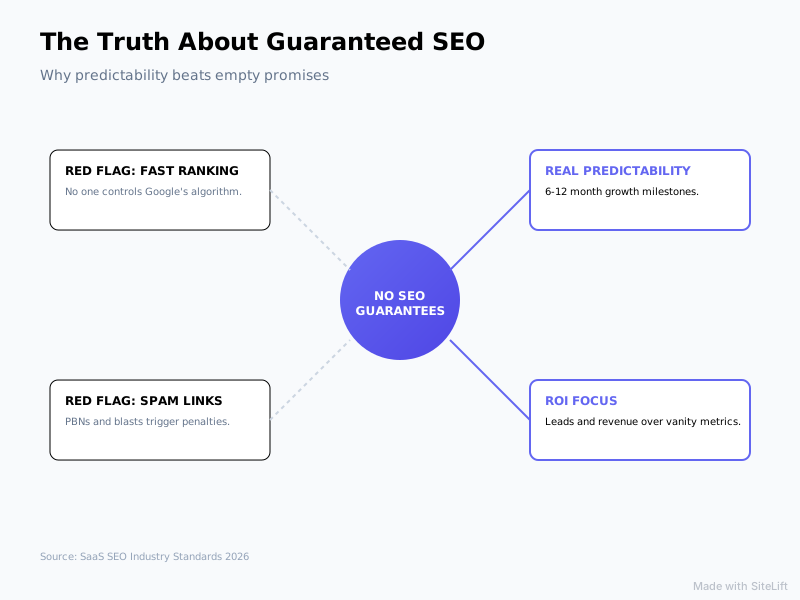
Infographic by SiteLift
| Phase | Timeline | What to Expect | KPI to Track |
|---|---|---|---|
| Foundation | Months 0-3 | Technical fixes, topical map, first 20-30 articles indexed | Indexation rate, impressions growth, Core Web Vitals |
| Momentum | Months 3-6 | Long-tails start ranking positions 8-20, impressions climb | Keywords in top 20, average position trend, CTR |
| Traction | Months 6-9 | Commercial pages hit page 1-2, first qualified leads | Organic conversions, assisted revenue, top 10 keywords |
| Compounding | Months 9-12+ | Authority compounds, new content ranks faster | Organic revenue ROI, share of voice, content velocity |
If an agency promises significant revenue in 30 days from cold organic, they're selling ads — not SEO. Real organic builds like interest, not like a lottery ticket.
For startups working with tight budgets, this guide to affordable search engine optimization services for startups breaks down how to hit those milestones without burning cash on bloated retainers.
How Do Guaranteed SEO Services Compare to Modern AI and Automation?
Traditional guaranteed seo services try to create certainty with contractual language. Modern platforms create predictability with data and systems.
It's the difference between a weather forecaster who guarantees sunshine and one who shows you satellite data, pressure systems, and an 85% probability model. I trust the second one.
Data-Driven Keyword Momentum Tracking
You can't guarantee rankings, but you can predict opportunity with surprising accuracy.
Modern SEO platforms track keyword momentum in real time: impression velocity, position movement, CTR curves, content decay, and competitor gaps. Instead of guessing, you see which clusters are gaining traction and double down.
For example, if 12 articles in your "AI accounting software" cluster jump from position 35 to 14 in 45 days while impressions triple, that's momentum. Publishing 10 supporting pieces and strengthening internal links is highly likely to push several into the top 10. That's not a guarantee — it's probability based on live data.
This is what predictable organic traffic really means: systematic testing, measurement, and scaling what works.
Scaling High-Quality Content Without Human Bottlenecks
The biggest reason SEO fails isn't strategy. It's execution bottleneck.
Agencies promise 4 blogs per month because they pay writers per word, editors per hour, and account managers per meeting. You get slow output, inconsistent quality, and $3,000 invoices for content you could have briefed yourself.
Autonomous publishing pipelines flip this. They generate targeted briefs from search intent data, draft comprehensive articles, optimize for entities and structure, publish directly to your CMS, and distribute through a curated network for initial visibility — all while you monitor momentum from a dashboard.
Volume matters because SEO is a numbers game filtered by quality. Publishing 100 well-targeted, helpful articles gives you 100 chances to hit, learn, and compound. Publishing four gives you four.
Continuous Optimization vs. One-Time Agency Retainers
Google updated its core systems multiple times last year alone. A one-time audit and a batch of links in January are stale by June.
Traditional retainers are static: same deliverables every month regardless of what the data says. Software-driven platforms are dynamic: if a page slips from #4 to #9, the system flags decay, suggests refreshes, improves internal linking, and republishes.
That continuous loop is why automation often beats manual execution for predictability. It doesn't sleep, forget, or get distracted by other clients. It just iterates.
How to Evaluate an SEO Partner or Platform Safely?
Whether you hire an agency, freelancer, or use software, vet them like you're hiring a CFO. You're trusting them with your most valuable growth channel.
Use this checklist before you sign anything with ranking guarantees attached.
Questions to Ask About Methodology and Deliverables
Ask these verbatim:
- What exact work will you do each month — how many articles, what length, who writes them?
- Where will content be published — my domain, and can I own it outright?
- How do you acquire links? Can I see a list of domains and approve them?
- How do you handle technical SEO, schema, and Core Web Vitals?
- What happens if rankings drop after an update? What's your recovery process?
- Can I cancel anytime and keep all work? Who owns logins and data?
Good answers are specific and boring. Bad answers are vague and exciting: "proprietary network," "secret partnerships," "Google insider method," "thousands of links."
Understanding the Total Cost of Ownership (TCO) of SEO
Don't just compare monthly fees. Compare total cost of ownership over 12 months:
- Agency retainer: $2,000-$8,000/mo + $2,000 setup + content upsells + link fees = $30,000-$100,000/year, often for 48 articles.
- In-house hire: $75,000 salary + tools ($500/mo) + management time = $85,000+/year for one person's output.
- Autonomous platform: Flat software fee + your time reviewing dashboards = fraction of agency cost for 5-10x content velocity.
When you calculate cost per published, optimized, indexed article — not cost per promise — automation usually wins by a landslide. That's especially true for SaaS, publishers, and multi-location businesses that need scale.
Aligning SEO Metrics with Actual Business Revenue
Insist on reporting that connects search to money. Your dashboard should show:
- Organic impressions → clicks → leads → closed revenue
- Top landing pages by conversions, not just traffic
- Keyword clusters by pipeline contribution
- Content velocity vs. traffic growth correlation
If your report only shows "rankings" and "domain authority," you're paying for vanity metrics. Demand transparency. A credible partner will integrate with Search Console, GA4, and your CRM to prove seo return on investment.
My Honest Take: Predictability Beats Promises Every Time
I'll be direct: I don't trust anyone who guarantees me a ranking anymore, and you shouldn't either.
Early in my career, I bought one of those too-good-to-be-true packages for a side project. $399 for "guaranteed page one." Within three weeks I was ranking #2 — for a keyword with literally 10 searches per month that had nothing to do with buyers. My traffic graph was flat. My refund request was ignored because, technically, they "delivered."
That experience changed how I evaluate everything in SEO. Now I look for systems, not slogans.
What I actually want is boring predictability: a clear topical plan, consistent publishing I can see and own, real-time data showing what's moving, and a tight feedback loop that improves every month. I want to know my cost per article, my impression growth rate, and my lead flow — not someone's pinky promise about position #1.
In my experience, the businesses winning organic right now aren't hiring the loudest guarantors. They're building quiet content engines that compound month after month. It's less sexy than "guaranteed," but it actually deposits money.
If you take one thing from this article, let it be this: don't pay for certainty about an algorithm you don't control. Pay for a transparent process that makes success probable, measurable, and scalable.
A More Transparent Path to Search Growth
If you're tired of black-box retainers and empty ranking guarantees, there's a calmer way to grow.
SiteLift was built specifically to replace guesswork with a system. Instead of promising a #1 spot, it gives you the levers that make top spots likely: autonomous content generation tuned to search intent, seamless publishing to your CMS, distribution across a curated premium network, and real-time keyword momentum tracking so you always know what's working.
You don't need to manage writers, chase link vendors, or decode vague monthly PDFs. You set your topics, the platform executes the publishing pipeline on autopilot, and you watch predictable organic traffic compound in a dashboard tied to real visibility.
For teams that want growth without the agency drama, that's a far healthier definition of low-risk SEO.
Explore how autonomous SEO works at sitelift.io and see if steady, data-driven momentum is a better fit than another guarantee.
FAQ
Can any SEO company legitimately guarantee top rankings?
No. No SEO company can legitimately guarantee a #1 ranking or specific position on Google. Search results are controlled by Google's proprietary, constantly changing algorithm and personalized by location, device, and history. Google itself states no one can guarantee a top ranking. Companies offering guaranteed seo services typically guarantee rankings for zero-volume keywords, use temporary black-hat tactics, or hide behind vague contract terms.
What happens if an SEO agency fails to deliver on their ranking guarantee?
Usually, very little in your favor. Most contracts define "delivery" as ranking for any keyword, even worthless ones, or offer only extra months of the same ineffective service instead of a refund. Some require you to keep paying to stay "eligible" for the guarantee. Always read the fine print, demand specifics on keywords, locations, and timelines, and ensure you retain ownership of all content and links if you cancel.
How long does it realistically take to see a return on investment (ROI) from SEO?
For most sites, expect 6 to 12 months for meaningful seo return on investment. Impressions often grow in months 2-4, long-tail traffic in months 4-6, and qualified leads and revenue in months 6-12. Ahrefs data shows only 5.7% of new pages hit the top 10 within a year, which is why consistency and volume matter. Competitive niches and new domains take longer; low-competition niches can move faster.
What is the difference between guaranteed SEO and performance-based SEO?
Guaranteed SEO promises a specific ranking outcome regardless of algorithm changes, which is inherently misleading. Performance-based SEO ties payment to agreed metrics, which can be legitimate if those metrics are revenue-focused like qualified leads or sales. Be cautious, though — if performance is tied to vanity rankings for easy keywords, it's just a rebranded guarantee with the same risks.
How does autonomous SEO software provide predictability without sketchy guarantees?
Autonomous software doesn't promise positions; it improves probability through systems. It analyzes search demand, publishes high-quality content at scale without human bottlenecks, distributes it for initial traction, and tracks keyword momentum in real time. By increasing content velocity and continuously optimizing based on data, it creates compounding, predictable organic traffic you can forecast — transparently, without PBNs or contractual tricks.
— sitelift.io
Topics Covered:
- guaranteed seo services
- ranking guarantees
- seo return on investment
- risk free search growth
- predictable organic traffic
More from SiteLift

SEO Conversion Optimization: How to Turn Organic Search Readers into Paying Customers
Learn how to turn organic search visitors into paying customers with this step-by-step SEO conversion optimization guide. Optimize your CTAs and UX.

How to Choose SEO Audit Companies That Deliver Actionable Automation Roadmaps
Stop paying for static PDFs. Learn how to choose SEO audit companies that deliver developer-ready, automated roadmaps to scale your organic traffic.

What Defines High-Quality Content SEO in Google’s AI-Driven Search Era?
Discover what defines high-quality content SEO today. Learn how to optimize for Google's AI Overviews, master E-E-A-T guidelines, and outrank generic copy.