How B2B Manufacturing Companies Can Drive High-Intent Search Leads

If you're vetting manufacturing SEO companies, you're probably not looking for more traffic. You want more RFQs from the right buyers — OEM engineers, procurement managers, and plant operations leads who already know what they need.
I work with a lot of industrial teams, and the pattern is consistent: a custom fabricator, injection molder, or CNC shop gets 2,000 visits a month and almost zero qualified quotes, while a competitor with half the traffic is booked out three months. The difference is rarely budget. It's intent.
This guide breaks down how industrial search marketing actually drives b2b manufacturing leads, what specialized agencies really do behind the scenes, and how to build a technical content pipeline that creates niche b2b organic growth without adding headcount.
Key Takeaways
| What You Need to Know | Why It Matters for RFQs |
|---|---|
| Manufacturing search is low-volume, high-value | 20 searches/month for 5-axis titanium machining AS9100 can drive six-figure deals |
| Buyers research independently before talking to sales | 71% of B2B researchers start with a generic search, per Google and Millward Brown Digital |
| Capability, material, and application pages convert best | Engineers search specs, tolerances, and use-cases — not homepage fluff |
| Technical SEO unlocks hidden demand | PDF-only catalogs, duplicate distributor content, and weak architecture kill rankings |
| RFQs, CAD downloads, and calls are the KPIs | Traffic alone means nothing if it doesn't enter your sales pipeline |
| Agencies vs. in-house vs. automation is a tradeoff | Expertise and speed vs. control and cost; hybrid models often win |
Why Is SEO Different for B2B Manufacturing Companies?
General SEO advice falls apart fast in manufacturing. You're not selling shoes to one impulse buyer. You're selling a $85,000 production run to a buying committee that will vet you for weeks.
Why do engineers and procurement teams search differently than consumers?
An engineer doesn't Google "best machine shop." She Googles:
316L stainless steel electropolishing for food gradetight tolerance CNC turning +/- 0.0005 inconel 718ITAR registered precision grinding supplier USA
These are problem-solution and specification queries. The searcher often pastes in a material, process, tolerance, finish, certification, or industry standard. Procurement then runs a parallel search focused on risk: lead time, MOQ, location, certifications, and past performance.
According to Google and Millward Brown Digital, 71% of B2B researchers start their research with a generic search. They aren't starting with your brand. They're starting with a problem, and if your capability pages don't match their language, you never enter the shortlist.
Pro Tip: Interview your estimators and applications engineers. The exact phrases they hear on RFQ calls are your highest-value keywords.
What makes high-intent keywords low-volume but high-value in manufacturing?
In B2C, 20 searches per month is a rounding error. In manufacturing, it's a pipeline.
Think about custom PTFE injection molding medical device. That term might show 10-50 searches a month in Ahrefs or Semrush. But one click could become a multi-year OEM contract. This is the core of niche b2b organic growth: you don't need 100,000 visitors. You need 30 of the right engineers finding your tolerance chart, material page, and RFQ form.
That also means traditional keyword tools lie to you. They show zero volume for hyper-specific long-tails like large format vacuum forming ABS enclosure NEMA 4X. Ignore the zero. If it maps to a capability you sell profitably, build for it.
How do long sales cycles change industrial search marketing strategy?
A typical industrial deal involves 6-10 stakeholders, CAD iterations, DFM feedback, samples, PPAP documentation, and vendor audits. Gartner research on B2B buying found buyers spend only 17% of their purchase time meeting with potential suppliers, with the rest spent researching independently and building internal consensus.
Translation: your website has to sell when your sales team isn't in the room.
That requires trust signals on every key page:
- Certifications: ISO 9001:2015, AS9100D, IATF 16949, ITAR, Nadcap
- Capabilities in numbers: envelope sizes, tonnage, tolerances, finishes
- Materials list with real depth, not just logos
- Lead times, MOQs, and inspection capabilities (CMM, Faro, X-ray)
- Application case studies with measurable outcomes
What Do Manufacturing SEO Companies Actually Do to Generate B2B Manufacturing Leads?
Not all manufacturing seo companies are created equal. The good ones don't sell you blog posts. They build a system that turns spec-driven searches into RFQs.
What core services should a specialized manufacturing SEO company offer?
Look for these five pillars:
- Technical SEO for industrial sites: Crawl budget optimization, site architecture for 200+ service/material combinations, Core Web Vitals, and schema for
Product,FAQPage,HowTo, andLocalBusiness. - Keyword mapping for products and capabilities: One keyword cluster per capability page. No more stuffing "CNC machining, fabrication, welding, stamping" all on the homepage.
- Engineering-grade content: Process explainers, material selection guides, DFM tips, and comparison pages written with SME input, not generic AI fluff.
- Digital PR and industrial link building: Links from trade publications, Thomasnet supplier profiles, industry associations (SME, PMA, AMT), university labs, and OEM supplier pages.
- Local SEO for plants: Optimized Google Business Profiles per facility, location + capability pages, and citation cleanup across Thomas, Kompass, and MacRAE's.
If an agency can't explain the difference between 304 and 316L, or between FDM and SLS, keep looking.
How do technical audits fix common industrial website issues?
Most manufacturing sites I audit have the same problems. If you want a framework for what a real audit should deliver, this breakdown of how to choose SEO audit companies that deliver actionable automation roadmaps is a useful benchmark — demand developer-ready fixes, not a static PDF.
Common industrial issues include:
- PDF-only catalogs: Google can crawl PDFs, but they convert terribly. Extract specs into HTML tables with filters and CTAs.
- Outdated CMS: Old Joomla, custom PHP, or unmaintained WordPress builds with slow TTFB and no schema.
- Duplicate distributor content: You use the same OEM description as 40 distributors. Google picks one winner, and it's rarely you.
- Flat architecture: 150 services buried three clicks deep under
/services.html. Rebuild into hubs:/cnc-machining/titanium/,/injection-molding/medical/. - No conversion tracking: No RFQ goal, no call tracking, no CAD download events. You can't optimize what you don't measure.
Pro Tip: Add Product and FAQ schema to your top 20 capability pages first. In industrial SERPs, rich results for tolerances, materials, and lead times win clicks from engineers.
How is SEO performance tied to RFQs, not just traffic?
Forget vanity traffic. A manufacturing SEO dashboard should report:
- Qualified RFQ form submissions by service line
- Phone calls over 90 seconds from service pages
- CAD file / spec sheet downloads
- Distributor and rep inquiries
- Keyword momentum for bottom-funnel terms (e.g., positions 11-30 moving into top 3 for
[process] + [material] + [location])
Gartner has predicted that 80% of B2B sales interactions will occur in digital channels. For manufacturers, that means your RFQ form, configurator, and DFM consultation offer are your sales team online. Every SEO task should ladder up to them.

How Can Industrial Search Marketing Capture High-Intent Demand?
Industrial search marketing works when you map every page to a stage of the buying journey — from early research to ready-to-quote.
How to map keywords to every stage of the industrial buying funnel?
Here's the framework I recommend to clients:
1. Informational (Engineer learning):
what is centerless grinding tolerance, PEEK vs Ultem high temp, galvanic corrosion stainless aluminum
Goal: Build authority. Format: guides, tolerance charts, videos.
2. Commercial investigation (Vendor shortlisting):
custom stainless steel fabrication Ohio, AS9100 CNC machine shop Arizona, food grade rotary seals supplier
Goal: Prove capability. Format: service pages, industry pages, comparison pages.
3. Transactional (Ready to buy):
request injection molding quote, rapid sheet metal prototype 5 day lead time, large part 5-axis machining RFQ
Goal: Convert. Format: RFQ-optimized service pages with instant estimator, file upload, and phone number above the fold.
Most manufacturers over-invest in top-of-funnel and under-invest in commercial and transactional pages. Flip it. Build bottom-funnel first.
What are the highest-converting page types for B2B manufacturing leads?
If you only build five page types this year, build these:
- Service / Capability pages:
/precision-cnc-milling/,/metal-stamping-500-ton/. Include envelope, tolerances, finishes, QA, gallery, and RFQ CTA. - Material + Process pages:
/titanium-6al-4v-machining/,/glass-filled-nylon-injection-molding/. Engineers search material-first. - Industry Application pages:
/aerospace-machining/,/medical-device-injection-molding/,/EV-battery-enclosures/. Speak their compliance language: FDA, AS9100, IATF. - Comparison and Vs. pages:
waterjet vs laser cutting 1-inch aluminum,die casting vs injection molding housings. These capture late-stage vetting searches and perform well in AI Overviews. - RFQ-optimized location pages:
/cnc-machining-houston-tx/,/sheet-metal-fabrication-midwest/. Not thin doorway pages — include plant photos, machines list, team, and local proof.
For sourcing behavior benchmarks, Thomasnet insights on industrial sourcing trends is worth following to see how buyers actually shortlist suppliers online.
How to win local, national, and niche vertical search simultaneously?
You don't have to choose. Use a hub-and-spoke model:
- Local: One Google Business Profile per plant. Add machine categories, photos of shop floor, and posts about new capabilities. Build location pages with embedded map, driving directions for audits, and local case studies. If you run multiple facilities, this guide to automated local SEO for European multi-location brands shows how to scale profiles and geo-targeted content without manual chaos.
- National: Rank capability pages nationally with depth. A 2,500-word page on
tight tolerance deep hole drillingwith diagrams, video, and data will beat a 300-word competitor page every time. - Niche vertical: Create programmatic clusters for material x process x industry. Example: 30 pages for
[injection molding] + [PEEK, Ultem, PPSU, PC-ABS...]each with DFM notes and case snippets.
And don't ignore AI search. Engineers now ask ChatGPT, Gemini, and Perplexity for supplier shortlists. Clear H2/H3 structure, definition boxes, comparison tables, and FAQ schema make you citable.
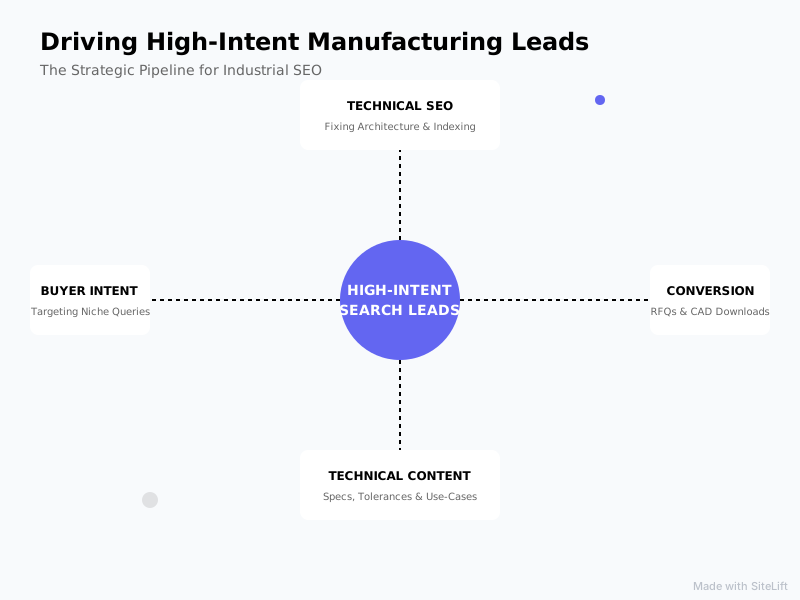
Infographic by SiteLift
How to Build a Technical Content Pipeline That Converts Engineers and Buyers?
Content is where most manufacturers stall. Everyone agrees "we should publish more," then the SME gets busy, the draft sits for six weeks, and nothing ships. A technical content pipeline fixes that.
What content formats earn trust from technical decision-makers?
According to annual research from the Content Marketing Institute, manufacturing marketers who document strategy and focus on educational content consistently outperform those chasing volume. In my experience, these formats drive RFQs:
- Process explainers with cutaway diagrams and machine photos
- Material selection guides and chemical compatibility charts
- Tolerance capability charts by process and material
- Application case studies: problem > constraints > solution > result with numbers
- DFM checklists and design guides (gated for emails, ungated for SEO)
- 2-minute shop-floor walkthrough videos with transcripts
- FAQ blocks answering real RFQ objections: lead time, MOQ, file formats, inspection reports
Engineers trust specifics. "High precision" means nothing. "+/- 0.0002" on 17-4 PH with CMM report means everything.
How to turn shop-floor expertise into scalable SEO content?
You don't need your lead machinist to write. You need 30 minutes of his time.
Here's a pipeline that works:
- Monthly SME interview (30 min): Record Zoom. Ask: What jobs did we quote last month? What designs cause scrap? What tolerance is everyone getting wrong?
- Repurpose spec docs: Turn work instructions, PPAP docs, and QC checklists (sanitized) into outlines.
- Brief + draft: Writer creates technical brief with target keyword, search intent, headings, and diagrams needed. SME reviews for accuracy only, not prose.
- Publish on cadence: 2-4 capability/supporting posts per month beats 12 posts once a year. Consistency builds topical authority.
- Distribute and interlink: Link new posts up to money pages. Share in LinkedIn groups, Reddit r/Machinists, Practical Machinist forum, and email to dormant quotes.
Pro Tip: Add a "Send files for DFM review" button inside every technical article, not just the contact page. Engineers convert mid-research when you remove friction.
How to structure content for both Google and AI visibility?
Think E-E-A-T for manufacturing:
- Experience: Original shop photos, machine lists with model numbers, real parts (with permission).
- Expertise: Author byline from your engineering manager, with LinkedIn link.
- Authoritativeness: Citations to ASTM, ISO, MatWeb, and OEM specs. Get links from associations.
- Trustworthiness: Clear address, certifications with PDFs, customer logos, and reviews.
Use short paragraphs, descriptive H2s as questions, bullet specs, and tables. Add FAQ schema for PAA boxes and AI Overviews. End every piece with a next step: download CAD guidelines, book a 15-min DFM consult, or start an RFQ.
How Should Manufacturers Evaluate Manufacturing SEO Companies vs In-House vs Automation?
This is the decision that stalls most teams for six months. Let's make it simple.
What questions to ask before hiring a manufacturing SEO company?
Ask these on the first call:
- Can you show 3 industrial clients with RFQ growth, not just traffic screenshots?
- Who writes technical content, and how do you handle SME review?
- How do you build links without PBNs or paid guest post farms?
- Do we own content, data, and site changes if we leave?
- How do you report on pipeline and revenue, not just rankings?
- What's your understanding of our processes, materials, and compliance terms?
Pricing context helps too. Most reputable agencies charge $3,000-$10,000+/month for industrial SEO with content, depending on competitiveness and content volume. For a full breakdown of fee models, see SEO agency fees demystified. If someone promises page one in 30 days for $499, run.
Expect 6-12 months to move competitive bottom-funnel terms, with early wins in months 2-4 from technical fixes and long-tail capability pages.
When does it make sense to keep SEO in-house?
In-house works if you have:
- A dedicated marketing manager + access to engineering time
- A developer who can ship site changes weekly
- Budget for tools (crawl, rank tracking, content optimization)
- Patience to publish consistently for a year
Where in-house fails: content stalls because SMEs are billable, link building never happens, and technical debt piles up. One marketing generalist can't do technical SEO, write about Inconel, and run digital PR alone.
Small niche shops can absolutely outrank large OEMs and distributors — and often do. Big sites target broad terms like CNC machining services. You can own microfluidic manifold PEEK machining or NEMA 4X stainless enclosures Texas with deeper, more specific pages. For lean teams taking on giants, the playbook in SEO for startups: outrank industry giants on a budget applies surprisingly well to niche manufacturers.
How can automated platforms compound organic growth on autopilot?
The bottleneck is rarely strategy. It's execution — publishing 80 capability, material, and FAQ pages while running a plant.
That's why many teams now use a hybrid: internal SMEs provide knowledge, automation handles production and distribution. Modern autonomous platforms can generate targeted drafts from your specs and keywords, publish via CMS integration, syndicate across a premium network for authority, and track keyword momentum in real time.
If you're exploring that route, modern search engine optimisation solutions embracing autonomous SEO explains how continuous publishing pipelines capture both Google and AI answer-engine visibility without manual bottlenecks.
The goal isn't to replace expertise. It's to stop letting great shop-floor knowledge die in someone's inbox.
My Take: Stop Chasing Traffic, Start Owning Intent
I've audited dozens of manufacturing sites that brag about traffic growth while RFQs flatline. In my opinion, that's a failure, not a win.
Manufacturing SEO isn't a volume game. It's an ownership game. Own 50 hyper-specific searches that map exactly to machines you already have, materials you love to run, and industries where you have proof — and you won't need viral content.
I also think most manufacturing seo companies overcomplicate this. You don't need 200 blogs about "What is CNC?" You need 20 exceptional capability pages, 30 material/process pages that answer real DFM questions, and a publishing rhythm you can sustain for 18 months.
My bias is simple: if a page can't plausibly lead to an RFQ, CAD download, or qualified call, don't build it yet. Build the money pages first, prove pipeline, then expand. That's how niche b2b organic growth compounds.
— sitelift.io
Turn Shop-Floor Expertise Into Pipeline on Autopilot
You already have the hardest part — real capabilities, real tolerances, real customer results. The gap is turning that into search-visible pages every week without pulling engineers off the floor.
sitelift.io is built for exactly that: autonomous SEO and AI visibility that automatically generates targeted content, distributes it across a curated premium network, integrates with your CMS, and tracks keyword momentum in real time. Think of it as your technical content pipeline running in the background while your team focuses on quoting and production.
Start by auditing which high-intent capability and material searches you're invisible for today — then pilot continuous publishing for one service line and measure RFQs, not just rankings.
FAQ
What is manufacturing SEO and how is it different from general SEO?
Manufacturing SEO is search optimization focused on generating RFQs and qualified b2b manufacturing leads from engineers, procurement, and OEM buyers. Unlike general SEO, it targets low-volume, spec-driven keywords (materials, tolerances, processes, certifications), relies on capability and application pages over blogs, and measures success by quotes and pipeline rather than traffic.
How do manufacturing SEO companies generate high-intent B2B leads?
Specialized manufacturing seo companies map bottom-funnel keywords to dedicated service, material, industry, and location pages, fix technical issues like PDF-only catalogs and poor architecture, create engineer-trusted content with SME input, build links from trade publications and associations, and optimize RFQ forms, file uploads, and call tracking for conversions.
How long does industrial SEO take to drive RFQs and sales?
Expect early technical wins and long-tail leads in 2-4 months, meaningful movement for competitive terms in 6-9 months, and compounding RFQ growth in 9-12+ months. Timelines depend on domain authority, niche competition, content velocity, and sales cycle length. Bottom-funnel capability pages typically convert faster than educational content.
How much do manufacturing SEO companies charge?
Most charge $3,000-$10,000+ per month for retainers including technical SEO, content, and link building, or $5,000-$25,000+ for initial audits and website rebuilds. One-time projects for keyword research or technical fixes range from $2,500-$15,000. Costs rise with niche competitiveness, number of service lines, and content volume required.
Can small niche B2B manufacturers outrank large OEMs and distributors on Google?
Yes. Large sites target broad terms and often have thin capability content. A small shop can win by owning specific material, tolerance, process, and location combinations with deeper pages, original photos and data, faster publishing, and stronger local signals. Focus on 30-50 terms you can profitably fulfill rather than trying to rank nationally for everything.
Topics Covered:
- manufacturing seo companies
- b2b manufacturing leads
- industrial search marketing
- niche b2b organic growth
- technical content pipeline
More from SiteLift

AI for SEO: How to Automate Research, Content Creation and Distribution
Learn how to use AI for SEO to automate keyword research, generative content creation, CMS publishing, and search engine visibility.

SEO Tools in 2026: How to Build an Autonomous Stack That Grows Traffic on Autopilot
Discover how to build an autonomous stack with modern AI SEO tools, automated publishing workflows, and real-time rank tracking to grow organic traffic.

Repurposing Content for SEO: How to Multiply Organic Reach Across Channels
Learn how repurposing content for SEO multiplies organic reach. Discover step-by-step strategies for syndication, AI visibility, and automation.