Topical Authority SEO: Build Content Clusters That Dominate Google and AI

If you're still chasing one keyword at a time, you're playing the old game. Topical authority SEO is how sites win entire categories in 2026 — not just single rankings, but dozens of related terms, featured snippets, and AI citations at once.
I’ve watched Google shift from strings to things, from keywords to entities. According to BrightEdge, 68% of online experiences begin with a search engine, but the clicks are harder to earn than ever. This guide breaks down exactly how to build a topical map SEO foundation, execute a content clusters strategy and pillar content strategy, and turn semantic SEO authority into compounding traffic from both Google and AI search.
Key Takeaways
| What You Need to Know | Why It Matters for 2026 |
|---|---|
| Topical authority = depth + breadth of expert coverage on one subject, interlinked and intent-complete | Ranks for full keyword clusters, not just one page; earns AI Overview citations |
| Topical map SEO comes first — pillar themes, subtopics, FAQs mapped by intent | Prevents random publishing and content cannibalization |
| Pillar + cluster + internal linking is the engine | Helps Google and LLMs understand entity relationships and crawl efficiently |
| E-E-A-T, original data, and information gain separate leaders from commodity content | Critical when According to Ahrefs, 90.63% of pages get no organic search traffic from Google |
| Measure share of voice, keyword momentum, AI visibility per cluster | Lets you double down, prune, and refresh instead of guessing |
| Velocity + refresh cycles win | Consistent, connected publishing compounds authority over 3-9+ months |
What Is Topical Authority SEO and Why Does It Matter in 2026?
Topical authority SEO is the practice of covering a subject so thoroughly, accurately, and usefully that search engines treat your site as a go-to source for that topic.
It’s not about one great blog post. It’s about proving you understand the whole conversation — core concepts, subtopics, use cases, objections, comparisons, and next steps — and connecting it all in a way both users and crawlers can follow.
Think of it like this: a site with 40 interlinked, genuinely helpful articles on “email deliverability” will outrank a higher-DR site with two generic posts on the same subject. Depth beats dabbling.
How Google and AI Search Define Topical Authority
Google doesn’t have a single “topical authority score” in Search Console, but its systems reward the behaviors that create it. The helpful content guidance from Google Search Central is clear: prioritize people-first, satisfying, comprehensive content that demonstrates first-hand experience.
In practice, that means:
- Covering entities and sub-entities, not just exact-match keywords
- Satisfying the full range of search intent around a topic
- Earning engagement, links, and brand mentions as a result of being useful
- Structuring content so relationships between pages are obvious
AI search raises the stakes. Google AI Overviews, ChatGPT, Perplexity, and other LLMs don’t want to cite ten thin pages. They want to synthesize from sources that are comprehensive, well-structured, and trustworthy. That’s exactly what a strong topical authority SEO foundation provides.
With around 58.5% of Google searches in the U.S. ending without a click in 2024, according to SparkToro and Datos, visibility inside the answer — as a cited source — is now as valuable as the classic blue link.
Topical Authority vs Domain Authority vs Page Authority
These terms get mixed up constantly. Here’s the simple breakdown:
| Metric | What It Measures | Example |
|---|---|---|
| Topical Authority | How deeply and expertly you cover one subject area | A small SaaS blog owns “freelance invoicing” despite low DR |
| Domain Authority (DA) | Third-party prediction (Moz) of overall ranking strength based largely on link profile | Learn more in Moz’s guide to domain authority |
| Page Authority (PA) | Predicted strength of an individual page, again link-centric | A single viral post with many backlinks |
Pro Tip: Stop chasing DA as a goal. I treat DA as a lagging indicator. Build topical authority in one winnable cluster first, and DA tends to follow as you earn relevant links naturally.
Domain authority is site-wide and heavily link-based. Topical authority is topic-specific and coverage-based. You can have modest domain authority and still dominate a niche — and that’s exactly how smaller sites beat giants.
Why Topical Authority Drives Rankings in Google and AI Overviews
Three shifts make this non-negotiable in 2026:
1. Keyword clusters rank together. When Google trusts your coverage of “project management software,” your new post on “project timeline templates” starts from position 25 instead of position 95. Internal links pass relevance, not just PageRank.
2. AI needs citable, structured sources. LLMs look for clear definitions, steps, comparisons, pros/cons, FAQs, and original data they can quote. Scattered, thin content rarely gets cited.
3. Clicks concentrate at the top. Backlinko's analysis of 5 million Google results found the #1 organic result gets around 27.6% of all clicks. Owning a topic means owning positions 1-3 across many related queries, which is the only way to grow when zero-click searches keep rising.
In short: topical authority SEO lowers your reliance on individual backlinks, increases your resilience to updates, and makes you visible where search is heading — inside AI answers.
How Does Topical Authority SEO Actually Work?
At its core, topical authority works because search engines are trying to model human expertise. They don’t just count words or links. They map meaning.
Semantic SEO Authority, Entities, and Knowledge Graphs Explained
Semantic SEO authority is about meaning and relationships. An entity is a distinct thing Google understands — a person, product, concept, or brand — like “HubSpot,” “canonical tag,” or “content decay.”
Google’s Knowledge Graph connects these entities: HubSpot is a CRM platform, has features like email automation, competes with ActiveCampaign, integrates with Gmail.
When you build content, you’re either strengthening those connections or confusing them. A strong cluster:
- Uses consistent entity language (don’t call it “topic groups” on one page and “content hubs” on another without explaining the relationship)
- Covers attributes people care about: definition, benefits, cost, alternatives, how-to, examples, risks
- Adds information gain — something new: original data, frameworks, screenshots, contrarian takes
That’s why synonym stuffing doesn’t work, but thoughtful, complete coverage does. You’re helping Google confidently place you in its mental model of the topic.
How Google Evaluates Coverage, Search Intent, and Internal Linking
Google evaluates authority through signals like:
- Coverage breadth: Do you answer informational, commercial, and transactional intents? A pillar on “CRM” that ignores “CRM pricing,” “CRM vs spreadsheet,” and “best CRM for agencies” is incomplete.
- Search intent alignment: Does each page match what the searcher actually wants? Guides should educate, comparisons should compare, product pages should convert.
- Internal link architecture: Pillar-to-cluster and cluster-to-cluster links with descriptive anchors tell Google which pages are central and how subtopics relate. Orphan pages signal disorganization.
- Engagement patterns: Dwell time, pogosticking, and return visits aren’t direct ranking factors you can game, but consistently satisfying content earns the links, mentions, and navigational searches that do move the needle.
If you want a deeper dive on structuring this technically, I recommend reading Site Architecture for Modern SEO & AI — it pairs perfectly with topical mapping because click depth and crawl budget determine whether your clusters even get discovered.
The Role of E-E-A-T and Brand Signals in Authority
Topical authority without trust is just a lot of words. That’s where E-E-A-T comes in: Experience, Expertise, Authoritativeness, and Trustworthiness.
For a full definition, see Google’s Search Quality Rater Guidelines on E-E-A-T.
In practice for 2026:
- Show real experience: screenshots, workflows, customer stories, “we tested this”
- Name authors with credentials, link to LinkedIn, keep author pages updated
- Cite primary sources, data, and expert quotes — then be citable with clear definitions and stats
- Build brand signals: branded searches, podcast mentions, Reddit/LinkedIn discussions, digital PR
Google and LLMs both lean harder on known, mentioned brands when deciding who to cite in AI Overviews. Publishing in isolation isn’t enough anymore.
How to Build a Topical Map SEO Foundation?
A topical map is your battle plan. It’s a visual hierarchy of one core topic, its subtopics, and the specific queries each page will own. Skip this, and you’ll publish randomly and cannibalize yourself.
For a step-by-step visual walkthrough, check out What Is a Content Map? Plan Topical Authority for SEO — it shows how entity clustering compounds traffic over time.
How to Find Core Topics and Subtopics with Keyword Research
Start narrow. One core topic you can realistically own in 6 months beats five you can’t.
- Pick your seed: e.g., “remote onboarding” for an HR SaaS, not “HR.”
- Mine Google itself: Search the seed, capture Autocomplete, People Also Ask, Related Searches, and Top Stories angles.
- Pull Search Console data: Filter existing impressions containing the seed. You’re often 70% of the way to a cluster already.
- Expand with Ahrefs / Semrush: Use Keyword Explorer, Content Gap, and Also Rank For. The Ahrefs guide to topic clusters is excellent for turning keyword lists into grouped themes.
- Talk to customers: Support tickets, sales calls, and Reddit threads reveal language tools miss.
Aim for 1 pillar + 15-40 supporting ideas per map. If you can’t list 20 genuine questions about the topic, the niche is either too narrow or you don’t know it well enough yet.
Pro Tip: I always add a “questions only” column to my topical map. If a subtopic doesn’t map to a real question with clear intent, it doesn’t get a dedicated page — it becomes an H2 or FAQ in the pillar.
How to Structure Your Topical Map by Intent and Funnel Stage
Don’t organize by volume alone. Organize by intent:
- TOFU / Informational: What is X? How does X work? Examples, templates, definitions
- MOFU / Commercial investigation: X vs Y, best tools for X, pros/cons, use cases
- BOFU / Transactional: Pricing, reviews, alternatives, demo, implementation
Example structure for “email outreach”:
- Pillar: The Complete Guide to Cold Email Outreach (2026)
- TOFU clusters: What is email deliverability? / SPF, DKIM, DMARC explained / Cold email templates
- MOFU clusters: Best cold email tools compared / Lemlist vs Instantly / How to build a prospect list
- BOFU clusters: Instantly pricing review / Cold email agency costs / Deliverability audit service
Each cluster links back to the pillar, and laterally to siblings where relevant. FAQs live inside each page and feed a dedicated FAQ hub if volume warrants it.
Topical Map Examples and Prioritization Frameworks
Here’s a simplified SaaS topical map SEO example:
Core: Project Time Tracking
- Pillar: Time Tracking Software Guide
- What is time tracking? (informational)
- Manual vs automatic time tracking (commercial)
- Best time tracking apps for freelancers (commercial)
- Toggl vs Harvest vs Clockify (commercial)
- Time tracking templates + how to bill hours (transactional / tool-led)
Prioritize with a simple ICE score:
- Intent fit: Will this drive trials, demos, or affiliate revenue? Score 1-3.
- Competition gap: Are top 10 results outdated, thin, forums, or mismatched intent? Score 1-3.
- Effort: Can you publish something 2x better with existing expertise? Score 1-3.
Start with high intent-fit + low competition + low effort. That’s how small sites build momentum before attacking head terms. The Semrush pillar page strategy guide has useful templates for scoring and briefing if you need a starting framework.

What Is the Best Content Clusters Strategy and Pillar Content Strategy?
There isn’t one perfect model — there’s the model that fits your site size, resources, and SERP reality.
Pillar, Cluster, and Supporting Content: Which Model to Choose?
1. Classic Pillar + Cluster One long pillar linking to 10-30 cluster posts, each linking back. Best for: defined topics with clear head term (“content marketing”).
2. Topic Hub / Hub-and-Spoke Library A hub index page (often /hub/ or /learn/) linking to multiple mini-pillars, each with their own clusters. Best for: SaaS and publishers covering 3-5 core categories.
3. Content Library / Database Model Programmatic or editorial library with filters, templates, examples, or use cases. Best for: marketplaces, directories, and SaaS with UGC or inventory. See Platform SEO for Marketplaces & SaaS if this is you.
My rule: if you have <100 posts, use classic pillar + cluster. If you have 100-500, move to hubs. If you have 1000+ URLs or user-generated inventory, you need library architecture with strict taxonomy.
Whatever you choose, your pillar content strategy should follow the same principle: the pillar answers everything at a 101 level and points to clusters for depth. Clusters go deep on one question and never try to re-answer the whole topic.
How to Plan Internal Linking for Maximum Topical Relevance
Internal linking is where most content clusters strategy efforts die. Publishing without linking is just digital hoarding.
My SOP:
- Pillar links out to every child cluster in-context (not just a list at the bottom) with varied, descriptive anchors
- Clusters link back to pillar with primary entity anchor once, plus 2-4 lateral links to siblings
- Breadcrumbs + hub navigation reflect hierarchy: Home > Learn > Time Tracking > Best Tools
- No orphans: Every new post gets at least 3 internal inlinks within 7 days of publishing
- Audit anchor text: 60% descriptive / partial match, 30% natural / branded, 10% exact match. Never force exact-match everywhere.
- Add “Further reading” boxes mid-content, not just related posts widgets Google ignores
Keep click depth under 3 for money clusters. If your best comparison page is 5 clicks from homepage and has no internal links, topical authority won’t save it.
How to Brief and Publish Cluster Content at Scale
Great briefs beat great writers. Every brief should include:
- Primary query + 3-5 secondary queries and People Also Ask to answer
- Search intent and funnel stage + CTA
- Required H2s/H3s mapped to entities (don’t let writers guess)
- Semantic terms to cover naturally (tools, steps, alternatives, costs)
- Original angle requirement: data, example, teardown, template, expert quote
- Internal links to add (source URLs + suggested anchors) and pages to link from
- Word count range based on SERP, not arbitrary minimums
Then publish with velocity. One pillar + one cluster per week for 12 weeks beats 12 random posts. Google and users learn what you’re about faster when coverage appears connected and consistent. For planning cadence, use an SEO Content Planner for 90-day compounding strategy to sequence pillars first, then high-opportunity clusters.
How to Measure, Maintain, and Scale Topical Authority?
You can’t improve what you don’t track per cluster — not site-wide averages that hide winners and losers.
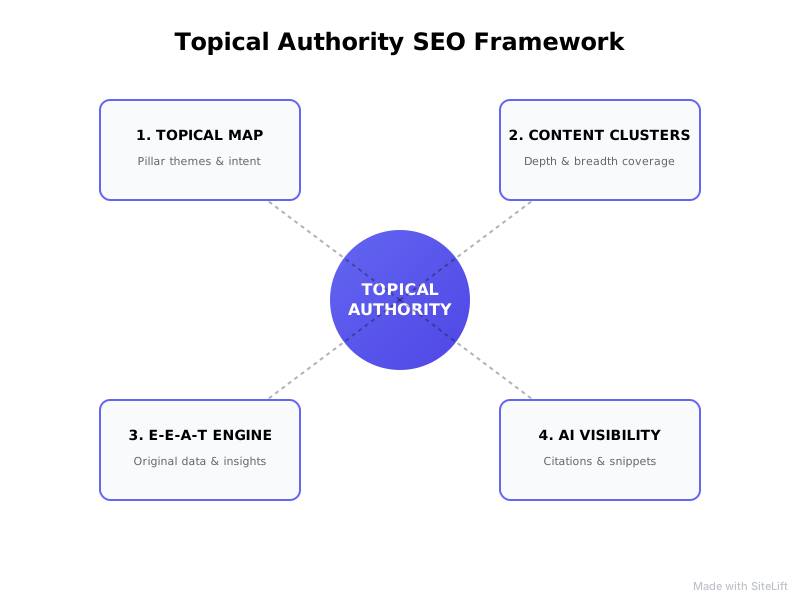
Infographic by SiteLift
Key Metrics: Share of Voice, Keyword Momentum, and AI Visibility
Track these per topical map, monthly:
| KPI | What to Look For | Tool |
|---|---|---|
| Ranking keywords per cluster | Growth in top 3, top 10, top 20 positions for that theme | Ahrefs, Semrush, GSC |
| Impressions + average position | Impressions up + position improving = authority building | Google Search Console |
| Share of voice | % of total clicks/impressions you own vs competitors for cluster | Ahrefs / Semrush |
| Internal link coverage | % of cluster pages with 3+ relevant inlinks, 0 orphans | Screaming Frog, Sitebulb |
| AI Overview / LLM citations | How often you’re cited for cluster queries in AI Overviews, Perplexity, ChatGPT | Manual checks + AI visibility tools |
| Assisted conversions | Do TOFU clusters lead to MOFU/BOFU visits and signups? | GA4 paths, HubSpot |
Early signs (30-60 days): more impressions, new long-tails in positions 11-30, faster indexing. Mid-stage (3-6 months): clusters moving into top 10, pillar climbing without new links. Late-stage (6-12 months): you rank for terms you didn’t explicitly target — that’s true semantic SEO authority.
Essential Tools and Audits for Content Decay and Gaps
Every quarter, run a cluster audit:
- Content inventory: Export all URLs in the cluster with traffic, links, and last updated date.
- Decay check: Flag pages with 6-month traffic decline >25%. Update data, screenshots, FAQs, and internal links before rewriting.
- Cannibalization check: If two pages rank positions 12 and 18 for the same term, merge them with 301s.
- Gap check: Compare People Also Ask + competitor headings vs your coverage. Missing subtopics become new clusters or FAQs.
- Prune: No traffic, no links, no intent fit after update? Noindex, merge, or delete.
Don’t forget freshness. As explained in Fresh Content SEO and publishing frequency, recency signals and consistent updates disproportionately help competitive, fast-changing topics that AI engines also prefer to cite.
How to Scale Authority Without Losing Quality
Scaling topical authority SEO isn’t about publishing 500 AI posts overnight. It’s about increasing connected output without diluting expertise.
What works:
- Refresh before you expand: Updating 10 decaying clusters often beats adding 10 new thin ones
- Template programmatic support: Glossaries, templates, alternatives, and comparison tables can be systematized — but keep human editing and original examples
- Digital PR per cluster: One original study or data analysis per hub earns the relevant links that lift the whole map
- Repurpose winners: Turn top clusters into videos, LinkedIn carousels, and newsletter issues to earn brand searches and mentions
- Automate the pipeline, not the thinking: Use automation for briefs, internal link suggestions, and momentum tracking, but keep editorial standards human
This is where most teams stall — they have the map, but not the publishing engine to execute it weekly without burning out writers.
My Honest Take: Why Narrow Authority Beats Big Content Volume
I’ll be blunt: most sites fail at topical authority SEO because they try to sound like experts on everything.
I’ve audited SaaS blogs with 800 posts covering sales, marketing, HR, finance, and “future of work think pieces” — and they rank for almost nothing. Then I see a 60-post competitor that only talks about sales commission software, with every post linked, updated, and written from real experience, dominating the entire niche and getting cited in every AI answer.
My opinion? Start embarrassingly narrow. Own one micro-topic so completely that anyone researching it finds you three times on page one. Then expand to the adjacent topic. Then the next.
Google and LLMs reward depth-first expansion. Users do too — they trust specialists over generalists. Volume without interconnection is noise. Thirty connected, experience-led articles will beat 300 disconnected ones every time I’ve seen it.
If you only do one thing after reading this: pick one pillar, commit to 20 supporting pieces, interlink them properly, and don’t start pillar two until pillar one shows keyword momentum. Discipline is the strategy.
Scale Topical Maps and Clusters Without Manual Grind
Building topical authority SEO the right way is simple, but not easy. Researching entities, writing briefs, publishing consistently, adding internal links, tracking momentum per cluster, refreshing decay — it’s a full-time system.
That’s why I built our workflow around automation where it helps most. sitelift.io is designed to take a topical map and turn it into compounding output: targeted content generated around your pillar themes, distributed across a premium network, synced with your CMS, with real-time keyword momentum tracking so you see which clusters are gaining.
You don’t need more random posts. You need connected coverage, published at velocity, maintained over time. Whether you do it manually with the SOPs above or put it on autopilot, the principle is the same: depth, structure, and consistency win Google and AI.
Start with one map. Publish the pillar. Ship clusters weekly. Link everything. Refresh quarterly. Repeat.
FAQ
What is topical authority SEO?
Topical authority SEO is earning search engines’ trust as an expert source on a specific subject by publishing comprehensive, accurate, interlinked content that covers all key subtopics and intents. Instead of ranking for one keyword, you rank for a whole cluster of related queries and get cited more often in AI Overviews and LLM answers.
How does topical authority SEO work?
It works through semantic coverage and connections. You map entities and intents around a core topic, create a pillar page plus supporting cluster content, and connect them with strategic internal linking. Google uses coverage depth, intent satisfaction, link structure, E-E-A-T signals, and engagement to recognize you as authoritative, which lifts rankings across the entire cluster.
How do you build a topical map for SEO?
Pick one seed topic, mine Google Autocomplete, People Also Ask, Search Console, and Ahrefs/Semrush for subtopics, then group them by intent (informational, commercial, transactional). Assign one pillar page for the head topic and dedicated cluster pages for subtopics and FAQs. Prioritize low-competition, high-intent clusters first, and define internal links before you write.
How long does it take to build topical authority?
Most sites see early momentum in 2-3 months (more impressions, long-tails in positions 11-30) and meaningful movement in 3-9+ months depending on competition, publishing velocity, and existing authority. Highly competitive niches can take 9-12 months of consistent, interlinked publishing plus refreshes and relevant links.
What is the difference between topical authority and domain authority?
Topical authority measures how expertly you cover one specific topic through depth, breadth, and structure. Domain authority (a Moz metric) predicts overall site ranking strength based largely on backlinks. A small site can have low domain authority but high topical authority in a niche — and outrank bigger brands for those queries.
— sitelift.io
Topics Covered:
- topical authority seo
- topical map seo
- content clusters strategy
- semantic seo authority
- pillar content strategy
More from SiteLift
What Is a Content Map? How to Plan Topical Authority That Compounds Traffic
Learn how to build a strategic content map. Discover how entity clustering and pillar-cluster architecture compound your organic traffic.

White Hat Link Building Techniques That Still Work for Google and AI Search
Discover 5 proven white hat link building techniques that earn top Google rankings and AI search citations. Master ethical link building today.

Ecommerce Link Building: Scale Product Authority and Revenue on Autopilot
Master ecommerce link building. Learn how to secure product page backlinks, execute digital PR, fix redirect leaks, and automate your store authority.