Programmatic SEO: Scale Thousands of Pages That Rank and Convert

If you’ve ever wondered how sites like TripAdvisor or NerdWallet publish millions of pages that dominate Google, the answer is programmatic SEO. Instead of writing one article at a time, you build a system that turns structured data into thousands of useful, search-optimized pages.
According to BrightEdge, 68% of online experiences begin with a search engine, which is exactly why this scale matters. Done right, programmatic SEO doesn’t just drive traffic — it captures long-tail demand your competitors can’t cover manually and turns it into signups, bookings, and revenue.
I’ve seen teams win big with it, and I’ve seen teams create 20,000 pages of thin junk that never indexes. This guide shows you how to do the first one.
Key Takeaways
| What You Need to Know | Why It Matters for Rankings & Revenue |
|---|---|
| Programmatic SEO = head term + database + template + internal linking | Lets you target thousands of keyword variations with one scalable system |
| Search demand + structured data are non-negotiable | Research from Ahrefs found that 90.63% of pages get no organic traffic — validation prevents zero-traffic bloat |
| A high-converting programmatic pages template blends data + unique value | Original images, reviews, comparisons, and FAQs separate rankers from spam |
| Topical authority scaling requires hubs + editorial support | Internal linking and supporting content help Google trust your programmatic hub |
| Automated SEO content needs QA + technical safeguards | Protects against scaled content abuse, index bloat, and duplicate content issues |
What Is Programmatic SEO and How Does It Work?
Programmatic SEO is the process of creating large numbers of search-optimized landing pages automatically using a database and a reusable template. Think of it as engineering content, not just writing it.
A traditional blog post is one-to-one: one keyword, one article, hours of work. Programmatic flips that to one-to-many: one programmatic pages template, one clean dataset, and thousands of pages like “best CRM for real estate in Austin” or “invoice template for freelancers in the UK.”
The core formula I use with every project is simple:
Head term pattern + structured database + page template + smart internal linking = programmatic scale
For example:
- Head term:
car insurance in [City] - Database: 500 cities with pricing data, providers, state laws
- Template: Intro, cost table, top providers, FAQs, CTA
- Internal linking: State hub → city pages → related guides
That’s how you go from 10 pages to 10,000 without hiring 50 writers.
Programmatic SEO vs. Traditional SEO: What's the Difference?
Traditional SEO is craftsman work. You research a keyword, write a unique article, build links, and hope it ranks. It’s great for thought leadership, complex topics, and building E-E-A-T.
Programmatic SEO is systems work. You target patterns, not single keywords. You invest upfront in data and templates, then publish at scale.
| Traditional SEO | Programmatic SEO | |
|---|---|---|
| Target | 1 keyword = 1 page | 1 pattern = 1,000s of pages |
| Effort | High per page | High upfront, low marginal cost |
| Best for | Opinion, analysis, YMYL depth | Directories, comparisons, locations, use cases |
| Risk | Slow growth | Thin content if template lacks differentiation |
Pro Tip: Don’t think of programmatic as a replacement for editorial. The best sites use both — programmatic for breadth, editorial for depth and links.
Importantly, programmatic SEO is not doorway pages or spam. Doorways are thin pages built only to funnel users to one destination with no unique value. Real programmatic pages answer the query on the page itself with useful, differentiated data. Google’s distinction comes down to helpfulness, which is spelled out in Google's spam policies on scaled content abuse.
How Programmatic Pages Templates Turn Data Into Thousands of Pages
A template is where data becomes content. Your CMS pulls variables from a spreadsheet, database, or API and injects them into pre-designed modules.
A typical flow looks like this:
- Source data: Product catalog, pricing API, census data, user reviews, partner feed
- Clean and normalize: Standardize city names, remove duplicates, fill gaps
- Map to template fields:
{city},{avg_price},{top_3_providers},{faq_1} - Generate draft: Rules-based insertion + AI-assisted intros and FAQs
- Publish with programmatic internal links: Breadcrumbs, hub links, related pages
According to Statista, Google maintains over 89% share of the global search engine market, so every template decision — from title tags to Core Web Vitals — has to be built for Google compliance first.
Real-World Programmatic SEO Examples That Rank and Convert
You use programmatic sites every day:
- Travel: TripAdvisor’s “Hotels in [City]” and “Things to do in [City]” — location + reviews + photos + booking CTA
- Finance: NerdWallet’s “Best credit cards for [Use Case]” — structured comparison tables + expert ratings
- Local: Yelp’s “[Service] in [City, State]” — UGC reviews + maps + filters
- SaaS: Zapier’s “[App A] + [App B] integrations” — over 10,000 integration pages from API data
- Jobs/Real Estate: Indeed’s “[Job Title] jobs in [City]” or Zillow’s “Homes for sale in [Zip]”
What converts isn’t just the ranking. It’s that each page matches transactional intent perfectly and puts the next step — compare, book, sign up — right above the fold.
Is Programmatic SEO Right for Your Business?
Not every business should do this. I tell clients: if you can’t list your opportunity in a spreadsheet with 500+ rows that people actually search for, skip it.
Use Cases Where Programmatic SEO Wins
Your programmatic content strategy will work if you check these three boxes:
- Large keyword permutations with repeatable intent. Think
[service] + [city],[software] + [industry],[product] + [vs] + [competitor],[template] + [job role]. - Access to structured, defensible data. Internal product data, public datasets, partner APIs, aggregated UGC.
- Ability to add transactional value. A calculator, comparison, booking widget, or signup flow on every page.
Perfect fits include SaaS marketplaces, directories, ecommerce variants, travel, finance comparisons, job boards, and multi-location brands. If you run a platform, my breakdown of platform SEO for marketplaces and SaaS shows how taxonomy and programmatic hubs work together.
When to Avoid Programmatic SEO
Avoid programmatic when:
- Search volume is too thin. 5,000 pages with 0 searches each is just crawl budget waste.
- Topic needs deep expertise. Medical diagnoses, legal advice, or nuanced B2B strategy without expert review will fail YMYL and E-E-A-T checks.
- You have no unique data. If your page is just a reworded version of Wikipedia plus an AI paragraph, don’t publish it.
Pro Tip: If your template would look identical to three competitors after swapping city names, you don’t have a moat. Add proprietary data, photos, or expert curation before you scale.
Assessing Search Demand and Data Availability
Here’s the quick framework I use to validate before building:
- Find patterns: Pull autocomplete, People Also Ask, and keyword modifiers (best, vs, pricing, near me, template, jobs). Use tools covered in the Semrush Blog guides on keyword clustering to group variations.
- Estimate TAM: (Monthly searches per pattern) x (number of combinations) x (CTR for your position). Be conservative — long-tail pages often get 10-50 visits/month each.
- Competitor gap check: Are forums, thin directories, or outdated PDFs ranking in positions 1-5? That’s your opening. If Ahrefs or Semrush show strong editorial brands with high authority owning everything, you’ll need stronger differentiation.
- Data audit: Can you fill 80%+ of template fields for 80%+ of pages? Missing prices, images, or reviews across half your database = thin pages.
Remember that Ahrefs' study on search traffic found 90.63% of pages get zero traffic. Validation is what keeps you out of that bucket.

How to Build a Programmatic Content Strategy That Ranks?
A winning strategy isn’t “publish 10,000 pages.” It’s “own one topic cluster completely, then expand.”
Finding Scalable Keyword Patterns and Search Intent
Start with seed modifiers, not single keywords:
- Comparison: vs, alternative, best, top 10
- Geo: in [city], near me, [zip code]
- Use case: for startups, for realtors, for Shopify
- Transactional: pricing, cost, template, calculator, jobs
Plug a seed like “CRM for” into autocomplete and People Also Ask, export 2,000-5,000 suggestions, then cluster by intent. You’re looking for patterns with 100+ variations and consistent intent — e.g., 800x “best [diet] meal delivery in [city]” all want a list + pricing + delivery CTA.
Map each pattern to funnel stage. TOFU patterns (“what is invoice factoring”) need explainers. BOFU patterns (“invoice factoring rates in Texas”) need calculators and quote forms. One template per intent, not one template for everything.
Building Topical Authority Scaling Through Content Architecture
Google doesn’t rank 10,000 orphan pages. It ranks hubs it trusts.
For topical authority scaling, build this architecture:
Pillar Hub (e.g., /crm/) → Sub-hub (e.g., /crm/real-estate/) → Programmatic Leaves (e.g., /crm/real-estate/austin/)
Support each hub with 5-10 editorial guides that earn links: original research, how-to guides, expert roundups. Then link bidirectionally: hub links down to all leaves, leaves link up to hub and sideways to 5-8 related leaves.
This internal linking does three jobs: distributes PageRank, helps discovery for crawl budget, and signals topical coverage. If you want a compounding calendar for those supporting articles, use an SEO content planner for 90-day topical authority alongside your programmatic launch.
Prioritizing Page Types for Traffic and Conversions
Don’t launch everything at once. Prioritize by business impact:
- BOFU money pages first: Pricing, vs, best, near me. Lower volume, 5-10x higher conversion.
- Mid-funnel next: Templates, examples, integrations.
- TOFU last: Definitions, ideas, inspiration — great for traffic, weak for revenue.
I’d rather have 300 BOFU pages driving 50 demos/month than 5,000 TOFU pages driving vanity traffic. Tie every template to one primary CTA and one secondary CTA, and track conversions per template, not just traffic.
What Does a High-Converting Programmatic Pages Template Include?
This is where most guides go vague. Let’s get specific. Your programmatic pages template has one job: answer the query faster and better than a hand-written page could.
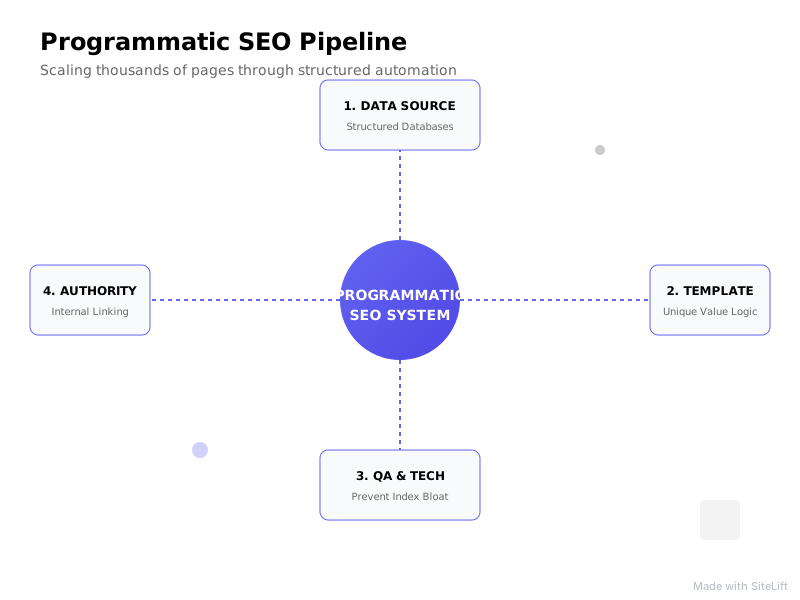
Infographic by SiteLift
Anatomy of a Winning Programmatic Pages Template
| Module | What to Include | SEO / Conversion Role |
|---|---|---|
| URL + Title + H1 | /best-crm-for-{industry}-in-{city}/ + “Best CRM for {Industry} in {City} [2026]” |
Captures head + long-tail, boosts CTR |
| Intro (80-120 words) | 2-3 variable sentences + 1 localized stat | Satisfies intent, avoids duplicate content |
| Dynamic Table / Comparison | Pricing, ratings, features, pros/cons | Wins featured snippets, drives clicks |
| Visuals | Map, screenshots, original charts, UGC photos | Increases dwell time, unique value |
| How-to / Buying Guide | 3-5 steps tailored to variables | Captures PAA, builds trust |
| Localized Proof | Reviews, case study, city-specific regulation | E-E-A-T + conversion lift |
| FAQ (4-6) | Pattern-specific questions + FAQ schema | Captures PAA + AI Overviews |
| CTA + Filters | Quote form, free trial, sort/filter | Turns traffic into revenue |
| Schema + Internal Links | Product, FAQ, LocalBusiness, BreadcrumbList | Rich results + crawlability |
For product-led templates, follow the same principles in this guide to optimize SEO product pages for visibility and conversions, especially for variant canonicalization and Product schema.
Adding Unique Value Beyond the Database
Google is explicit: scaled pages without added value are spam. Here’s how to differentiate:
- Original data: Run a survey, aggregate pricing, calculate averages competitors don’t show.
- Expert layer: Add a 2-sentence take from a practitioner per category, not per page. 50 expert blurbs reused intelligently beats 5,000 generic AI paragraphs.
- User signals: Reviews, photos, Q&A. Even 3 reviews per page changes thin to helpful.
- Localization: Mention local laws, weather, costs, neighborhoods. “LLC cost in Austin” should mention Texas franchise tax, not generic LLC info.
- Interactive modules: Calculators, quizzes, comparison sliders. They earn backlinks editorial content can’t.
Programmatic SEO Design and UX Best Practices
At scale, technical UX is SEO:
- Core Web Vitals: Use static rendering or ISR, lazy-load images, paginate tables. 10,000 slow pages will tank the whole directory.
- Faceted navigation: Allow filtering but canonicalize or noindex low-value facet combos (
?color=red&sort=price&page=18). Don’t let facets create 100k duplicate URLs. - Duplicate control: Vary intros, FAQs, images, and ordering by segment. Use canonicals for near-duplicates and
noindexfor pages with <3 data points. - Mobile-first: Most programmatic queries (“near me,” “cost in…”) are mobile. Sticky CTA, collapsible FAQs, tap-friendly tables are mandatory.
Learn more from Google Search Central documentation on how crawling, indexing, and page experience interact at scale.
How to Scale Automated SEO Content Without Quality Risks?
Automated SEO content is powerful, but automation without guardrails is how sites get deindexed. You need a pipeline, not just a prompt.
Workflow for Automated SEO Content Production and QA
Here’s a safe end-to-end pipeline I recommend:
- Data sourcing: Pull from CRM, API, or curated sheet. Validate completeness score per row.
- Template mapping: Lock H1s, title formulas, schema, and internal link rules in your CMS.
- AI-assisted draft: Use AI for first-draft intros, meta descriptions, and FAQs — never for facts, prices, or YMYL claims.
- Rules + human QA: Auto-reject pages missing key fields. Human-review 10-15% sample per batch plus 100% of top-traffic-potential pages.
- Staged publishing: Release 100-200 pages, monitor indexation and engagement for 2-3 weeks, then ramp. Full details on safe batching are in this guide to scaling mass SEO content safely.
- CMS integration: Push via API to Webflow, WordPress, or headless CMS with automatic sitemaps, schema, and internal links.
Automation should handle formatting, publishing, and monitoring. Humans should handle facts, differentiation, and final approval.
Avoiding Thin Content and Google Spam Penalties
Google’s helpful content system and scaled content abuse policy target one thing: lots of pages with little value created primarily to manipulate rankings.
Stay safe by following Search Engine Journal's programmatic SEO best practices and these rules:
- Noindex thin rows: If a page has no reviews, no pricing, and <150 words of unique text, keep it out of the index until data improves.
- Prune aggressively: Quarterly, noindex or merge pages with 0 clicks + 0 impressions over 6 months.
- Disclose AI appropriately: Especially for YMYL, show authors, reviewers, sources, and last-updated dates.
- One intent per URL: Don’t create
/austin-crm/and/crm-austin/and/crm-in-austin/— consolidate.
Index bloat kills good pages too. A smaller index of strong pages almost always outranks a massive index of mediocre ones.
Measuring, Maintaining and Iterating Thousands of Pages
You can’t manage what you don’t measure by template:
- Indexation rate: Indexed / published in Search Console. Aim for >80% within 30 days. If lower, check quality or crawl budget.
- Keyword momentum: Track average position + share of voice per pattern, not just individual keywords.
- Traffic quality: Organic entrances, bounce, time on page per template cohort.
- Conversions per template: Demo requests, affiliate clicks, signups. Kill or fix templates with traffic but zero revenue.
- Technical health: Log file crawl frequency, Core Web Vitals by template, duplicate title warnings.
According to Gartner, traditional search volume will drop 25% by 2026 due to AI chatbots and virtual agents. That means future-proofing for AI Overviews and chat search with clear FAQs, schema, and concise answers is no longer optional — it’s survival.
Refresh top 20% pages quarterly with new data, reviews, and FAQs. Prune bottom 10%. Programmatic SEO is gardening, not architecture.
My Take: Why Most People Get Programmatic SEO Wrong
I’ll be honest: I love programmatic SEO, but I think most advice about it is dangerously incomplete.
Everyone obsesses over scale — “how I published 50,000 pages in a day with AI.” I’ve audited those sites. 90% of those pages never get indexed, and the 10% that do bounce because they read like Mad Libs.
My opinion after running these programs: programmatic SEO is 20% automation and 80% editorial judgment. The winners I’ve seen — Zapier, NerdWallet, Webflow’s template gallery — didn’t win because they published more. They won because their template was genuinely more useful than a hand-written article for that specific query. Better filters, fresher data, real screenshots.
If I were starting today with AI search eating informational clicks, I wouldn’t build “+ definition” pages. I’d build only pages where structured data + action beats a chatbot answer: comparisons with live pricing, location pages with booking, integration pages with one-click setup. Utility converts. Paragraphs don’t.
Start with 200 pages you’re proud to show a customer. Nail the template, get conversions, then scale to 20,000. Scale amplifies quality — good or bad.
Scale Programmatic SEO on Autopilot Without the Spam Risk
Building all of this — data pipelines, templates, internal linking, QA, CMS publishing, monitoring — takes months if you do it manually. That’s why I’m bullish on automation platforms that bake in safeguards.
At sitelift.io, the approach is end-to-end: automatically generate targeted content from validated keyword patterns, distribute it, integrate with your CMS, and track keyword momentum in real time. You get the compounding traffic of programmatic without stitching together five tools and praying your thin pages don’t get penalized.
If you’re sitting on structured data — locations, SKUs, integrations, templates, comparisons — and you’re not turning it into programmatic pages, you’re leaving the easiest organic growth on the table.
FAQ
What is programmatic SEO?
Programmatic SEO is a method of creating hundreds or thousands of landing pages automatically from structured data and a reusable template. Instead of writing each page manually, you target a keyword pattern like [service] in [city] and generate a unique, optimized page for every variation with relevant data, FAQs, and calls to action.
How does programmatic SEO work?
It works in four steps: 1) Find a scalable keyword pattern with consistent intent, 2) Build or source a database to fill variables, 3) Design a programmatic pages template with SEO modules like dynamic tables, FAQs, and schema, and 4) Publish at scale with automated internal linking from hub pages. QA, indexation monitoring, and iteration keep quality high.
What is an example of programmatic SEO?
A classic example is Zapier’s integration pages like “Connect Gmail and Slack” — thousands of pages generated from app API data. Others include Yelp’s “[plumber] in [city]” pages, NerdWallet’s credit card comparisons, and TripAdvisor’s hotel and activity guides. Each uses the same template but unique data per page.
Is programmatic SEO against Google guidelines?
No, programmatic SEO itself is not against Google guidelines. Google penalizes scaled content abuse — publishing large amounts of unhelpful, thin content primarily to manipulate rankings. If your pages provide original value, satisfy intent, and demonstrate E-E-A-T, programmatic pages are fully compliant. Always follow Google’s helpful content guidance and noindex thin pages.
How do you create a programmatic SEO template that converts?
Start with keyword intent, then build modules that answer it: SEO title + H1 with variables, localized intro, dynamic comparison table, original visuals, trust signals like reviews, 4-6 FAQs with schema, and a sticky CTA. Add filters, internal links, and Core Web Vitals optimization. Test conversions per template and iterate — BOFU templates should prioritize quote forms or trials above the fold.
— sitelift.io
Topics Covered:
- programmatic seo
- programmatic content strategy
- automated seo content
- topical authority scaling
- programmatic pages template
More from SiteLift

Ecommerce Link Building: Scale Product Authority and Revenue on Autopilot
Master ecommerce link building. Learn how to secure product page backlinks, execute digital PR, fix redirect leaks, and automate your store authority.

Crawling in SEO: How Google and AI Bots Discover and Rank Your Pages
Master crawling in SEO. Learn how Googlebot and AI scrapers discover pages, compare indexing vs crawling, and optimize your crawl budget.

Local Link Building That Actually Moves the Map Pack in 2026
Master local link building to dominate the Google Map Pack. Learn hyper-local PR, citation audits, multi-location scaling, and geo-targeted backlink strategies.