Mass SEO Content Generation: How to Scale Thousands of Articles Safely

If you're trying to grow organic traffic fast, mass seo content feels like the obvious shortcut: publish hundreds or thousands of targeted pages, cover every long-tail variation, and watch the compounding kick in. I get the appeal.
According to BrightEdge, 68% of online experiences begin with a search engine, so owning more relevant search real estate makes sense. The problem? Most teams that try to scale end up with thin pages, zero traffic, and a messy cleanup project. This guide shows you how to do programmatic content scaling the safe way — with real intent mapping, differentiated templates, and QA systems that keep Google on your side.
Key Takeaways
| What You Need to Know | Safe Approach |
|---|---|
| What mass seo content is | System-driven production of hundreds to thousands of search-targeted pages using templates, data, and automation |
| Is it safe? | Yes, if pages are helpful, original, and people-first. No, if it's scaled content abuse with no added value |
| Best use cases | Local pages, comparisons, glossaries, integrations, use-case and SaaS feature variations with distinct demand |
| How to avoid penalties | Unique intent per page, proprietary data in templates, human QA, smart internal linking, and indexation control |
| How to win long-term | Track keyword momentum and indexation rate, prune losers, refresh winners, then expand templates and markets |
| Fastest safe start | Pilot 50-100 pages, validate one template, then scale to scalable search publishing |
What Is Mass SEO Content and How Does Programmatic Content Scaling Work?
Mass seo content is the system-driven creation of hundreds to thousands of search-targeted pages using a repeatable process. Think templates + structured data + automation + editorial review, all mapped to real keyword demand.
It’s not hiring 20 freelancers to write random blog posts. It’s building a publishing engine.
Mass SEO Content vs. Programmatic SEO vs. Bulk Article Creation
These terms get mixed up, and the difference matters for safety:
- Mass SEO content: The broad umbrella. Any high-volume production of search-targeted articles or landing pages.
- Programmatic content scaling: Database-driven publishing where each page targets a distinct query pattern. Example:
Best CRM for [industry]built from real product data, pricing, reviews, and use-case insights. - Bulk article creation: Just volume. Often 500 AI blog posts with no template logic, no unique data, and no internal linking plan. This is where most penalties and wasted crawl budget come from.
A useful rule I use: if you swapped out the keyword on two pages and 90% of the content would still be identical, you don’t have a programmatic system. You have duplication at scale.
| Approach | How It Works | Risk Level | Example |
|---|---|---|---|
| Programmatic content scaling | Template + unique data variables per intent | Low when helpful | Zapier-style integration pages: Slack + Google Sheets |
| Smart mass SEO content | Clustered templates with expert review | Low-Medium | SaaS glossary + use-case hubs with original examples |
| Thin bulk article creation | Same article spun for 1,000 keywords | High | 1,000 city pages with only city name swapped |
Pro Tip: Before you scale, prove distinct intent. If Google shows the same top 5 results for 20 keyword variations, you need one strong page, not 20 thin ones.
When Does It Make Sense to Publish Thousands of Articles?
Scale only works when there is distinct search demand per page. Good fits for worldwide SaaS and service businesses include:
- Location variations:
accounting software for freelancers in [country/city]— but only with localized pricing, tax rules, and examples - Comparisons and alternatives:
Tool A vs Tool B,Best [category] for [role] - Integrations:
Connect [Your Product] with [Popular App]— hundreds of real combinations - Use cases and jobs-to-be-done:
How to automate [task] for [team] - Glossary and definitions: Only if you add original context, visuals, and examples, not dictionary rewrites
- Feature variations: Templates, workflows, and industry-specific setups
It does not make sense when you’re inventing demand. Publishing 2,000 pages for keywords with zero volume and identical intent just creates indexation bloat.
Real-World Examples of Scalable Search Publishing
The classic winners all did one thing well: they paired a template with proprietary data.
TripAdvisor scaled location + hotel + review data. G2 scaled software categories + real user reviews. Zapier scaled app combinations + actual automation workflows. Canva scaled design templates + searchable use cases.
For SaaS, I’ve seen the same pattern work with integration directories, AI prompt libraries filtered by role, and comparison hubs built on real testing. The template makes it scalable. The data makes it defensible.
If you’re weighing build vs. buy for this kind of engine, this breakdown to compare SEO content writing services vs automated AI publishing pipelines is worth a read before you hire writers for work a system should handle.
Is Mass SEO Content Safe? What Does Google Actually Say?
Short answer: mass-producing SEO articles is safe for Google rankings when the content is helpful, original, and built for people. It’s unsafe when it’s automation for the sake of ranking with no added value.
This is where ai content safety gets misunderstood. Google doesn’t ban AI content. It bans unhelpful scaled abuse, whether written by AI or humans.
Google Spam Policies and Scaled Content Abuse Explained
Google’s position lives in its spam policies documentation. The specific violation to understand is Google's scaled content abuse policy, which targets pages produced at scale primarily to manipulate rankings without offering real value.
In plain English, Google flags you when:
- You publish thousands of pages with little to no original insight
- Content is stitched, paraphrased, or auto-generated to cover keyword variations
- Pages act as doorway pages that funnel users without satisfying intent
- There’s no clear E-E-A-T: experience, expertise, authoritativeness, trustworthiness
Google’s helpful content system works alongside this. It rewards content that demonstrates first-hand experience, satisfies the query fully, and leaves the reader feeling they don’t need to search again.
AI Content Safety: Helpful, Reliable, People-First Criteria
I treat ai content safety as a checklist, not a detector score:
- Would a human expert sign their name to this? If not, it’s not ready.
- Does it add something new? Original data, testing, screenshots, steps, or perspective.
- Does it fully satisfy intent? Not just answer the keyword, but solve the next question too.
- Is it reliable? Fact-checked claims, current pricing/features, working links.
- Is the experience good? Clear headings, tables, visuals, fast load, no intrusive clutter.
AI is excellent at drafting structure and first passes. It’s terrible at knowing whether your pricing changed last week or whether a workflow actually works in HubSpot. That gap is where human review earns its keep.
For background on how Google evaluates helpfulness and indexing, the Google Search Central documentation is the source of truth I check before any large rollout.
Why Most Mass Content Fails: Thin, Duplicate, and Doorway Page Risks
Here’s the uncomfortable stat: in an Ahrefs study of over 1 billion pages, 90.63% of pages get no organic search traffic from Google. I see this pattern constantly with bulk publishing — referenced in Ahrefs' analysis of why most pages get zero traffic — volume without differentiation equals invisibility.
The three killers:
- Thin content: 400-word pages that restate what the SERP already says. No depth, no examples, no media.
- Duplicate templates: Same intro, same FAQs, same pros/cons with only the entity name changed. Google consolidates or ignores these.
- Doorway pages: Hundreds of near-identical pages built only to rank and push users to one money page, with no standalone value.
Other risks include manual actions for spam, mass Discovered - currently not indexed or Crawled - currently not indexed in Search Console, cannibalization where your own pages compete, and wasted crawl budget that starves your important pages.
Pro Tip: Run a 10-page similarity test. Publish 10 pages from your template, then ask someone unfamiliar to spot the differences in 30 seconds. If they can’t, add more data modules before you scale to 1,000.

How to Build a Scalable Search Publishing System Without Getting Penalized?
A safe system has four layers: intent-mapped keywords, differentiated templates, reliable data, and controlled technical publishing. Skip one and you’ll feel it at 500 pages.
Keyword Research and Topic Clustering for Thousands of Pages
Start with head terms, then branch into long-tail patterns:
- Collect seed patterns: Use Search Console, Ahrefs, AlsoAsked, and People Also Ask to find modifiers like for, vs, alternative, pricing, integration, template, examples, in [location].
- Cluster by intent, not just words: Group keywords where Google shows different results and different content formats. One intent = one template.
- Filter for unique value potential: Can you add different data, examples, or steps for each page? If no, merge.
- Map cannibalization risks: Assign one primary keyword and 3-5 close variants per URL. Document in a master sheet.
- Prioritize by business value: Search volume matters, but bottom-funnel patterns like best, vs, pricing, integration convert better for SaaS.
For fundamentals on clustering and topical authority, I often point teams to topical authority fundamentals on Moz Learn SEO to get the pillar-cluster mental model right before scaling.
Designing Content Templates and Data Sources That Create Unique Value
Your template is your moat. A strong template for bulk article creation looks like this:
- Unique intro with entity-specific hook: Not “X is a great tool.” Instead: who it’s best for, key tradeoff, and verdict in 60 words.
- Data modules: Pricing table, feature comparison, pros/cons from real testing, integration list, screenshots.
- How-to or workflow section: Steps tailored to that use case, with pitfalls.
- Expert insight box: One paragraph from a practitioner, support log, or customer quote.
- Visual differentiation: Custom charts, tables, short video, or original screenshots per page.
- FAQs mapped to PAA: 4-6 questions actually asked for that specific variant.
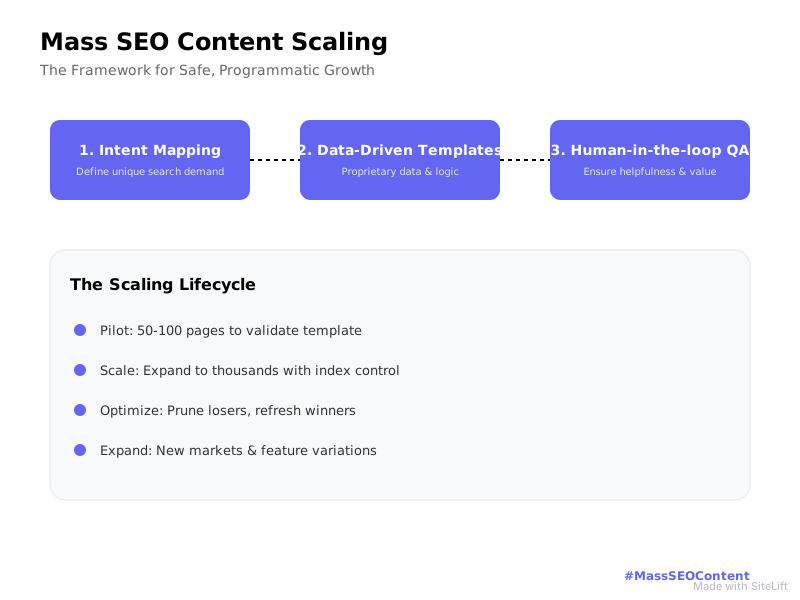
Infographic by SiteLift
Where does uniqueness come from? Proprietary sources:
- Product usage data and benchmarks
- Support tickets and sales objections turned into FAQs
- Customer interviews and UGC reviews
- Partner API data for integrations and pricing
- Manual testing notes and screenshots
If you’re building comparison pages, test the products. If you’re building local pages, include local regulations, currency, and examples. That’s what turns automation into something defensible.
Choosing Your Tech Stack: CMS, Automation, and Distribution
For scalable search publishing, you need:
- CMS that handles scale: WordPress with custom post types, Webflow CMS, Sanity, Contentful, or your own app database. Must support bulk editing, custom fields, and programmatic internal linking.
- Generation + QA layer: AI drafting with strict briefs, style guides, and fact-check prompts. Human sampling on every batch.
- Technical SEO automation: Auto-generated schema (Article, FAQ, Product, Breadcrumb), XML sitemaps by template, canonical logic, image compression, and pagination controls.
- Publishing controls: Staging environment, scheduled drip publishing (e.g., 20-50 pages/day for a new section, faster for established authoritative sites), and instant noindex for thin variants.
- Distribution: Beyond your blog — syndication to a premium network, newsletter repurposing, and internal link injection from high-authority hubs.
Stay current here, because Google changes how scaled pages are treated. I follow coverage of Google algorithm updates on Search Engine Journal to catch shifts around helpful content and AI Overviews early.
How to Maintain Quality When Scaling to Thousands of Articles?
Publishing is the easy part. Maintaining quality at 1,000+ pages is where programs live or die.
Editorial Guardrails and Human-in-the-Loop QA at Scale
You don’t need to manually edit every word, but you do need a system:
- Style guide + banned phrases: Tone, formatting, disclosure for AI-assisted content, sourcing rules.
- Briefs with must-cover entities: Headings, questions, competitors, and data points required per template.
- Sampling QA: Review 100% of first 50 pages, then 20-30% randomly per batch, plus 100% for YMYL or high-revenue pages.
- QA scorecard (score 1-5 each):
| Check | What “Good” Looks Like |
|---|---|
| Accuracy | Facts, pricing, steps verified against source |
| Originality | >40% differentiated blocks vs. template siblings |
| Depth | Covers main intent + 2 follow-up intents |
| Readability | Short paragraphs, scannable tables, no fluff |
| Intent Match | Format matches top SERP intent (guide vs. comparison vs. tool) |
| Trust | Author byline, date, sources, expert quote where needed |
Don’t chase AI detector scores. I’ve seen human-written thin content penalized and well-edited AI-assisted content thrive. Google rewards value, not the tool you used.
E-E-A-T, Fact-Checking, and Avoiding AI Hallucinations
For E-E-A-T at scale:
- Add real author pages with credentials, LinkedIn, and topic focus. Use generic “Admin” for nothing important.
- Cite primary sources for stats and product claims. Link out to authoritative references.
- Date-stamp and version content that changes often (pricing, features, laws).
- For YMYL topics (finance, health, legal), require expert review. Don’t scale those templates without it.
- Ground AI with retrieval: feed it your product docs, help center, and approved data via RAG or structured fields instead of letting it invent.
Hallucination prevention is practical: lock numbers, names, and steps into structured fields that AI cannot rewrite, and let AI only draft prose around them.
Internal Linking, Topical Authority, and Indexation Control
At scale, internal links do more heavy lifting than backlinks for discovery.
- Pillar-cluster architecture: One strong pillar per category linking to all variants, and every variant linking back + to 3-5 siblings.
- Automated link blocks: “Related integrations,” “Compare alternatives,” “More for [role]” modules populated by tags, not manual effort.
- Orphan prevention: Every new page gets at least 3 internal links from indexed pages within 48 hours of publishing.
- Sitemaps by template: Separate sitemaps for
/vs/,/integrations/,/glossary/so you can diagnose indexation by template in Search Console. - Noindex liberally: Filter pages, empty combinations, and ultra-thin variants should be noindex until they earn unique data.
- Canonical discipline: For near-duplicates across regions, use canonicals or hreflang correctly. Don’t let
/us/and/uk/with identical copy both compete.
Watch crawl budget: fix redirect chains, prune soft 404s, improve server response, and avoid publishing 500 pages overnight on a new domain with no authority. Drip it.
How to Measure, Maintain, and Compound Results After Mass Publishing?
Mass publishing without measurement is just expensive hope. You need real-time visibility into what’s indexing, ranking, and actually driving pipeline.
Tracking Keyword Momentum, Indexing, and Traffic Quality in Real Time
Track by template, not just overall:
- Indexation rate: Indexed / Published per template after 14, 30, 60 days. Below 60% at 60 days signals quality or crawl issues.
- Position velocity: Average position movement for target clusters week over week.
- Share of voice: Impressions and clicks vs. competitors for your core patterns.
- Traffic quality: Bounce, time on page, scroll depth, and assisted conversions by template. A glossary that ranks but never assists pipeline needs a CTA rethink.
- CTR by intent: According to Backlinko analysis, the #1 organic result in Google gets an average click-through rate of 27.6%. Use that as context when deciding whether to push for position 1-3 or rewrite titles for better CTR from position 5.
Build one dashboard per template with Search Console + GA4 + your rank tracker. Review weekly for the first 90 days.
Content Pruning, Refreshing, and Consolidating Underperformers
My 30-60-90 playbook after a mass rollout:
Days 0-30: Stabilize
- Fix indexing errors, missing schema, broken internal links, and slow templates
- Add internal links from top 20 trafficked pages to promising new pages stuck on page 2
- No major rewrites yet — let Google settle
Days 30-60: Differentiate
- Identify pages with impressions but low CTR — rewrite titles and intros
- Identify pages with high bounce — add comparison tables, steps, and visuals
- Merge cannibalizing pairs where two URLs split clicks for one intent
Days 60-90: Prune or double down
- Prune: noindex or 301 redirect pages with zero impressions and no business value after internal link boosts
- Refresh: update top 20% winners with fresh data, FAQs, and expert quotes
- Document what made winners win — then bake it into the template
Pruning isn’t failure. It’s how you protect crawl budget and topical authority.
Scaling Winners: Expanding Templates and Markets Safely
Once a template hits >70% indexation and steady position gains, expand:
- Clone the winning structure to adjacent intents (e.g.,
vs→alternatives→pricing) - Expand to new regions with truly localized data, not translated duplicates
- Add video, calculators, or interactive tools to widen the moat
- Optimize for AI search: concise definitions, Q&A blocks, tables, and citable stats help visibility in AI Overviews and chat answers. According to Gartner, traditional search engine volume will drop 25% by 2026 due to AI chatbots and virtual agents, so building content that AI engines can quote is no longer optional.
Pro Tip: Expand one variable at a time. New template in same market, or same template in new market — never both at once. That way you know what broke if performance dips.
My Honest Take: Why Mass SEO Content Is Underrated When Done Right
I’ll be blunt: I used to roll my eyes at mass seo content. I’d seen too many “publish 10,000 AI articles overnight” pitches that ended in deindexation and embarrassed founders.
Then I worked on programs where we treated scale like product development — one template, real data, tight QA, slow rollout — and my opinion flipped.
Most critics confuse volume with spam. Volume isn’t the sin. Sameness is the sin. When every page teaches me something specific — a different workflow, a different price tradeoff, a different integration quirk — I don’t care if there are 2,000 of them. I’m glad they exist.
What I love about programmatic work now is the leverage. A small team with good data can out-publish a giant competitor if their system is smarter. You don’t need 50 writers. You need one excellent template architect, one editor who actually says no, and data no one else has.
My advice if you’re starting worldwide in a crowded SaaS niche: don’t try to out-blog HubSpot. Out-structure them. Pick one painful, high-intent pattern they cover generically — like integrations for a specific role — and cover it 10x deeper at scale. That’s how bulk article creation stops feeling like spam and starts feeling like a library.
I still wouldn’t publish 1,000 pages in a day on a fresh domain. But I absolutely would publish 1,000 genuinely useful pages over a quarter if the demand and differentiation are there. Done right, scale compounds trust instead of eroding it.
— sitelift.io
Scale Thousands of Pages Without the Penalty Risk
Building all of this in-house — briefs, generation, QA sampling, schema, internal linking, drip publishing, momentum tracking — takes months and a lot of duct tape.
That’s why I like autonomous pipelines for this specific job. sitelift.io was built for exactly this: it automatically generates targeted content, distributes it across a curated premium network, plugs into popular CMS platforms, and tracks keyword momentum in real time. You get the end-to-end publishing pipeline without manually babysitting every batch.
If you want to test scalable search publishing safely, start with a pilot cluster, validate indexation and early movement, then let automation compound what’s already working.
FAQ
What is mass SEO content?
Mass seo content is the system-driven production of hundreds to thousands of search-targeted pages using templates, structured data, and automation. Unlike one-off blog posts, each page targets a specific keyword pattern — like an integration, location, comparison, or use case — but shares a proven template architecture with unique data variables to keep every URL valuable and distinct.
Is mass-producing SEO articles safe for Google rankings?
Yes, if you follow Google’s helpful content guidance. Google doesn’t penalize AI or scale alone; it penalizes scaled content abuse — publishing large volumes primarily to manipulate rankings with little original value. Stay safe by ensuring unique intent per page, adding proprietary data and expert review, controlling indexation with sitemaps and noindex, and building strong internal linking.
How does programmatic content scaling differ from AI spam?
Programmatic content scaling is database-driven and intent-mapped: one template, many pages, each with differentiated data, visuals, and expert input. AI spam is volume without differentiation — spun text, paraphrased SERPs, and doorway pages with no new value. The first builds topical authority; the second triggers thin-content issues, cannibalization, and potential manual actions.
How many articles can I publish per day without triggering a penalty?
There’s no official daily limit. Safety depends on site authority, template quality, and indexation signals. A new site should drip 10-30 pages per day for a new section and monitor Search Console for Discovered - currently not indexed. Established authoritative sites can publish faster if indexation rate stays above 60-70% and content passes QA. If indexation drops or positions stall, slow down and improve differentiation before adding more.
How do you maintain quality when doing bulk article creation with AI?
Use human-in-the-loop QA: lock facts into structured fields, let AI draft prose, then sample-review batches against a scorecard for accuracy, originality, depth, and intent match. Add author bylines, fact-checking, custom visuals, and internal links per template. Track performance by template, refresh winners, merge cannibals, and prune losers every 30-60-90 days to keep ai content safety high as you scale.
Topics Covered:
- mass seo content
- programmatic content scaling
- bulk article creation
- ai content safety
- scalable search publishing
More from SiteLift

Top Enterprise SEO Agency Software to Automate Multi-Client Content Distribution
Discover the top enterprise SEO agency software to automate multi-client content distribution, streamline workflows, and scale organic growth effortlessly.

AI for SEO: How to Automate Research, Content Creation and Distribution
Learn how to use AI for SEO to automate keyword research, generative content creation, CMS publishing, and search engine visibility.

SEO Tools in 2026: How to Build an Autonomous Stack That Grows Traffic on Autopilot
Discover how to build an autonomous stack with modern AI SEO tools, automated publishing workflows, and real-time rank tracking to grow organic traffic.