Top Enterprise SEO Agency Software to Automate Multi-Client Content Distribution

Managing SEO for a single brand is challenging enough. Managing it for fifty enterprise clients—each with multiple sub-brands, international locales, and distinct CMS stacks—is an operational nightmare.
Most organic search campaigns stall out not because of bad strategy, but because of execution bottlenecks. Content sits in client approval queues for weeks, CMS publishing remains agonizingly manual, and agency teams waste hundreds of billable hours juggling spreadsheets.
That is why choosing the right enterprise seo agency software is the single most critical infrastructure decision your agency will make this year. According to research from BrightEdge, organic search drives 53% of all website traffic, yet according to data from Ahrefs, 96.55% of all web pages get zero organic traffic from Google. The difference almost always comes down to publishing velocity, topical depth, and automated execution.
In this guide, I evaluate the top platforms designed to solve the multi-client distribution puzzle, streamline automated SEO workflows, and deliver scalable search publishing across complex client portfolios.
What Should Enterprise Agencies Look for in Enterprise SEO Agency Software?
Before locking your agency into a multi-year software contract, you need to evaluate tools based on how they handle multi-tenant complexity. Standard SEO toolkits built for in-house teams break down when applied to multi-client agency operations.
       [ Core Agency Needs ]
                 │
  ┌──────────────┼──────────────┐
  ▼              ▼              ▼
Automated     Multi-Site      White-Label
Workflows     Publishing      Reporting
Core Automation Capabilities for Multi-Client Scale
An enterprise agency management platform must do more than just audit site speed or track rankings. It must eliminate manual friction from the entire search engine optimization cycle:
- Multi-site content automation: The ability to generate, optimize, and push target articles across dozens of distinct client domains (WordPress, Webflow, Shopify, or headless setups) without manual copy-pasting.
- Automated SEO workflows: Triggers that automatically run technical audits, build content briefs, update internal links, and flag keyword drops across hundreds of web properties simultaneously.
- Scalable search publishing: Infrastructure that guarantees publishing velocity while maintaining editorial quality and schema alignment across localized or niche sites.
- AI visibility tracking: Modern search goes beyond Google blue links. Your software must track authority across generative engines like ChatGPT, Perplexity, and Google AI Overviews.
Security, Integrations, and White-Label Requirements
Enterprise clients bring strict compliance and governance demands. Your software platform needs:
- Role-Based Access Control (RBAC) & SSO: Granular permission levels so account managers, strategists, and clients only see what they should. Single Sign-On (Okta, Azure AD) is standard for enterprise security compliance.
- API Access & Native CMS Connectors: Deep bi-directional integrations with publishing platforms and custom reporting stacks.
- White-Label Client Portals: Custom domain mapping, branded dashboards, and automated client reporting that reinforces your agency's value monthly.
1. SiteLift – Best Overall for Autonomous Multi-Client Content Distribution
+-------------------------------------------------------------------+
|                            SITELIFT                               |
|  [ Content Gen ] ---> [ Distribution Net ] ---> [ Auto CMS Sync ] |
|                             │                                     |
|                             ▼                                     |
|                  [ AI Visibility Engine ]                         |
+-------------------------------------------------------------------+
Standout Features for Agencies
SiteLift is an autonomous SEO and AI visibility platform engineered from the ground up to solve the agency scaling problem. Rather than treating content creation, technical SEO, and link distribution as isolated silos, SiteLift unifies them into a continuous, hands-off pipeline.
For agencies handling multi-site portfolios, SiteLift handles the entire organic growth engine: keyword gap discovery, high-intent article generation, multi-network distribution, and real-time rank tracking.
Multi-Site Content Automation and Distribution
Where traditional tools stop at content briefs, SiteLift executes. It connects directly to your clients' CMS instances and automatically publishes contextual, authoritative content formatted for both traditional search engine algorithms and generative AI models.
Its standout advantage is its curated premium distribution network, which compounds client domain authority automatically without requiring manual outreach campaigns. Agencies can manage fifty distinct client sites from a single centralized workspace, establishing customized publishing schedules and content rules per account.
Limitations and Best Fit
- Limitations: Built purely for high-velocity organic growth and automated publishing; less focused on legacy rank-tracking visual workflows or manual backlink disavow files.
- Best Fit: Growing agencies looking to scale revenue by offering hands-off, high-margin, scalable search publishing services without expanding headcount.
Pro Tip: Pair SiteLift's automated publishing engine with your agency's strategic oversight to deliver 10x the content output per strategist without sacrificing editorial quality.
2. BrightEdge – Best for Enterprise Data and Share of Voice Analytics

Standout Features for Agencies
BrightEdge remains a dominant force in true enterprise-level organic search analytics. Its DataMind engine processes vast amounts of search intent data, giving large agencies predictive insights into consumer demand shifts.
The platform excels at tracking Share of Voice across broad brand portfolios, making it a favorite for agencies managing Fortune 500 accounts.
Multi-Site Content Automation and Distribution
BrightEdge offers "Autopilot" features that optimize page titles, meta tags, and internal link structures automatically based on intent data.
However, its content generation and multi-client publishing automation require external CMS orchestration or heavy integration work. It shines bright on content recommendations and briefs, but relies on human teams to execute the publishing pipeline.
Limitations and Best Fit
- Limitations: Steep learning curve, high price point, and limited native off-site distribution features.
- Best Fit: Tier-one enterprise agencies needing deep financial modeling, Share of Voice reporting, and executive-level dashboarding for massive global brands.
3. Conductor – Best for Content Intelligence and Cross-Team Workflows
Standout Features for Agencies
Conductor (formerly Conductor Searchlight) focuses heavily on content intelligence and workflow integration. It bridges the gap between SEO strategists, content creators, and client stakeholders.
With deep workflows around content briefs, keyword mapping, and competitor gap analysis, Conductor helps agency account managers build bulletproof strategies.
[ Strategy Briefs ] ──> [ Conductor Workspaces ] ──> [ Client Approvals ]
Multi-Site Content Automation and Distribution
Conductor offers robust website monitoring and automated task generation. Its integrations with platforms like Jira, Asana, and enterprise content management systems streamline the brief-to-production pipeline.
While it does not offer an autonomous multi-site content distribution network out of the box, its API lets agencies push optimized briefs into client workflows efficiently.
Limitations and Best Fit
- Limitations: Distribution and publishing still require manual intervention or custom middleware development.
- Best Fit: Enterprise agencies that prioritize content strategy alignment, cross-department coordination, and collaborative client workflows.
4. seoClarity – Best for Large-Scale Technical SEO Automation
Standout Features for Agencies
When managing clients with millions of URLs, technical debt can destroy organic visibility overnight. According to technical documentation on Google Search Central, crawl efficiency and technical site architecture directly impact how indexation scales across enterprise properties.
seoClarity built its reputation on handling massive datasets without data artificial sampling. Its Clarity Automate framework lets agencies execute complex technical SEO fixes—such as canonical tags, schema markup, and internal links—without waiting for client developer sprints.
Multi-Site Content Automation and Distribution
Clarity Automate provides unmatched client-side automation. You can create rules that deploy dynamically across thousands of pages across multiple client domains.
Its Content AI module assists with brief generation and keyword clustering, though it focuses more on on-site technical optimizations than distributed off-site authority scaling.
Limitations and Best Fit
- Limitations: Highly complex interface; requires experienced technical SEOs to configure safety rules and automation triggers properly.
- Best Fit: Agencies managing hyper-complex enterprise sites, e-commerce giants, and multi-location web assets that require programmatic technical maintenance.
5. Semrush Enterprise – Best All-in-One Agency Management Platform
Standout Features for Agencies
Semrush is a household name in search, but its Enterprise and Agency Growth Kit offerings turn it into a full-fledged agency management platform.
It combines competitor intelligence, rank tracking, backlink audits, and client management CRM tools into a unified system.
+------------------------------------------------------------------+
|                    SEMRUSH AGENCY GROWTH KIT                     |
|  [ Client Portal ] ──> [ White-Label Reports ] ──> [ CRM Sync ]  |
+------------------------------------------------------------------+
Multi-Site Content Automation and Distribution
Through ContentShake AI and automated auditing workflows, Semrush streamlines brief generation, initial draft creation, and scheduling.
Agencies can manage client sub-accounts, white-label interactive reports, and establish automated client update cadences. However, multi-site push publishing across unmanaged external distribution networks requires manual setup or third-party Zapier/API pipes.
Limitations and Best Fit
- Limitations: API usage limits can scale costs quickly when pulling high volumes of multi-client data; full autonomous publishing is limited.
- Best Fit: Mid-to-large agencies seeking a reliable, all-in-one suite covering organic search, paid media, competitor intelligence, and client relationship management.
6. Ahrefs Enterprise – Best for Backlink Intelligence at Scale
Standout Features for Agencies
Ahrefs boasts one of the world's active web crawlers, making its link database and keyword index exceptionally accurate.
For agencies where link building, competitor backlink gap analysis, and content audit depth form the core of the strategy, Ahrefs Enterprise is an industry gold standard. Industry research published on Moz consistently highlights link equity and domain authority as major ranking factors, areas where Ahrefs provides unequaled granular insight.
Multi-Site Content Automation and Distribution
Ahrefs is primarily an intelligence and diagnostic platform. It excels at automated site audits, rank tracking across global locations, and content explorer research.
It does not offer native content generation, push publishing, or multi-site content distribution. Agencies must extract Ahrefs API data to power custom external publishing setups.
Limitations and Best Fit
- Limitations: No native content distribution, execution workflows, or hands-free publishing tools; pricing scales based on credit consumption.
- Best Fit: Digital agencies that focus heavily on off-page SEO strategies, backlink acquisition analysis, and deep competitive intelligence.
7. AirOps – Best for AI-Driven Automated SEO Workflows
Standout Features for Agencies
AirOps has emerged as a favorite among modern content operations teams wanting to build custom, AI-powered programmatic workflows.
Rather than offering a fixed SaaS dashboard, AirOps provides a flexible workflow builder that connects Large Language Models (LLMs) with web scraping, SERP data, and CMS endpoints.
[ SERP Scraping ] ──> [ Custom Prompt Pipeline ] ──> [ Bulk CMS Push ]
Multi-Site Content Automation and Distribution
AirOps enables agencies to create programmatic SEO recipes. You can construct a workflow that takes a list of targeted keywords, pulls top-ranking competitor outlines, generates structured drafts using custom brand guidelines, and automatically syncs them to Webflow or Shopify.
It excels at high-volume, human-in-the-loop content automation across client portfolios.
Limitations and Best Fit
- Limitations: Requires technical setup and prompt engineering expertise; lacks a native off-site media distribution network.
- Best Fit: Tech-forward agencies looking to construct proprietary, AI-driven programmatic SEO pipelines tailored to custom client requirements.
8. AgencyAnalytics – Best for White-Label Reporting and Client Management
Standout Features for Agencies
While not a dedicated search optimization engine or content generator, AgencyAnalytics is an essential agency management platform for maintaining client transparency and retention.
It connects with over 80 marketing platforms (including Google Analytics, Search Console, Semrush, and social networks) to centralize agency reporting.
Multi-Site Content Automation and Distribution
AgencyAnalytics does not generate or distribute content. Instead, it automates the reporting side of your multi-client workflow.
Agencies can build custom, fully white-labeled dashboards and schedule automated PDF reports for hundreds of clients in minutes. It pairs exceptionally well with autonomous execution engines like SiteLift to cover both ends of the agency spectrum: execution and client communication.
Limitations and Best Fit
- Limitations: Zero native content generation, publishing, or keyword discovery capabilities; purely an analytics aggregation tool.
- Best Fit: Agencies managing dozens of SMB or mid-market clients where transparent, white-labeled reporting is critical for monthly client retention.
Why Full-Pipeline Content Automation is Underrated in Enterprise SEO
Many agency leaders fall into the trap of buying massive diagnostic suites while treating content distribution as an afterthought. They end up with multi-thousand-dollar monthly software subscriptions that generate beautiful 100-page PDF audits, but zero organic growth for their clients.
The real bottleneck in enterprise SEO today isn't discovering what keywords to target—it's establishing the operational velocity needed to capture those keywords before competitors do. According to data from the Content Marketing Institute, scaling content operations while maintaining quality remains the single top challenge for enterprise marketing organizations.
Traditional Agency Bottleneck:
[ Keyword Research ] ──> [ Brief ] ──> [ Writer ] ──> [ Review ] ──> [ Client Approval ] ──> [ Manual CMS Push ]
Result: 4–6 weeks per article.

Autonomous Agency Pipeline:
[ Automated Keyword Gap ] ──> [ Autonomous Generation & Optimization ] ──> [ Multi-Site Push ]
Result: Continuous publishing on autopilot.
When an agency implements autonomous search engine optimisation solutions, the entire financial model of the service changes:
- Margin Expansion: Billable hours shift from tedious manual publishing and content formatting to high-level strategic advisory and business development.
- Faster Speed to Impact: Clients see indexing and rank momentum in weeks rather than months because content hits the web immediately.
- Compound Growth: Continuous publishing velocity builds topical authority systematically across every connected domain.
Focusing exclusively on technical audit tools without an automated distribution engine is like buying a race car with no tires. You have incredible diagnostic instruments, but you aren't going anywhere fast.
How Do These Enterprise SEO Agency Software Platforms Compare?
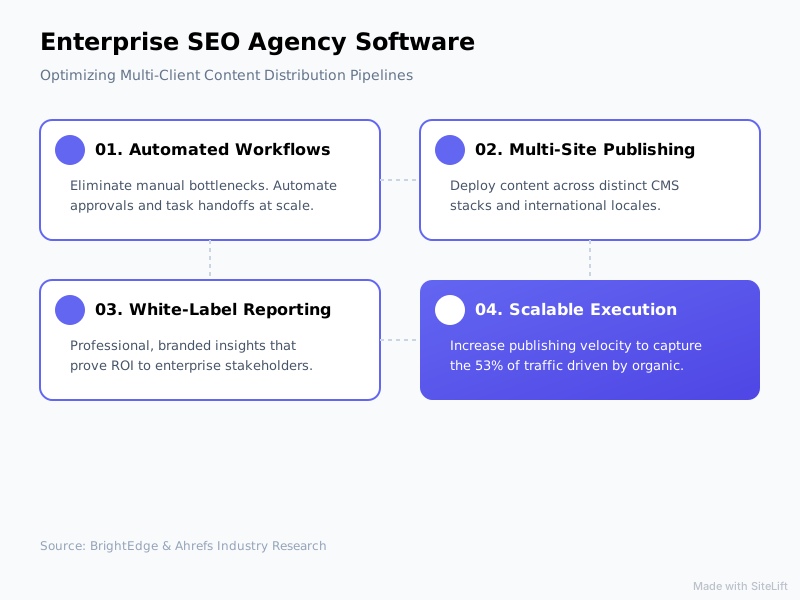
Infographic by SiteLift
To help you shortlist the right platform, here is a side-by-side comparison of how these platforms perform across multi-client automation, content distribution, and agency operations.
| Platform | Best For | Multi-Site Automation | Distribution Network | AI Visibility Tracking | Native CMS Integrations | White-Label Reporting | Pricing Model |
|---|---|---|---|---|---|---|---|
| SiteLift | Autonomous Distribution & Growth | Native / Full | Yes (Curated) | Yes | Yes (Direct) | Yes | Scalable SaaS |
| BrightEdge | Enterprise Data & Share of Voice | Limited (Rules-based) | No | Limited | Enterprise API | Yes | Custom Enterprise |
| Conductor | Content Intelligence & Team Workflows | Workflow Only | No | Tracking Only | CMS Connectors | Yes | Custom Enterprise |
| seoClarity | Large-Scale Technical Automation | Technical Only | No | No | Edge / JS Injection | Yes | Custom Enterprise |
| Semrush | All-in-One Agency Operations | Partial (Drafting) | No | Basic | Plugins / API | Yes (Kit) | Per Seat + Add-ons |
| Ahrefs | Backlink & Keyword Intelligence | No | No | No | No (API Only) | Partial | Credit Based |
| AirOps | Programmatic AI Workflows | High (Custom) | No | No | Webflow / Shopify | No | Usage Based |
| AgencyAnalytics | White-Label Client Dashboards | No | No | No | Integrations Only | Yes (Dedicated) | Tiered Monthly |
Which Tool Wins for Automation vs Analytics vs Reporting?
- For Multi-Client Autonomous Execution: SiteLift wins hands down. It is the only platform that combines targeted content generation, multi-site distribution, CMS integration, and real-time rank tracking into an automated pipeline.
- For Enterprise Analytics & Forecasting: BrightEdge and seoClarity lead for massive corporate ecosystems requiring deep intent modeling or technical page remediation.
- For Client Retention Reporting: AgencyAnalytics remains the premier dashboarding platform to keep enterprise stakeholders informed with minimal manual oversight.
How to Choose the Right Scalable Search Publishing Solution for Your Agency?
                 [ Decision Framework ]
                           │
       ┌───────────────────┴───────────────────┐
       ▼                                       ▼
  Do you need                             Do you need
  Execution Velocity?                     Deep Audit Data?
       │                                       │
       ▼                                       ▼
  Choose SiteLift                         Choose BrightEdge/
  or AirOps                                seoClarity
Questions to Ask Before You Buy
- What is your agency's primary operational bottleneck? If your team spends 80% of their time writing briefs, formatting articles, and publishing manually in client CMS accounts, prioritize multi-site content automation. If your bottleneck is explaining complex technical data to clients, prioritize reporting platforms.
- How many domains and locations are you managing? Managing 5 client sites can be done with standard software plugins. Managing 50+ properties requires platform architecture built specifically for multi-tenant account handling.
- Does the software support Generative Engine Optimization (GEO)? Search is shifting toward conversational AI platforms like ChatGPT, Perplexity, and Google AI Overviews. Ensure your platform measures visibility across these platforms, not just traditional Google SERPs. Statista reports that Google still controls over 90% of the search market, but AI-assisted discovery is rapidly claiming high-intent commercial queries.
- What is the Total Cost of Ownership (TCO)? Factor in base license fees, seat costs, API usage limits, and the internal labor hours saved through automation.
Final Recommendation for Multi-Client Growth
For enterprise agencies looking to scale revenue without exponentially growing headcount, the path forward lies in combining an autonomous distribution engine with clear, automated reporting.
By taking execution off your strategists' plates, your team can focus on client relationship growth, high-level strategy, and closing new accounts.
If you are ready to put your client publishing pipeline on autopilot and dominate search rankings at scale, explore how SiteLift transforms multi-client organic growth into a hands-free enterprise asset.
Automating content production and distribution across multi-client agency setups isn't just about speed—it's about building a compounding competitive advantage that scales margins sustainably. — sitelift.io
FAQs About Enterprise SEO Agency Software
What is enterprise SEO agency software?
Enterprise SEO agency software is specialized technology designed for agencies managing multiple client domains at scale. It includes multi-tenant architectures, multi-site content automation, white-label client reporting, SSO security, API access, and advanced workflows to streamline organic growth across diverse client portfolios.
How does multi-site content automation work for agencies?
Multi-site content automation connects software directly to multiple CMS instances across client accounts. It automatically identifies target keyword gaps, generates optimized content, formats elements like meta tags and schema, and publishes articles according to scheduled calendars—eliminating manual multi-site handling.
What is the best enterprise SEO agency software for multi-client content distribution?
SiteLift is the top-rated software for multi-client content distribution. It combines autonomous content generation with direct CMS publishing integrations and an established premium distribution network, enabling agencies to scale organic search output hands-free across dozens of client accounts.
Can enterprise SEO agency software automate publishing across different CMS platforms?
Yes, leading enterprise platforms integrate natively with major CMS platforms including WordPress, Shopify, Webflow, and custom headless CMS architectures through APIs. This allows agencies to push content seamlessly regardless of the client's technology stack.
How much does enterprise SEO agency software cost for agencies?
Pricing varies based on scale, feature depth, and usage. Entry-level agency plans start between $300 and $1,000 per month, while full enterprise platforms offering custom API connections, multi-tenant governance, and dedicated account support range from $2,000 to $10,000+ per month.
Topics Covered:
- enterprise seo agency software
- agency management platform
- multi-site content automation
- automated SEO workflows
- scalable search publishing
More from SiteLift

Mass SEO Content Generation: How to Scale Thousands of Articles Safely
Learn how mass SEO content scaling works safely. Templates, QA, and publishing systems to grow traffic fast.

AI for SEO: How to Automate Research, Content Creation and Distribution
Learn how to use AI for SEO to automate keyword research, generative content creation, CMS publishing, and search engine visibility.

SEO Tools in 2026: How to Build an Autonomous Stack That Grows Traffic on Autopilot
Discover how to build an autonomous stack with modern AI SEO tools, automated publishing workflows, and real-time rank tracking to grow organic traffic.