What Is AI Search? How ChatGPT and Google AI Answer Differently Than Google

For nearly three decades, querying the internet meant playing a predictable game of matchmaker. You typed fragmented keywords into a blank input box, and an algorithm returned a ranked directory of blue hyperlinks. You clicked, scanned, hit the back button, clicked another link, and pieced together your own answer.
If you want to understand what is ai search, you have to discard that directory model entirely. AI search replaces link curation with real-time synthesis. Instead of handing you ten different doors to open, an AI search engine reads the rooms behind those doors, extracts the relevant insights, and writes a direct, comprehensive answer tailored to your exact question.
This shift represents the biggest disruption to digital information retrieval since Google indexed its first webpage. Between Google AI Overviews, ChatGPT Search, and Perplexity, the way we discover information, validate brands, and make purchasing decisions is fundamentally transforming.
What Is AI Search? The Shift from 10 Blue Links to Synthesized Answers
To define what is ai search in practical terms: it is an answer-first retrieval system powered by Large Language Models (LLMs) that ingests, understands, synthesizes, and presents live web data conversationally.
Traditional search engines act like library card catalogs. They tell you which shelf holds the book you might need based on keyword matching and backlink popularity. AI search engines act like a tireless research assistant who has already read every book on the shelf, compared their perspectives, and drafted an executive briefing addressing your specific inquiry.
Traditional Search:   [Query] ---> [Index Match] ---> [List of 10 Blue Links] ---> User Clicks & Synthesizes
AI Search:            [Query] ---> [Live Retrieval + LLM Synthesis] ---> [Direct Comprehensive Answer + Citations]
The Traditional Search Engine Paradigm vs. Conversational AI
Traditional search relies heavily on inverted indexes, lexical matching, and link-graph algorithms like PageRank. When you searched for a query like "best enterprise CRM for remote teams," Google looked for documents containing those exact keywords and evaluated which domains had the strongest backlink authority. The cognitive burden of reading five different listicles, filtering out sponsored placements, and synthesizing the findings fell squarely on you.
Conversational AI flips this dynamic. When AI search engines explained their core architectures over recent releases, one premise stood out: semantic intent matters more than string matching. A conversational engine grasps the nuance behind "remote teams," understands that you likely care about asynchronous communication and cloud integrations, and constructs an answer addressing those underlying needs directly.
Why User Search Behavior Is Shifting
Search behavior is moving away from fragmented keyword strings toward long-form, contextual problem-solving. Users no longer want to translate their human thoughts into "search engineese."
Instead of typing:
b2b email deliverability spf dkim setup checklist
Users now submit full, multi-conditional prompts:
Why are my cold outreach emails landing in Gmail spam folders after switching to Google Workspace, and how do I verify my SPF and DKIM records step by step?
Users expect platforms to resolve multi-step workflows in a single session. According to a Gartner research projection, traditional search engine volume is projected to drop by 25% by 2026 due to the rapid rise of conversational AI and generative search agents. People are abandoning the blue links because direct answers save time.
How Does AI Search Work Under the Hood?
Behind the clean conversational interfaces of modern search engines lies a complex technical pipeline. It combines massive pre-trained neural networks with real-time web retrieval.
Retrieval-Augmented Generation (RAG) Explained
The backbone of modern generative search is Retrieval-Augmented Generation (RAG). Pure LLMs suffer from two major flaws when used as search engines: knowledge cutoffs (they only know what they were trained on) and hallucinations (they generate plausible-sounding falsehoods when uncertain).
RAG solves this by creating a dynamic bridge between the LLM and the live internet:
- Query Processing: The engine takes your prompt and rewrites it into targeted sub-queries.
- Real-Time Retrieval: The engine queries a live web index to fetch the most relevant, up-to-date source documents.
- Context Augmentation: The retrieved snippets are fed into the LLM’s context window alongside your original prompt.
- Grounded Synthesis: The LLM generates a response drawn strictly from those retrieved documents, appending direct citations to the source material.
Vector Embeddings and Semantic Understanding
Classic search engines rely on lexical indexing (matching words to documents). AI search operates in high-dimensional vector spaces.
Every webpage, paragraph, and user query is transformed into a mathematical vector—a sequence of numbers representing its semantic meaning. If two concepts are contextually related (such as "revenue churn" and "customer attrition"), their vectors sit close to each other in vector space, even if they share zero identical keywords.
When you submit a query, the vector database finds content with the highest semantic proximity. This allows generative engines to extract answers from sources that traditional keyword crawlers might overlook completely.
Real-Time Web Indexing and Citation Mechanics
AI engines do not cite websites at random. When an engine like ChatGPT Search or Perplexity selects reference links, it evaluates three primary signals:
- Information Density: Does the page provide factual, extractable data points without excessive fluff?
- Source Authority & Trust: Does the domain demonstrate technical or professional authority on the topic?
- Direct Alignment: How precisely does a specific paragraph answer the isolated sub-query generated during the RAG phase?
Pro Tip: To maximize your LLM search visibility, eliminate long narrative introductions in your content. Lead every section with a clear, definitive statement that an AI retrieval agent can lift and quote directly.

Generative Search vs. Google: How Do They Differ in Practice?
The competition between generative search vs google traditional search is an architectural clash between two completely different user experiences.
Information Retrieval vs. Information Synthesis
Traditional search prioritizes retrieval: indexing the web exhaustively and sorting results by relevance. It leaves interpretation to the human reader.
Generative search prioritizes synthesis: aggregating facts from multiple disparate domains, reconciling conflicting opinions, and presenting an actionable conclusion. If three different review sites evaluate a software tool, an AI engine reads all three, compares their pros and cons, and summarizes the consensus in a single comparative breakdown.
Zero-Click Searches and the Elimination of Friction
The rise of generative engines accelerates a trend that has been building for years: the zero-click journey.
Data published by SparkToro revealed that nearly 60% of Google searches on mobile and desktop end without a click to an external website. Google's traditional SERP features (featured snippets, knowledge panels, local packs) started this shift, but generative engines complete it. When a user asks an AI search engine to troubleshoot a software bug, calculate a mortgage schedule, or summarize a regulatory filing, the answer is generated inline. The user gets what they came for, and the publishing site receives no referral traffic.
For businesses, this means old vanity metrics like page impressions are losing relevance. The new battleground is brand citation and entity association within the answer itself.
Query Complexity: Multi-Step Prompts vs. Segmented Keywords
Traditional search breaks down when forced to process multi-part, conditional logic.
Consider this query:
Find three European B2B SaaS billing platforms that support SEPA direct debit, handle reverse-charge VAT automatically, and integrate natively with HubSpot, then compare their starter pricing.
On traditional Google, you would run at least four separate searches, open a dozen tabs, and build a spreadsheet manually. In an AI search engine, the system parses the constraints, queries the web for the individual criteria, filters out non-compliant providers, and outputs a formatted comparison table in seconds.
Comparing the Leaders: How ChatGPT, Google AI Overviews, and Perplexity Answer Queries
Not all AI search engines approach the problem the same way. The market has splintered into distinct models, each with its own interface style, citation frequency, and underlying commercial incentives.
Google AI Overviews: Hybrid SERP Integration
Google occupies a delicate position. Its multi-billion-dollar business model depends on users clicking search ads, meaning it cannot cannibalize its classic SERP entirely without threatening its primary revenue stream.
As documented in official announcements on Google AI Overviews, Google's implementation is a hybrid model. AI Overviews do not appear for every query. They trigger primarily on complex, informational searches where synthesis delivers obvious value. The overview sits atop the organic results, displaying a collapsable panel with source cards on the right. Google balances conversational answers with its traditional ad ecosystem and organic listings below.
ChatGPT Search: Conversational Assistant with Inline Citations
With the rollout of integrated web search, OpenAI turned ChatGPT from a static knowledge base into a real-time competitor to traditional search engines. Detailed in OpenAI's documentation on web search capabilities, ChatGPT Search operates inside a clean chat interface.
It does not clutter your screen with banner ads or sponsored links. When queried, it browses the live web automatically or when prompted, providing conversational prose with interactive footnote citations. Clicking a citation opens a sidebar listing source publications with publication dates and direct deep links.
Perplexity AI: The Academic Research Engine
Perplexity positions itself as an "answer engine" built from the ground up for transparent research.
Every response generated by Perplexity leads with an explicit list of numbered sources across the top of the interface. The generated text features pervasive, academic-style citations mapping every single factual claim directly to its origin URL. Perplexity also automatically surfaces logical follow-up questions, encouraging an iterative, deep-dive research workflow.
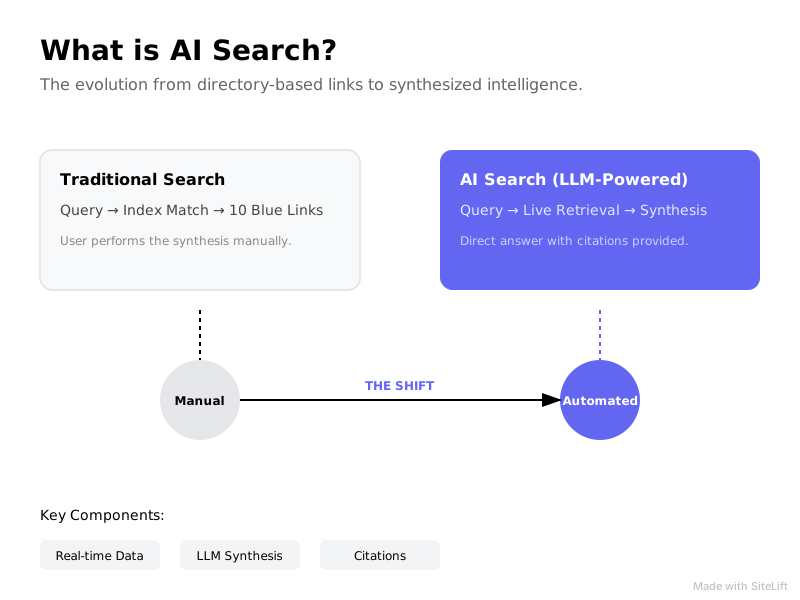
Infographic by SiteLift
Platform Comparison Matrix
| Feature / Dimension | Google AI Overviews | ChatGPT Search | Perplexity AI | Traditional Google Search |
|---|---|---|---|---|
| Primary Interface | Search Engine Results Page (SERP) | Conversational Chat Window | Answer Engine with Follow-up Prompts | 10 Blue Links + Rich Snippets |
| Output Type | Collapsible summary + classic links | Fully synthesized conversational prose | Multi-source synthesized research | Ranked list of indexed URLs |
| Citation Visibility | Source cards & expandable links | Inline numbered footnotes & source drawer | Prominent source carousel & superscript tags | External page titles and URLs |
| Ad Monetization | Heavy (Shopping, Sponsored Links, Text Ads) | Minimal / Subscription-first model | Premium tier + Sponsored follow-ups | Massive (Primary revenue engine) |
| Best Used For | Fast consumer lookups, local queries | Nuanced problem-solving, iterative writing | In-depth technical & academic research | Navigational queries (e.g., "login portal") |
Beyond Keywords: What Is AI Search Optimization and How Does GEO Work?
As user behavior shifts from clicking links to consuming synthesized answers, standard Search Engine Optimization (SEO) is evolving into Generative Engine Optimization (GEO).
SEO vs. GEO: Understanding the Fundamental Differences
Traditional SEO is obsessed with ranking positions. You optimize title tags, build backlink profiles, and adjust keyword frequency to secure positions 1 through 3 on a search results page.
GEO focuses on LLM search visibility and recommendation frequency. The objective is not necessarily to rank on a static list, but to be the definitive source that an LLM extracts, references, and recommends when synthesizing an answer.
Traditional SEO Goal:  Index Page ---> Rank in Top 3 ---> Win Organic Click
GEO Goal:              Feed Retrieval Agent ---> Get Ingested in Context Window ---> Earn Citation & Recommendation
How LLMs Select Sources for Inclusion and Quotation
A seminal GEO study published on arXiv by researchers from Princeton, Georgia Tech, and Allen AI revealed that generative engines favor specific structural and qualitative patterns. According to the research, incorporating authoritative statistics and citations can boost visibility in generative engine responses by up to 40%.
LLMs select and cite content based on predictable criteria:
- Statistical Backing: Content that supports claims with concrete figures and named attributions is cited far more often than generic advice.
- Topical Authority & Semantic Breadth: Engines evaluate whether a domain covers an entire topic cluster comprehensively rather than publishing isolated articles.
- Structured Quotability: Text organized into concise definitions, clean HTML tables, and clear bullet points matches the extraction algorithms of RAG pipelines.
Core GEO Optimization Basics for Digital Brands
If you want your brand cited by ChatGPT, Perplexity, and Google AI Overviews, you need to adjust your publishing strategy:
- Answer Questions Immediately: Use the "inverted pyramid" method. Deliver the direct answer in the first two sentences of a section before unpacking technical context.
- Publish Original Data: AI models love citing original research, benchmarks, and survey results because they represent authoritative ground truth.
- Structure Data with Tables: LLMs process tabular data cleanly. When comparing products, pricing, or workflows, use Markdown or HTML tables.
- Monitor Brand Citations Systematically: Traditional rank trackers only show whether your URL appears on Google page one. Modern strategies require dedicated AI search monitoring across ChatGPT and Perplexity to track brand sentiment and share of model.
- Build Entity Consistency: Ensure your brand’s name, services, and leadership are described consistently across third-party directories, industry publications, and digital PR channels so LLMs establish a clear knowledge-graph entity.
Pro Tip: Add an executive summary or bulleted key takeaways block directly below your article headings. LLM retrieval agents frequently ingest these summary blocks as high-confidence snippets for synthesis.
Key Takeaways: Traditional vs. AI Search
| Factor | Traditional Search (Google) | AI Search Engines (ChatGPT, Perplexity) |
|---|---|---|
| Core Mechanism | Indexing, keyword matching, PageRank | Semantic vector search, LLM reasoning, RAG |
| Output Style | Directory of links with metadata snippets | Unified natural language answer with citations |
| User Effort | High: User opens tabs and compares data | Low: Engine synthesizes data automatically |
| Commercial Model | Pay-per-click advertising & sponsored slots | Subscriptions, API tokens, and hybrid sponsored prompts |
| Optimization Method | Traditional SEO (Keywords, backlinks, technical crawl) | GEO (Entity authority, direct answers, citation hooks) |
Why The Disruption of Classic Search Is Long Overdue
Search engines have been broken for a long time. Over the past decade, traditional SERPs turned into cluttered minefields of sponsored ads, affiliate spam, and keyword-stuffed articles designed to game an algorithm rather than help a human. Getting a straight answer to a simple technical question often required scrolling past three screen lengths of ads and reading a blogger's life story.
AI search is not just a technological gimmick; it is an overdue correction. It puts the user's objective—finding an answer—back at the center of the experience.
Traditional publishers are understandably anxious about losing organic referral clicks to zero-click answers. But fighting the shift is futile. The internet has always moved toward lower friction. Winning brands will stop mourning the loss of the blue links and start engineering their content to become the trusted knowledge sources that AI engines rely on every day.
The brands that dominate the next decade of digital discovery won't be the ones that know how to game an algorithm. They will be the authoritative entities that AI engines cannot answer questions without. — sitelift.io
Scaling Your Brand's Authority in the Era of AI Search
Maintaining organic visibility across multiple search interfaces used to be straightforward: identify keywords, write posts, and build backlinks. In the generative era, you need to manage your presence across traditional Google, Google AI Overviews, ChatGPT Search, and Perplexity simultaneously.
Navigating this transition manually is resource-intensive. That is why modern marketing teams rely on autonomous platforms like SiteLift. SiteLift manages your entire search and AI engine visibility pipeline on autopilot.
By analyzing the semantic concepts and entities AI search engines look for, the platform automatically generates high-authority content, distributes it across curated networks, and synchronizes with your CMS. If you need the right features in an AI search tracking tool to monitor citations, or want to deploy autonomous search automation to grow organic reach, automating the pipeline ensures your brand stays visible no matter where users ask questions.
Frequently Asked Questions
What is the main difference between AI search and traditional search engines?
Traditional search engines return a ranked list of links pointing to external websites, requiring users to navigate pages and compile information manually. AI search engines retrieve live web data and synthesize it using large language models, delivering a direct, conversational answer with inline citations.
Will AI search engines replace Google completely?
AI search is unlikely to wipe Google out overnight, but it is dramatically altering how people use search. Google is actively transforming its own core interface through Google AI Overviews to keep pace. While traditional search will persist for quick navigational queries and e-commerce shopping, generative answers are rapidly becoming the standard for research, technical troubleshooting, and complex inquiries.
How do AI search engines choose which websites to cite?
AI search engines prioritize pages with high information density, clear semantic relevance, and strong topical authority. During Retrieval-Augmented Generation (RAG), the engine identifies passages that answer sub-queries directly. Content featuring verified statistics, structured data tables, and authoritative language is cited significantly more often than conversational filler.
What is GEO (Generative Engine Optimization) in SEO?
Generative Engine Optimization (GEO) is the practice of optimizing digital content so that AI search engines (like ChatGPT, Perplexity, and Google AI Overviews) select, quote, and cite your brand in synthesized responses. Unlike traditional SEO, which targets rank positions, GEO targets contextual inclusion and share of model inside AI responses.
How can businesses track their visibility in AI search engines?
Businesses can track AI visibility by auditing brand mentions, source citations, and recommendation sentiment across major platforms like ChatGPT Search, Perplexity, and Google AI Overviews. Because conventional rank trackers only monitor standard SERP positions, tracking AI presence requires specialized tools that measure whether your domain is referenced when users submit category-relevant prompts.
Topics Covered:
- what is ai search
- AI search engines explained
- generative search vs google
- LLM search visibility
- GEO optimization basics
More from SiteLift

SEO Programs Free: 9 Free Workflows to Audit, Plan and Publish Faster
Discover 9 powerful workflows using free SEO programs to audit technical health, track keywords, write content with AI, and automate your publishing.

Google AI Search Change: What SGE and AI Overviews Mean for Your Traffic
Understand the Google AI search change. Learn how SGE and AI Overviews impact organic traffic, zero-click searches, and how to optimize for LLM citations.

White Hat Link Building Techniques That Still Work for Google and AI Search
Discover 5 proven white hat link building techniques that earn top Google rankings and AI search citations. Master ethical link building today.