AI Search Monitoring: Track Brand Mentions Across ChatGPT, Perplexity and Google AI

For decades, search visibility meant one thing: tracking your position on a list of ten blue links. If a prospect typed "best payroll software for startups" and your website sat in position two, you won the click.
That playbook is unraveling. Today, buyers open ChatGPT to compare enterprise vendors, prompt Perplexity for stack recommendations, and digest Google AI Overviews without ever visiting a vendor site. If your brand is omitted from these answers—or worse, hallucinated as obsolete—you lose revenue before you even know a prospect was looking.
This shift makes ai search monitoring an urgent operational discipline. Traditional rank tracking tells you where your URL ranks on a static page; generative search monitoring tells you whether your brand exists in the synthesis that actually drives buyer decisions. Here is how modern brands can monitor, analyze, and optimize their presence across the generative web.
What Is AI Search Monitoring and Why Is It Critical for Modern Brands?
The Paradigm Shift: From Blue Links to Generative Synthesis
Search has transformed from an index retrieval model into an answer engine. When potential customers evaluate software, agency partners, or physical products, they no longer scan through dozens of individual websites. Instead, they interact with conversational interfaces that aggregate facts, compare alternatives, and recommend a shortlist within seconds.
According to research from SparkToro analyzing clickstream data from Datos, nearly 60% of Google searches now end without a click to the open web. As generative summaries become the primary interface across search engines, zero-click behavior will expand from informational lookups into high-value transactional queries. Furthermore, Gartner predicts that traditional search engine volume will drop by 25% by 2026 as users pivot toward AI chatbots and virtual agents.
When an artificial intelligence engine synthesizes the landscape, it does not display twenty competing links. It selects three or four clear winners, contextualizes them, and discards the rest. If you are not in that answer, you are invisible.
Defining LLM Brand Monitoring vs Traditional Rank Tracking
Traditional rank trackers poll search engine result pages (SERPs) for a defined target keyword and log the numerical coordinate of your domain name. It is a deterministic, linear metric.
LLM brand monitoring, on the other hand, evaluates probabilistic semantic outputs. Large Language Models (LLMs) do not rank documents; they predict the most coherent and helpful sequence of tokens based on their training parameters and real-time retrieval data.
| Feature | Traditional Rank Tracking | AI Search Monitoring |
|---|---|---|
| Primary Metric | Keyword position (1–100) | Share of Model (SoM), Share of Voice (SoV), Citation Frequency |
| Evaluation Object | Domain URLs and page titles | Entity relationships, brand sentiment, context accuracy |
| Output Type | Ordered list of web pages | Synthesized text answers, comparative tables, cited sources |
| Query Mechanism | Static keywords | Conversational prompts and multi-turn buyer journeys |
| Volatility Cause | Algorithm updates, link loss | RAG retrieval shifts, source consensus changes, weights |
Tracking your brand across AI engines requires observing whether your company is identified as a category entity, whether the model highlights your core value propositions, and which citations back up those claims.
The Business Impact of Unmonitored Brand Hallucinations
The commercial risk of failing to conduct continuous ai visibility tracking is not merely lost traffic—it is active brand damage.
LLMs frequently generate false information about products. An unmonitored model might inform an enterprise buyer that your platform lacks SOC 2 compliance, that your pricing is double its actual cost, or that your flagship feature was deprecated two years ago. Because users treat conversational models as objective authorities, these hallucinations directly derail deals.
A foundational report by McKinsey & Company noted that generative AI could add between $2.6 trillion to $4.4 trillion annually across global business use cases. A massive portion of that economic transfer happens at the discovery and procurement layer. When an AI hallucination misrepresents your offering, that capital flows directly to your competitors.
How Do Generative AI Search Engines Select and Cite Brand Mentions?

To track and influence brand mentions effectively, you must understand how generative engines assemble answers. The architecture dictates what gets cited and what gets ignored.
Pre-training Data vs Retrieval-Augmented Generation (RAG)
Generative models rely on two distinct layers of knowledge:
- Parametric Memory (Pre-training): Information baked into the model's neural network weights during training runs. This data changes infrequently and reflects massive crawls of Common Crawl, Wikipedia, and public internet archives.
- Retrieval-Augmented Generation (RAG): Real-time web lookups executed at the moment a user submits a prompt. The engine queries an underlying index, fetches top documents, feeds them into the model's context window, and synthesizes an answer supported by inline citations.
While historical brand presence in training sets builds foundational entity recognition, real-time citation frequency is driven almost entirely by RAG pipelines. If your brand dominates the sources pulled during real-time retrieval, you dominate the final output.
The Role of Entity Salience, Brand Authority, and Knowledge Graphs
LLMs think in terms of entities—distinct, identifiable concepts connected by relationships in a broader semantic web. When a user asks an AI engine for "top cloud cost optimization platforms," the model identifies the category entity and looks for brand entities with high semantic proximity.
Entity salience determines how central your brand is to a topic. Generative models gauge this by evaluating:
- Co-occurrence across authoritative sources: Are you consistently mentioned alongside industry leaders in editorial roundups?
- Knowledge graph validation: Does your brand exist as an established node across Wikidata, Google's Knowledge Graph, and industry registries?
- Sentiment consistency: Do credible third-party publications and review platforms validate your claims?
When an engine's RAG system finds high consensus across third-party sources, it assigns high confidence to including your brand in its answer.
Understanding Platform Differences: ChatGPT Search vs Perplexity vs Google AI Overviews
Not all generative engines retrieve information the same way. An effective monitoring strategy accounts for the specific retrieval and citation mechanics of each platform:
- ChatGPT Search: Built on OpenAI infrastructure, this engine blends internal search indexes with partner data to pull fresh citations. It prioritizes authoritative news sources, clear informational structure, and direct answers to nuanced, multi-part questions. Tracking chatgpt brand mentions requires monitoring conversational prompts that simulate complete buyer qualification workflows.
- Perplexity: Operating on its Sonar model family alongside open-source engines, Perplexity acts as an answer engine that cites multiple sources per paragraph. It draws heavily from live web searches, recent Reddit conversations, industry blogs, and technical documentation. Its citations change rapidly as fresh web content is published.
- Google AI Overviews: Integrated directly into search results, Google's Gemini-powered overviews draw primarily from Google’s primary web index. They heavily favor pages demonstrating high Information Gain, authoritative structured schema, and strong organic rankings across core SERPs, as detailed across industry coverage on Search Engine Land.
Understanding these variations is critical. A brand can hold a 70% share of voice on Perplexity while remaining completely absent from Google AI Overviews for the exact same query.
What Metrics Should You Track in AI Search Monitoring?
Evaluating AI visibility requires moving beyond single-keyword rankings to qualitative and structural metrics that reflect how generative engines communicate your brand identity.
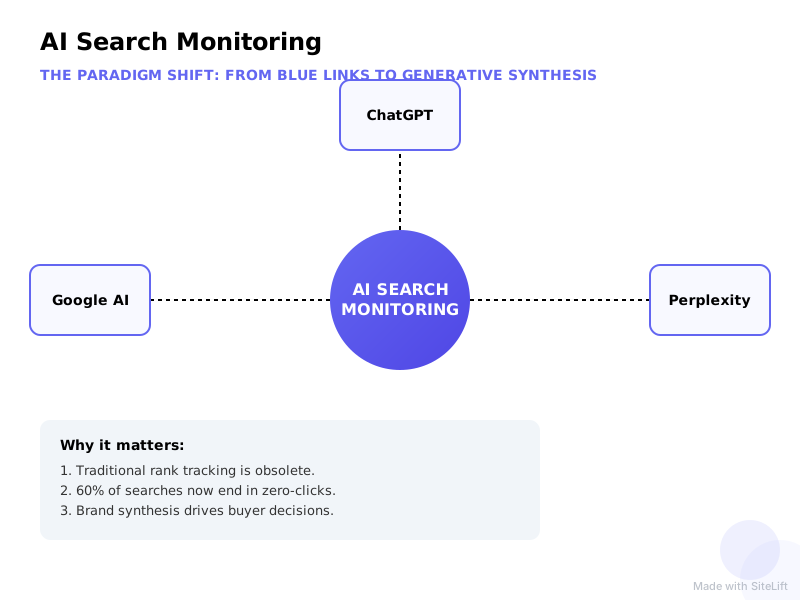
Infographic by SiteLift
Generative Share of Voice (SoV) and Prompt Penetration
Prompt Penetration measures the percentage of relevant category prompts that mention your brand in their output. If you run 100 enterprise buyer prompts regarding your software niche and your company appears in 45 of them, your penetration rate is 45%.
Generative Share of Voice (SoV) or Share of Model (SoM) goes a step further by measuring how much conversational real estate your brand occupies compared to direct competitors.
$$\text{Share of Model} = \left( \frac{\text{Brand Mentions Across Model Responses}}{\text{Total Competitor Mentions Across Model Responses}} \right) \times 100$$
Tracking this over time reveals whether model updates and content campaigns are expanding or shrinking your conversational footprint.
Citation Frequency and Source URL Provenance
A mention without a citation leaves the user stranded inside the model; a mention with a citation drives high-intent referral traffic.
Track:
- Raw Citation Count: The total number of times your domain is linked within generative answers.
- Source URL Provenance: The specific third-party pages the LLM cites to validate its mention of your brand. You will often find the model cites a software review directory, a niche trade publication, or a Reddit thread rather than your own homepage.
- Domain Diversity: The number of unique root domains referenced to support your brand's authority.
Pro Tip: Pay closer attention to the third-party URLs being cited than your own site. If an AI engine repeatedly cites a specific third-party comparison article when recommending your competitor, securing placement in that specific article is the fastest way to earn that citation for yourself.
Sentiment, Recommendation Positioning, and Competitive Context
Unlike blue links, an AI mention can be outright negative or secondary. Your monitoring program must evaluate:
- Recommendation Order: Are you recommended as the premier solution ("Top choice"), an alternative ("Other options include"), or a budget compromise?
- Semantic Sentiment: Does the model describe your product as "robust, scalable, and intuitive" or "clunky, difficult to implement, and expensive"?
- Head-to-Head Win Rate: In prompts asking the AI to compare your product directly against a competitor, which entity does the model recommend for specific enterprise use cases?
Key Takeaways: Traditional SEO vs. AI Search Monitoring
Before building out your monitoring workflow, review this summary of how traditional organic search and generative search tracking diverge:
| Operational Dimension | Traditional SERP Monitoring | AI Search Monitoring |
|---|---|---|
| Primary Goal | Rank #1 to capture high organic CTR | Secure primary recommendation & citation in synthesized answers |
| Target Query Type | Short, high-volume keywords | Long-tail, conversational, multi-intent prompts |
| Data Volatility | Moderate; tied to periodic algorithmic updates | High; models dynamically balance citations per prompt run |
| Key Competitive Metric | Keyword Rank & Organic Traffic Share | Share of Model (SoM) & Recommendation Win Rate |
| Optimization Focus | On-page SEO, backlinks, technical crawlability | Entity authority, knowledge graph consensus, digital PR, forum sentiment |
| Measurement Tooling | Standard rank trackers and Google Search Console | Dedicated LLM visibility tool platforms |
An Editorial Perspective: Why Entity Consensus Is Hugely Underrated
Most marketing teams tackling Generative Engine Optimization (GEO) are repeating the mistakes of early-2000s SEO: they are obsessing over technical hacks and prompt tricks while ignoring the underlying architecture.
The secret to winning generative visibility isn't hiding semantic markup in your footer or stuffing keywords into headers. It is entity consensus.
LLMs are fundamentally consensus engines. When a user asks an AI engine for a recommendation, the underlying retrieval mechanism scans dozens of external publications, user forums, and industry databases. If your website claims you are the "easiest enterprise tool to deploy," but five Reddit threads and three independent software reviews describe your onboarding as a nightmare, the LLM will synthesize the consensus—not your marketing copy.
Too many teams waste time tracking whether their homepages show up in AI search results while completely neglecting the broader media ecosystem that informs the AI's training and RAG data. The brands that will dominate generative search over the next decade are those that curate widespread, verified agreement across the entire web.
Winning AI visibility requires shifting from single-page ranking to comprehensive ecosystem dominance. — sitelift.io
Step-by-Step: How to Implement an AI Search Monitoring Workflow
Building a systematic approach to generative search monitoring requires moving away from ad-hoc manual queries toward a structured tracking engine. Here is the operational blueprint.
+---------------------------------------------------------+
| Step 1: Map Buyer Intent Prompts                        |
| Define discovery, evaluation, and comparative taxonomies|
+----------------------------+----------------------------+
                             |
                             v
+---------------------------------------------------------+
| Step 2: Automate Multi-Model Tracking                   |
| Run daily batch tests across ChatGPT, Perplexity & Google|
+----------------------------+----------------------------+
                             |
                             v
+---------------------------------------------------------+
| Step 3: Analyze Provenance & Reverse-Engineer Citations |
| Map cited URLs, identify content gaps & Digital PR targets|
+---------------------------------------------------------+
Step 1: Mapping Core Buyer Intent Prompts and Categorical Taxonomies
Do not monitor keywords; monitor the exact questions high-intent buyers ask AI assistants. Categorize your tracking taxonomy into three distinct tiers:
- Category Discovery Prompts: Broad exploratory queries used by prospects identifying the market.
- Example: "What are the most reliable automated data pipelines for healthcare organizations?"
- Comparative & Evaluation Prompts: Middle-of-the-funnel prompts weighing specific alternatives.
- Example: "Compare Platform A vs Platform B for a mid-market e-commerce company. Which has lower total cost of ownership?"
- Constraint-Driven Qualification Prompts: Highly specific queries addressing technical requirements, integrations, or operational limitations.
- Example: "Which AI visibility tools offer direct API access and SOC 2 Type II compliance?"
For a detailed breakdown of building a high-impact prompt battery, review our prompting guide for brand visibility.
Step 2: Automating Multi-Model Prompt Execution and Data Collection
Manually pasting prompts into ChatGPT or Perplexity is unsustainable. Because generative engines return non-deterministic responses, a single manual prompt does not provide a statistically valid sample.
To automate collection:
- Establish Run Cadences: Run your core prompt battery at least weekly across ChatGPT Search, Perplexity Sonar, and Google AI Overviews.
- Control Temperature and Parameters: When using APIs for monitoring, maintain consistent model temperatures (e.g., 0.2 to 0.5) to balance creativity and deterministic consistency.
- Capture Raw Outputs: Store full response texts, cited URLs, and metadata to identify sentiment shifts and brand deprecation trends over time.
Teams looking to scale this operational infrastructure can integrate dedicated tools or review our guide on automated SEO monitoring to run tracking pipelines alongside standard rank tracking.
Step 3: Analyzing Citation Sources to Identify Digital PR Gaps
Once data is gathered, aggregate every external URL cited across your prompt battery.
Sort these citations by frequency:
- Which media sites, comparison roundups, or directories appear in 80% of generative responses?
- Is your brand included, cited, or linked within those specific third-party pages?
If an industry publication appears in half of Perplexity's responses for your target prompts, securing editorial inclusion on that page will immediately boost your AI visibility. This turns AI monitoring into an actionable digital PR roadmap.
How to Improve and Protect Your Brand Visibility Across AI Engines
Monitoring is only half the battle; the real value comes from turning those insights into defensive and offensive market authority.
Entity-First Content Optimization and Digital PR Syndication
To make it effortless for LLMs to extract, categorize, and cite your brand:
- Implement Explicit Structured Data: Use detailed Organization, Product, and TechArticle schema markup. Clearly define your company's name, parent entity, founders, and core software categories.
- Publish Objective, Fact-Dense Content: LLMs prioritize clear informational density over promotional marketing fluff. Structure articles with concise definitions, clear comparative tables, and data-backed claims that RAG systems can quote as factual answers.
- Syndicate to Authoritative Platforms: Regularly contribute verified thought leadership and research to authoritative industry hubs that LLM web crawlers continuously index.
Pro Tip: Include concise FAQ sections on core landing pages that directly answer common transactional queries using simple, declarative language. RAG retrieval algorithms extract direct, self-contained paragraphs far more easily than fragmented text spread across multiple design modules.
Managing Forum Presence: Reddit, Quora, and Industry Community Signals
Generative search engines heavily weight unvarnished, community-driven discussions. Google’s partnership with Reddit and Perplexity’s preference for user forums mean that candid peer reviews frequently bypass corporate marketing to dictate AI answers.
- Audit Community Sentiment: Regularly track mentions of your product across Reddit subreddits and developer forums.
- Engage Transparently: Encourage your product advocates and technical teams to participate in community discussions, answering troubleshooting questions and correcting factual inaccuracies.
- Address Negative Feedback Publicly: If customers encounter bugs or pricing issues, respond openly with solutions. Generative engines ingest both the criticism and the resolution; an unresolved complaint is far more likely to feed a negative brand hallucination.
Autonomous Content Engine Scaling to Own the Information Ecosystem
To consistently influence AI search engines, you cannot publish one or two blog posts a month and expect to outpace competitors. Generative algorithms demand comprehensive topic coverage across hundreds of long-tail permutations.
This is where autonomous publishing pipelines transform visibility. By systematically producing targeted, expert-level content and distributing it across a verified network of authoritative publication hubs, platforms like SiteLift help brands establish categorical authority on autopilot.
Instead of manually fighting for every mention, an autonomous engine compounds your footprint across both traditional search indexes and generative RAG pipelines, ensuring that whenever an AI model queries the web for answers in your niche, your brand is the consensus authority it finds.
FAQ
What is the difference between traditional SEO tracking and AI search monitoring?
Traditional SEO tracking measures a specific URL’s rank on a search engine results page for a fixed keyword string. AI search monitoring tracks whether your brand entity is mentioned, recommended, or cited inside dynamically synthesized paragraphs generated by models like ChatGPT, Perplexity, and Google AI Overviews. It measures entity share of voice, sentiment, and cited source URLs rather than simple positions.
Can ChatGPT, Perplexity, and Google AI Overviews show different citations for the same query?
Yes. Each platform uses distinct retrieval architectures, index fresh-rates, and RAG weighting algorithms. Perplexity heavily incorporates recent forum threads and news articles, ChatGPT Search relies on specific media partnerships and proprietary indexing, and Google AI Overviews pull directly from Google’s primary web index. A brand may dominate citations on Perplexity while remaining absent on Google.
How often do LLM brand mentions and citations change?
Because generative search engines use real-time retrieval for commercial queries, citations and mentions can change daily or even hourly depending on web updates, indexing speed, and model re-ranking. Tracking should be run on a consistent weekly or automated daily cadence to capture meaningful trends and shifts.
What is Generative Engine Optimization (GEO) and how does it relate to monitoring?
Generative Engine Optimization (GEO) is the practice of optimizing content, digital PR, and semantic entities to increase visibility within AI-generated responses. AI search monitoring is the diagnostic feedback loop for GEO; it provides the empirical data needed to verify whether your optimization efforts are actually increasing your share of model and citation frequency.
Can you remove incorrect or negative brand information generated by an LLM?
You cannot directly edit an LLM's neural network weights. However, because commercial engines rely heavily on Retrieval-Augmented Generation, you can correct hallucinations by addressing the source material. Identify the third-party websites the model cites to support the incorrect claim, reach out to have those pages updated, and publish clear, authoritative corrections on your own high-authority channels to establish new consensus.
Topics Covered:
- ai search monitoring
- llm brand monitoring
- ai visibility tracking
- chatgpt brand mentions
- generative search monitoring
More from SiteLift

LLM Visibility Tool: How to Measure and Grow Your Brand in ChatGPT and Perplexity
Discover how to use an LLM visibility tool to monitor ChatGPT brand mentions, track Perplexity citations, and scale your AI share of voice.

Visibility Tracker Explained: Measure True Share of Voice Across Google and AI Search
Discover how a visibility tracker measures search visibility scores and share of voice across Google and AI search engines to compound your organic reach.

White Hat Link Building Techniques That Still Work for Google and AI Search
Discover 5 proven white hat link building techniques that earn top Google rankings and AI search citations. Master ethical link building today.