SEO Monitoring in 2026: How to Track Rankings, Site Health and AI Visibility on Autopilot

Setting up an effective seo monitoring strategy used to mean opening a spreadsheet once a week, pulling ranking positions from a standard rank tracker, and checking if your homepage was still indexed. That passive approach no longer works.
Search ecosystems undergo continuous algorithmic adjustments, while AI answer engines directly answer user queries inside LLMs like ChatGPT, Perplexity, and Google Gemini. If your site experiences a rogue noindex tag, a sudden drop in Core Web Vitals, or a shift in how AI engines summarize your brand, relying on delayed manual checks will cost you traffic and revenue long before you notice the issue.
Modern seo monitoring requires an automated, continuous feedback loop. It combines real-time technical health checks, organic traffic anomaly detection, and generative search visibility tracking—allowing you to detect and fix issues automatically.
Key Takeaways
| Monitoring Pillar | Core Metric / Focus | Critical Risk Mitigated | Automation Goal |
|---|---|---|---|
| Technical Site Health | Canonical tags, status codes, Core Web Vitals, indexability | Silent traffic wipeouts from technical bugs | Real-time alerts & instant programmatic fixes |
| Organic SERP Performance | Rank shifts, impression dips, CTR anomalies | Unnoticed algorithm updates or competitor gains | Daily anomaly detection via GSC API integration |
| AI Search Visibility | LLM citations, brand sentiment, answer engine share of voice | Complete erasure from conversational AI results | Real-time prompt monitoring across LLM networks |
| Autonomous Remediations | Content freshness, link health, CMS sync | Content decay and slow manual execution | Automated publishing and content refreshes |
What is Modern SEO Monitoring and Why Has It Shifted?
Traditional search tracking was built for a static web. Marketers published a piece of content, waited weeks for Google’s crawlers to index it, and tracked keyword positions on a linear rank tracker.
That model broke. Modern search engines evaluate thousands of real-time signals, while answer engines summarize web content directly for users without requiring a traditional SERP click.
Moving Beyond Passive Weekly Rank Tracking
Relying on weekly PDF reports creates dangerous blind spots. If a deployment mistake adds a disallow rule to your robots.txt file on Monday morning, waiting until your Friday audit means losing five full days of indexation.
According to data from Ahrefs, 90.63% of all web pages receive zero search traffic from Google. A primary reason pages fail to gain or maintain search volume is that critical technical errors and content decay go unnoticed for months.
Continuous seo monitoring transforms your posture from reactive troubleshooting to immediate threat prevention. Instead of asking "Why did our traffic drop last month?", automated systems tell you "A canonical tag changed 10 minutes ago on your top revenue page—here is the fix."
Legacy Monitoring:   [Issue Occurs] ---> (Wait 7-30 Days) ---> [Manual Audit] ---> [Manual Fix]
Modern Autopilot:    [Issue Occurs] ---> (Instant Alert)  ---> [Automated Pipeline Fix]
The Triad of Modern Search: Rankings, Site Health, and AI Visibility
To maintain search market share today, your tracking stack must monitor three distinct layers simultaneously:
- Traditional SERP Rankings: Tracking rank positions, rich snippet ownership, and SERP feature shifts across desktop and mobile.
- Technical Website Health: Auditing site availability, status codes, Core Web Vitals, renderability, and indexation status continuously.
- AI Search Visibility: Tracking how generative engines cite, reference, and frame your products when users ask conversational queries.
According to research by Gartner's market analysis, traditional search engine volume is projected to drop 25% by 2026 due to the mass adoption of AI chatbots and virtual agents. If your team only tracks standard blue links on Google, you are blind to a quarter of your potential search audience.
What Are the Key Pillars of an Automated SEO Monitoring System?
Building an automated seo monitoring stack requires setting up specialized tracking across technical health, organic traffic telemetry, and AI engine outputs.
Technical Website Health Monitoring for SEO
Technical errors kill organic visibility faster than any competitor campaign. When search crawlers encounter server timeouts, broken internal redirect chains, or misconfigured international tags, search algorithms downgrade your domain’s reliability.
Your website health monitoring for seo must monitor:
- Indexation & Directives: Tracking
noindexinjections, changes torobots.txt, and unintendedcanonicalupdates. - Response Codes & Uptime: Catching 4xx and 5xx response code spikes across high-priority landing pages instantly.
- Core Web Vitals: Measuring Largest Contentful Paint (LCP), Interaction to Next Paint (INP), and Cumulative Layout Shift (CLS) against real user metrics.
Performance directly impacts search performance and user conversion. Per research published in Google's web.dev guidance, as page load time goes from 1 second to 3 seconds, the probability of a bounce increases by 32%.
Automated site health monitors check technical assets hourly, alerting engineering and marketing teams before performance degradations harm your search rankings.
Organic Traffic Monitoring & Search Console Anomaly Detection
Rankings tell only half the story; actual organic sessions and click-through rates (CTR) complete the picture. Algorithmic shifts often impact search impressions before keyword positions explicitly reflect the change.
By integrating directly with the Google Search Console API and Google Analytics 4, organic traffic monitoring systems establish statistical baselines for your site performance.
When impressions drop below a expected standard deviation for a given day of the week, the monitor flags an anomaly.
Expected Impression Band:  =======================  (Normal trend)
Actual Impressions:       ---------\_________      (Anomaly Triggered!)
This rapid signal detection allows you to isolate whether a traffic dip is caused by a site-wide technical issue, a targeted algorithm update, or seasonal search behavior.
AI Search Visibility Monitoring Across LLMs
Generative engine optimization (GEO) requires tracking your presence inside non-traditional search interfaces like ChatGPT, Perplexity, Claude, and Gemini.
Unlike traditional SERPs with fixed rankings from positions 1 through 10, LLMs generate dynamic answers based on underlying training sets and real-time web retrieval.
An automated ai search visibility monitoring framework periodically executes contextual prompts across target LLM engines to evaluate:
- Citation Share: How frequently your domain is linked as a primary source in AI-generated answers.
- Brand Sentiment & Accuracy: Whether LLMs accurately describe your value proposition or recommend direct competitors instead.
- Anchor Prompts: Which specific user prompts trigger your brand as a recommended solution.
If your organization wants to scale its presence across LLMs, deploying a specialized LLM visibility tool provides real-time brand mention tracking and citation management.

How Do You Set Up Automated SEO Monitoring on Autopilot?
Transitioning from manual tracking to an automated growth and monitoring loop involves three practical implementation steps.
Step 1: Set Threshold Alerts  ===>  Step 2: Intent-Based Tracking  ===>  Step 3: Auto-Publishing Loop
(Slack/Webhook Triggers)          (SERP + LLM Prompts)                (Real-time CMS Updates)
Step 1: Configuring Real-Time Alerts for Critical Site Changes
Not every site change requires an urgent late-night alert. Effective automated seo monitoring relies on tiered threshold alerting to prevent notification fatigue while catching site-critical emergencies.
- Tier 1 (Critical - Instant Slack/SMS Alert): Any core landing page switching to
noindex, globalrobots.txtblocking search crawlers, or 5xx server error spikes exceeding 2% of total traffic. - Tier 2 (High Priority - Daily Email Digest): Core Web Vitals dropping from "Good" to "Needs Improvement," single-page keyword ranking drops of 5+ positions for primary terms.
- Tier 3 (Low Priority - Weekly Summary): Minor impression fluctuations on secondary blog posts, loss of non-converting long-tail rankings.
Pro Tip: Route Tier 1 technical alerts directly to your engineering team's Slack or PagerDuty channel, while routing content decay alerts to your publishing editorial team. Separating technical remediation from content strategy speeds up fix times.
Step 2: Automating Keyword and Generative Engine Citation Tracking
Group your tracked keywords by search intent rather than dumping them into a single list. Organize terms into distinct buckets:
- Transactional / High-Intent: Terms directly tied to revenue conversions.
- Informational / Top of Funnel: Educational terms that build audience authority.
- Generative Prompts: Conversational queries users input into AI chatbots (e.g., "What is the best automated SEO platform for enterprise websites?").
Setting up programmatic tracking via a dedicated rank tracker API lets you feed ranking data directly into custom analytics dashboards, combining Google SERP tracking with real-time generative engine response monitoring.
Step 3: Connecting Technical Signals to Autonomous Publishing Pipelines
Monitoring by itself does not fix problems—it simply highlights them. The real breakthrough in modern search strategy is connecting monitoring data directly to execution pipelines.
When an automated monitor detects content decay (e.g., a high-converting page losing organic impressions over 90 days), the system shouldn't just send an email. It should trigger an automated workflow:
- Analyze competing pages currently taking top positions on Google.
- Identify missing subtopics, outdated citations, or schema markup gaps.
- Generate an updated draft or schema enhancement.
- Push updates directly to your CMS via API to restore content freshness automatically.
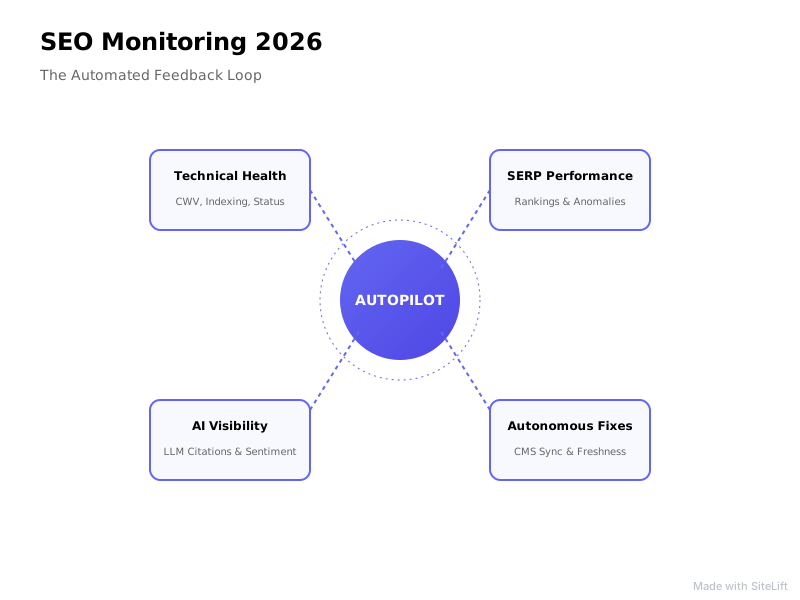
Infographic by SiteLift
Technical Feature Comparison: Monitoring Approaches
| Feature / Capabilities | Manual Auditing | Standalone Uptime Trackers | Autonomous Growth & SEO Platforms |
|---|---|---|---|
| Crawl Frequency | Monthly or Quarterly | Every 5-15 Minutes | Continuous / Real-Time |
| AI Visibility Tracking (LLMs) | Manual Prompts | Not Supported | Native Multi-LLM Citation Audits |
| Core Web Vitals Telemetry | Single Spot-Checks | Basic Ping Audits | Continuous Field & Lab Data Checks |
| Action Automation | None (Manual Tickets) | Notifications Only | Automated Publishing & CMS Sync |
| Developer API Access | No | Limited | Full REST API & Webhook Integrations |
How to Choose the Right SEO Monitoring Tools for Your Stack?
Selecting modern seo monitoring tools requires moving past basic keyword desktop tracking. You need a platform that integrates directly with your existing infrastructure and supports both classic search engine needs and AI search discovery.
Essential Features in Next-Gen SEO Monitoring Platforms
When evaluating platforms, ensure your selection fulfills these essential requirements:
- Multi-Engine Capabilities: Tracks legacy engines (Google, Bing) and AI search platforms (ChatGPT Search, Perplexity, Gemini) in one unified dashboard.
- Direct CMS Integration: Connects seamlessly with systems like WordPress, Webflow, Shopify, or headless environments to push updates automatically.
- Granular Crawling & JS Rendering: Executes client-side JavaScript rendering to ensure single-page applications (SPAs) are evaluated exactly as Googlebot sees them, adhering to official Google Search Central documentation.
- Custom Threshold Alerting: Flexible webhooks that integrate with internal tools (Slack, Teams, Jira) without spamming team members.
Point Solutions vs. End-to-End Autonomous Engines
Many engineering teams try to stitch together four different point solutions: an uptime monitor, a traditional rank tracker, a site crawler, and an AI prompt tracker.
While point solutions solve narrow problems, they create data silos. An uptime monitor won't tell you that a site migration ruined your canonical hierarchy, and a standard rank tracker won't tell you why an LLM stopped citing your primary product pages.
End-to-end platforms replace disparate tools with a single continuous operational loop. They monitor technical health, detect search anomalies, measure AI citation frequencies, and immediately execute content updates to protect organic visibility.
Teams looking to catch algorithm changes instantly can leverage daily rank tracking to react to search shifts before competitors even notice a drop.
What Is the Future of Search Visibility and Predictive SEO Monitoring?
The future of search optimization is moving from reactive tracking to predictive analytics. Instead of waiting for a traffic drop to register in your analytics dashboard, machine learning models can predict visibility loss before it damages revenue.
Predictive Impact Scoring Before Traffic Drops Occur
Predictive monitoring models analyze leading indicators to forecast ranking shifts:
- Internal Link Velocity: Tracking drops in internal link equity when new pages are published without proper contextual linking.
- Content Decay Velocity: Identifying pages where search impressions are trending downward, predicting complete ranking drops weeks in advance.
- SERP Layout Shifts: Detecting when Google introduces new AI Overviews or video carousels above organic listings, estimating CTR losses before sessions fall off.
Predictive Signal (Impression Shift) ---> AI Decay Forecast ---> Auto Content Refresh Executed
By scoring pages based on decay vulnerability, enterprise websites can automatically queue up updates, preventing traffic losses entirely.
The Rise of Generative Engine Optimization (GEO) Benchmarks
As search shifts toward conversational interfaces, measuring search performance requires brand-new KPIs:
- Generative Share of Voice (gSOV): The percentage of AI-generated answers within your sector that include your brand versus your direct competitors.
- Citation Position: Whether your brand is cited as the primary recommendation or listed as a secondary alternative.
- Entity Association Strength: How strongly LLM models associate your brand name with key category topics.
Establishing baselines for these metrics now ensures your site maintains visibility as generative search continues to evolve.
Why Passive Monitoring Is Dead (An Editorial Perspective)
Let’s be honest about the state of search optimization today: if your monitoring strategy relies on human eyes logging into a tool, reviewing alerts, writing Jira tickets, and waiting for a developer sprint to deploy a fix, you are playing a losing game.
Search engine algorithms update thousands of times per year. Generative AI models retrain and update their web indexes constantly. Technical deployments happen daily across modern engineering pipelines.
In this environment, passive alert dashboards are useless. Knowing your site lost 20% of its organic traffic three weeks ago doesn't help you preserve revenue today.
We believe the future belongs entirely to autonomous growth systems. Monitoring should not end with an email notification—it must be directly connected to an execution pipeline capable of publishing content updates, resolving technical errors, and managing citations automatically.
Data without action is noise. The best search strategies don't just track changes; they resolve them automatically.
Build an Autonomous SEO & AI Visibility Pipeline with SiteLift
Monitoring search rankings and site health manually is no longer sustainable. To scale organic traffic and maintain brand dominance across both Google SERPs and generative AI platforms like ChatGPT and Perplexity, you need an automated system that operates 24/7.
SiteLift provides an autonomous SEO and AI visibility platform that turns search tracking into automated execution.
Instead of forcing your team to audit spreadsheets and draft tickets manually, SiteLift:
- Monitors Site Health & Performance: Continuous real-time detection of indexation errors, canonical issues, and performance drops.
- Tracks AI & SERP Share of Voice: Measures keyword rankings and LLM citation frequency in real time.
- Automates Content Growth & Fixes: Automatically generates, optimizes, and publishes targeted content updates across your native CMS to capture missing market share.
- Distributes Across Premium Networks: Compound domain authority on autopilot via curated distribution channels.
Stop reacting to traffic losses weeks after they happen. Let your search strategy run on autopilot while you focus on scaling your business.
Explore SiteLift's Autonomous Growth Engine Today
— sitelift.io
Frequently Asked Questions About SEO Monitoring
What is the difference between traditional rank tracking and complete SEO monitoring?
Traditional rank tracking measures keyword positions on search engine result pages (SERPs) at set intervals. Complete seo monitoring goes far beyond rank positions—it continuously tracks site health, indexation status, Core Web Vitals, organic traffic anomalies, and brand citations across generative AI engines like ChatGPT and Perplexity.
How does automated website health monitoring protect my organic traffic?
Automated website health monitoring for seo audits your site continuously for critical technical bugs—such as accidental noindex directives, broken canonical links, 5xx server errors, or web speed drops. Catching these issues instantly prevents search crawlers from deindexing your pages and dropping your organic rankings.
How can businesses track their brand visibility in AI engines like ChatGPT and Perplexity?
Businesses can track AI visibility by deploying prompt monitoring tools that evaluate how conversational LLMs answer industry queries. These systems measure your brand's citation frequency, sentiment accuracy, and share of generative voice compared to competitors inside AI search interfaces.
How frequently should automated SEO monitoring tools audit a website?
Critical technical parameters (uptime, canonical tags, robots.txt, status codes) should be audited in real time or hourly. Organic traffic anomalies and keyword ranking fluctuations should be evaluated daily, while comprehensive site architecture and content decay audits can run weekly.
Topics Covered:
- seo monitoring
- automated seo monitoring
- seo monitoring tools
- website health monitoring for seo
- ai search visibility monitoring
- organic traffic monitoring
More from SiteLift

White Hat Link Building Techniques That Still Work for Google and AI Search
Discover 5 proven white hat link building techniques that earn top Google rankings and AI search citations. Master ethical link building today.

Ecommerce Link Building: Scale Product Authority and Revenue on Autopilot
Master ecommerce link building. Learn how to secure product page backlinks, execute digital PR, fix redirect leaks, and automate your store authority.

Crawling in SEO: How Google and AI Bots Discover and Rank Your Pages
Master crawling in SEO. Learn how Googlebot and AI scrapers discover pages, compare indexing vs crawling, and optimize your crawl budget.