Link Building Examples That Earned Real Authority (And How to Replicate Them)

Most guides showcasing link building examples recycle the exact same theoretical tactics: pitch a guest post, scan for a 404 error on an obscure directory, or send five hundred cold emails hoping for a single unlinked brand mention.
In practice, those manual approaches yield diminishing returns. High-growth brands do not build thousands of tier-one backlinks by begging webmasters for favors. Instead, they engineer linkable assets that compel journalists, creators, and analysts to reference them organically.
We evaluated dozens of link building campaigns across enterprise SaaS, consumer tech, and high-growth startups to isolate what actually drives compounding search visibility. Below, you will find five world-class campaigns, complete with their operational mechanics, psychological triggers, and actionable blueprints to adapt them for your own growth pipeline.
How We Evaluated These High-Authority Link Building Examples
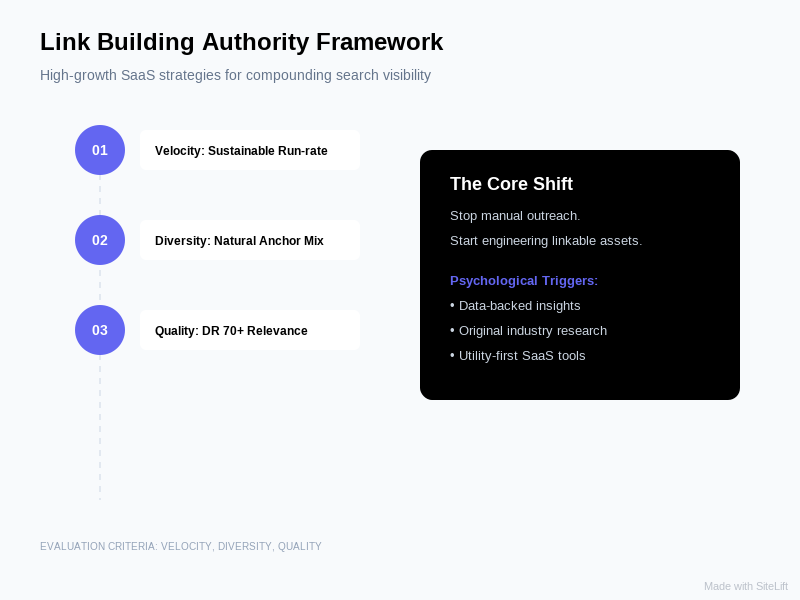
To filter out one-hit wonders from durable authority engines, we judged each campaign against three strict criteria rather than sheer link count.
Core Selection Criteria: Velocity, Diversity, and Referring Domain Quality
A spike of two hundred forum links might temporarily nudge a metric, but it does nothing for sustainable search dominance. Our evaluation focused on:
- Referring Domain Quality: Links originating from topically relevant platforms with established domain authority (DA/DR 70+) and genuine search traffic.
- Link Acquisition Velocity: The asset's ability to maintain a steady monthly run-rate of incoming links long after its initial publication date.
- Anchor Text Diversity: A natural mix of branded, URL, and contextual semantic anchors that protect against algorithmic penalties.
According to research from Ahrefs, 66.5% of links to sites in the last nine years are dead or broken. The campaigns featured here defy that decay curve; they earn durable, evergreen equity that compounds month over month.
Passive Link Earning vs. Active Content Distribution
There is a fundamental difference between manual link building and systemic link earning. Manual outreach burns engineering and marketing hours on transactional link exchanges. Link earning, by contrast, relies on high-utility assets that rank for "source queries"—searches performed by writers looking for statistics, calculators, or industry benchmarks.
Pairing these assets with structured content marketing for link building creates a flywheel: your content secures tier-one placements, these placements boost organic search visibility, and higher rankings attract more passive citations from creators across the web.
1. HubSpot's Industry Benchmark Reports (Original Data & Proprietary Research)
What It Is
HubSpot's annual State of Marketing and State of Sales reports are comprehensive industry studies compiling data from thousands of global business professionals, paired with anonymized platform usage trends.
- Who it's best for: Established B2B companies with existing user bases, customer lists, or proprietary transactional data.
- Standout strength: Unrivaled longevity. A single annual report continues earning citations for two to three years after release.
- Main drawback: High initial production cost, demanding multi-team coordination across data science, design, and content.
The Campaign Mechanics & Link Asset
HubSpot packages its survey findings into an interactive, ungated landing page alongside a downloadable executive PDF. Crucially, they extract every striking data point into standalone visual charts with simple embed codes and tweetable summaries.
Whenever a content creator writes an article about conversion rates, social media ROI, or sales outreach velocity, HubSpot's report ranks at the top of Google for those statistical queries. As a result, journalists from Forbes, Fast Company, and thousands of niche blogs cite the report as their primary source.
Why It Earned Authority (The Psychology)
Writers and journalists are on tight deadlines. They cannot run proprietary surveys to validate an assertion; they must cite an authoritative third party to maintain editorial credibility.
An extensive analysis of 912 million blog posts by Backlinko confirmed that content containing original research and data generates 3.2x more backlinks than standard opinion or how-to content. When you become the creator of primary data, you capture the highest layer of citation intent.
Step-by-Step Replication Blueprint
- Identify the Core Question: Determine the unverified claims people make in your industry. What metrics do writers cite without having a definitive, recent source?
- Collect Primary Data: Survey your customer base, aggregate anonymized telemetry from your software, or partner with a niche community to collect 500+ responses.
- Isolate 5 to 7 "Hero Stats": Format these as punchy, counterintuitive data points (e.g., "64% of outbound sales reps spend less than two hours a day selling").
- Build a Dedicated Statistics Hub: Instead of burying your numbers in a gated PDF, present every key stat in plain HTML with accompanying charts so search bots and writers can index them immediately.
2. CoSchedule's Headline Studio (Interactive Tools & Free SaaS Utilities)
What It Is
CoSchedule created a lightweight, browser-based tool called the Headline Analyzer (now Headline Studio) that scores blog and newsletter titles on readability, emotional sentiment, and search impact.
- Who it's best for: SaaS companies capable of stripping down one core software feature into an ungated, web-based utility.
- Standout strength: Ridiculously high viral loops and natural inclusions in curated listicles.
- Main drawback: Attracts broad, top-of-funnel users who may have a low conversion rate to paid product tiers.
The Campaign Mechanics & Link Asset
Rather than writing another tactical guide on "How to Write Catchy Headlines," CoSchedule built an interactive calculator. Users paste a headline, receive a numerical score from 1 to 100, and get actionable recommendations to improve it.
Because the tool delivers instant, repeatable utility, it became the default recommendation across university syllabi, agency onboarding docs, and marketing resource lists worldwide.

Why It Earned Authority (The Psychology)
Curators of resource roundups are constantly looking for practical utilities that make their guides more valuable to readers. Linking to a how-to post feels redundant; linking to a functional tool provides real utility.
A study by Siege Media found that interactive content and tool-based assets generate backlinks at a 42% lower cost per link compared to traditional cold outreach pitching. Tools solve problems faster than text, earning bookmarks, direct shares, and permanent resource page citations.
Pro Tip: Never gate your interactive tool behind a mandatory sales demo. Allow users to test it at least once without an account to remove friction and encourage immediate bookmarking.
Step-by-Step Replication Blueprint
- Audit Repetitive Workflow Bottlenecks: Identify a calculation, assessment, or repetitive formatting task your target audience performs manually in spreadsheets.
- Build a Zero-Friction Utility: Create an ungated single-page application (SPA) using frameworks like Next.js or embeddable JavaScript that delivers an answer in seconds.
- Incorporate Shareable Outputs: Provide users with a visual grade, badge, or unique summary link they can share with their colleagues or post on social media.
- Target Resource Hubs: Pitch your tool directly to universities, industry libraries, and authors of established "Best Tools for [Niche]" articles.
3. Wise's Cross-Border Living Index (Digital PR & Data-Led Newsjacking)
What It Is
Wise (formerly TransferWise) regularly develops dynamic public data indexes comparing global cost-of-living metrics, hidden bank remittance fees, and currency conversion losses for digital nomads.
- Who it's best for: FinTech, travel, consumer tech, and real estate brands that intersect with macroeconomic shifts.
- Standout strength: Attracts mainstream national news citations (BBC, Bloomberg, Business Insider) with high domain authority.
- Main drawback: Link velocity relies on short news cycles, requiring rapid iteration and timely media outreach.
The Campaign Mechanics & Link Asset
Wise leverages both its proprietary transaction datasets and publicly available economic tables to calculate exactly how much money expats and remote workers lose when moving between major global hubs.
When global inflation spikes or remote work trends dominate national headlines, Wise releases localized reports tailored to individual media markets (e.g., "How Much a UK Expat Loses Relocating to Spain"). Journalists hunting for fresh angles use Wise's calculations to back their stories.
Why It Earned Authority (The Psychology)
Top-tier journalists rarely link to standard product pages; doing so violates their editorial guidelines. However, they are permitted—and encouraged—to cite verifiable data sources, proprietary indexes, and consumer advocacy studies.
By framing their assets around consumer advocacy and financial transparency, Wise turned a currency product into a trusted editorial authority. This approach serves as a prime study in digital PR examples, proving that positioning matters far more than outreach volume.
Step-by-Step Replication Blueprint
- Monitor Macro Trends: Track recurring media conversations around policy changes, cost indexes, or technical industry shifts.
- Extract Localized Angles: National journalists love regional data. Break your national findings into state, city, or demographic sub-reports.
- Create Static Reference Landing Pages: House each index on a dedicated URL containing downloadable data sheets, high-res charts, and pre-written expert commentary.
- Execute Targeted PR Outreach: Reach out to specialized beat reporters covering your niche with exclusive embargo access to the findings before public release.
4. Canva's Embeddable Design Badges & Templates (Product-Led Link Building)
What It Is
Canva's user base creates millions of digital assets every month. To capture search authority, Canva engineered embed options, interactive portfolio badges, and public template directories that link back to their platform.
- Who it's best for: Product-led growth (PLG) SaaS platforms, design suites, website builders, and collaborative workspaces.
- Standout strength: Compounds completely hands-off as your user base expands.
- Main drawback: Requires deep product engineering support and strict guardrails to prevent manipulative link profiles.
The Campaign Mechanics & Link Asset
When a designer, marketer, or educator creates a resume, presentation, or infographic on Canva, they can publish it directly to the web or embed it within their own site.
The embedded player displays an unobtrusive "Created with Canva" attribution link. Concurrently, Canva maintains a public template library where creators publish their designs, generating thousands of indexed landing pages that attract organic long-tail search traffic and contextual backlinks from personal portfolios.
Why It Earned Authority (The Psychology)
This strategy capitalizes on user pride. Creators want to showcase their work on personal blogs, company websites, and industry forums.
The backlink is not an artificial addition; it is an organic by-product of user-generated content distribution. When implemented with clean, brand-centric anchors, product-led loops earn diverse referring domains without requiring manual outreach.
Step-by-Step Replication Blueprint
- Identify User-Facing Exports: Look at what your users build with your software (dashboards, badges, certificates, reports, or visual assets).
- Engineer an Embed Engine: Offer responsive HTML/iFrame embed snippets that allow users to display their creations on third-party sites with zero technical friction.
- Include Natural Brand Attribution: Ensure the embed script includes a clean, crawlable link back to your homepage or asset landing page.
- Monitor Anchor Diversity: Keep your embedded links branded or navigational (e.g., "Powered by [Brand]") to adhere to the core principles outlined in the Moz link building guide and avoid unnatural anchor text manipulation.
5. Automated Content Syndication Across Curated Authority Networks
What It Is
Automated content syndication uses specialized distribution pipelines to publish, canonicalize, and co-cite high-value insights across pre-vetted publishing networks without manual pitching.
- Who it's best for: Growing SaaS companies and digital enterprises looking to compound their organic authority without expanding manual outreach teams.
- Standout strength: Predictable velocity and total control over thematic relevance and technical anchor distributions.
- Main drawback: Requires sophisticated programmatic distribution infrastructure to maintain strict editorial standards and avoid duplicate content issues.
The Campaign Mechanics & Link Asset
Modern search algorithms—both traditional search engines and emerging AI answer engines—prioritize entities that appear consistently across authoritative, topically aligned contexts. Rather than relying solely on one-off guest posts, leading brands publish authoritative analysis on their primary site and programmatically syndicate companion assets across a distributed network of relevant publications.
Each syndicated iteration features contextual references, topical co-occurrences, and direct citations that reinforce the primary entity's authority within its knowledge graph.
Why It Earned Authority (The Psychology)
Editorial networks constantly need high-tier, authoritative thought leadership to satisfy their readers' appetite for industry analysis. When you supply well-structured, research-backed insights directly into these curated hubs, you create a symbiotic distribution channel.
The network gains expert material that drives engagement, while your primary brand earns natural contextual links from established domains. This balance represents one of the most scalable content distribution examples available today, shifting link building from an unpredictable gamble into an automated growth channel.
Step-by-Step Replication Blueprint
- Map Your Knowledge Graph: Identify the core conceptual topics, parent categories, and semantic keywords your brand must be associated with.
- Develop Foundational Pillar Assets: Produce authoritative, deeply researched articles on your primary domain that act as the definitive reference points.
- Establish Network Distribution Channels: Connect with verified industry publications, syndicated partner networks, and specialized media platforms open to publishing high-quality analysis.
- Automate the Deployment Workflow: Use an automated engine to adapt, format, and distribute complementary companion content across your partner network with proper canonical tags and natural attribution.
For teams executing this model, pairing it with verified white hat link building techniques ensures that every syndicated asset builds sustainable authority without triggering algorithmic scrutiny.
Comparative Analysis: Which Link Building Examples Deliver the Highest ROI?
Every strategy featured in these link earning case studies offers distinct trade-offs between production effort, link velocity, and long-term search impact. The table below breaks down the unit economics of each model.
Infographic by SiteLift
| Link Building Strategy | Primary Link Asset | Upfront Effort | Link Acquisition Velocity | Authority / Longevity | Best Suited For |
|---|---|---|---|---|---|
| Original Data Reports (e.g., HubSpot) | Industry survey, telemetry data hub | High (80+ hrs) | Moderate to High | Permanent (Evergreen) | Enterprise & Mid-Market B2B |
| Interactive Free Tools (e.g., CoSchedule) | Web utility, grader, calculator | High (Eng heavy) | High | Permanent (Tool utility) | Product-focused SaaS |
| Digital PR Indexes (e.g., Wise) | Macroeconomic dataset, price index | Moderate (40 hrs) | Extremely High (Short burst) | Moderate (Decays over cycles) | B2C, Travel, Consumer FinTech |
| Product-Led Embeds (e.g., Canva) | Native embed badges, template directory | High (Eng heavy) | Continuous / Compounding | High (User-dependent) | PLG SaaS with public output |
| Automated Syndication (e.g., Modern SaaS) | Thought leadership, companion assets | Low to Moderate | High & Predictable | High (Durable co-occurrences) | B2B SaaS & Scaling Startups |
The Shift from Manual Outreach to AI-Powered Distribution
Manual outreach is hitting an operational wall. Cold email open rates continue to decline, and top-tier webmasters receive dozens of generic pitch templates every single day. Teams that rely solely on human reps sending manual follow-ups will find their customer acquisition costs skyrocketing while their link velocity slows down.
Winning the organic search game today requires shifting toward passive citation magnets (like tools and proprietary research) coupled with automated distribution pipelines. When your link acquisition runs continuously in the background, your content team can focus on what actually moves the needle: engineering exceptional products and publishing original industry perspectives.
Why Automated Distribution Is Drastically Underrated
There is an old, dogmatic belief in SEO circles that if link building does not involve spending sixty hours a week manually personalizing cold email pitches, it is somehow inferior. I disagree entirely.
Cold outreach pitching is fundamentally broken for most early-stage and scaling companies. You spend weeks building a prospect list, drafting pitches, and negotiating with webmasters who often demand grey-hat editorial fees under the table anyway. That is not authority building; that is an inefficient operational sinkhole.
The most resilient link profiles do not come from transactional email exchanges. They stem from systemic distribution engines: building assets people want to link to, and plugging those assets into an automated publishing and syndication infrastructure that guarantees cross-web visibility.
When your distribution runs autonomously, your content appears everywhere your target audience—and Google's crawlers—look. It turns link building from an anxious, unpredictable monthly hustle into a compounding infrastructural asset.
— sitelift.io
Scale Your Organic Authority with SiteLift
If you manage a SaaS or cloud business, you likely do not have the engineering bandwidth to build a custom tool suite or the public relations budget to run nationwide survey campaigns every quarter.
This is where sitelift.io transforms your growth equation. As an autonomous SEO and AI visibility platform, SiteLift automates your entire organic footprint on autopilot:
- Autonomous Content Generation: Identifies high-intent topical gaps and produces publication-ready content designed to earn citations.
- Curated Premium Network Distribution: Automatically distributes and syndicates your content across an elite, pre-vetted publisher ecosystem to build natural third-party authority.
- Frictionless CMS Integration: Plugs directly into your existing setup (WordPress, Webflow, Ghost, or custom stacks) to publish without manual intervention.
- Real-Time Momentum Tracking: Monitors keyword rankings, link indexation, and generative search visibility in a unified dashboard.
Instead of burning engineering cycles on manual outreach campaigns, explore how external link building combined with autonomous distribution can compound your search engine rankings and AI engine citations automatically.
FAQ
What is the difference between link building and link earning?
Link building typically refers to active, manual efforts to acquire hyperlinks—such as cold outreach, guest post pitching, or broken link hunting. Link earning focuses on creating high-utility assets (such as proprietary data, free interactive tools, or comprehensive industry benchmarks) that naturally compel creators, editors, and journalists to cite and link to your content without direct solicitation.
Which link building tactic earns backlinks the fastest for SaaS companies?
For immediate velocity, data-led digital PR campaigns and free interactive tools yield the fastest results. A well-placed data asset tied to a trending news cycle can earn dozens of high-DR referring domains within forty-eight hours. Over the long run, however, automated content syndication and ungated SaaS tools provide the most reliable, predictable monthly acquisition rates.
How can early-stage companies replicate enterprise link building campaigns on a budget?
Early-stage startups cannot afford $50,000 research reports, but they can aggregate publicly accessible data. You can scrape public datasets, analyze trends within public community forums, or build simple calculators using low-code or AI-assisted development tools. Publishing a focused study with five unique charts can earn tier-one links just as effectively as a massive enterprise report.
Are digital PR backlinks better for SEO than contextual content syndication links?
Neither is inherently better; they serve complementary roles. Digital PR links often secure mentions on massive news platforms (e.g., Forbes, Business Insider, TechCrunch), which provide strong domain-level trust signals. Contextual content syndication links, however, supply deep topical relevance, semantic co-occurrences, and specific contextual anchor text directly aligned with your target commercial keywords.
How does automated content distribution help compound domain authority?
Automated distribution ensures that your brand's expertise and content assets are systematically shared across a verified network of niche publications. This constant, contextual syndication signals topical authority to search engines, reinforces your brand within entity knowledge graphs, and secures a steady baseline of referring domains without the high churn and inconsistency of manual outreach.
Topics Covered:
- link building examples
- backlink examples seo
- digital PR examples
- content distribution examples
- link earning case studies
More from SiteLift
Link Building Advice From Scaleups: What to Automate and What to Avoid
Practical link building advice for scaleups. Learn what tactics to automate, high-risk strategies to avoid, and how to scale domain authority on autopilot.

How Long Should Meta Descriptions Be in 2026? Length, CTR and AI Snippets
Learn how long meta descriptions should be in 2026. Discover exact pixel limits, desktop vs mobile rules, CTR strategies, and AI snippet optimization.
Define Crawler: How Search and AI Bots Read the Web
Learn to define crawler, spider & bot. See how Googlebot and AI bots like GPTBot work and control them.