How Long Should Meta Descriptions Be in 2026? Length, CTR and AI Snippets

If you are auditing your site's technical health or refreshing old blog posts, one question comes up constantly: how long should meta descriptions be in 2026? Search engines have evolved far beyond basic character counters, and generative engines now parse your HTML headers to feed AI summaries.
Getting your snippet length right is the difference between capturing high-intent traffic and watching your link get buried under truncated sentences. In this guide, we break down exact character and pixel limits, how meta descriptions affect your click-through rates, and how to format snippets for traditional search as well as AI Overviews.
Key Takeaways
| Metric / Consideration | Desktop SERPs | Mobile SERPs | AI Search Engines (Gemini, Perplexity) |
|---|---|---|---|
| Recommended Character Limit | 150–160 characters | 110–120 characters | 140–160 characters (fact-dense summary) |
| Maximum Pixel Width | ~960 pixels | ~680 pixels | Variable container width |
| Primary Goal | High CTR & truncation safety | Scannability on small viewports | Direct source extraction for LLM answers |
| Key Risk | Mid-sentence cutoffs | Keyword loss below fold | Auto-rewrite by Google or omission |
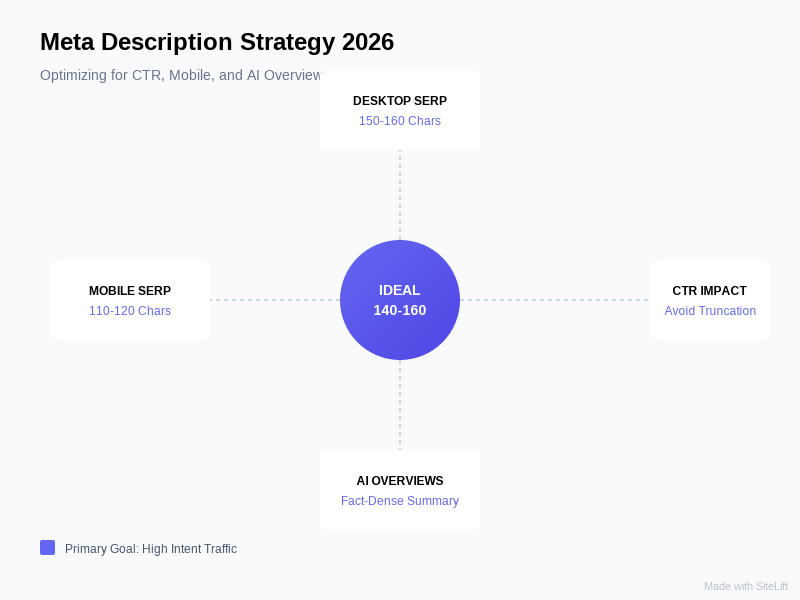
Infographic by SiteLift
How Long Should Meta Descriptions Be in 2026? Desktop vs. Mobile Limits
The short answer is that your meta description length should sit comfortably between 140 and 160 characters for desktop, and closer to 110 to 120 characters if you prioritize mobile experience. However, counting characters is only half the battle.
The Ideal Meta Description Character Limit
Search engine result pages (SERPs) do not evaluate text by character count alone. Instead, Google sets a hard visual container limit. If your text exceeds that visual box, Google cuts off the remainder with an ellipsis (...).
For universal safety, target 150 characters. This allows room for wider letters while ensuring your core message fits on desktop screens without getting cut off on mobile devices.
Understanding Pixel Width: Desktop vs. Mobile Limits
Google measures search snippets in pixels rather than character counts. Research from the Moz guide on meta description pixel limits reveals that desktop snippets truncate around 960 pixels, while mobile snippets truncate at approximately 680 pixels.
Because typography is proportional, wide characters like uppercase "W", "M", or "G" consume significantly more horizontal pixel space than thin characters like "i", "l", or "t". A 150-character sentence filled with capital letters can easily exceed 960 pixels and truncate early.
Pro Tip: Before publishing critical landing pages, test your snippet render in our free SERP Preview Tool to verify exact pixel boundaries across desktop, mobile, and social cards.
Why Truncation Happens and How to Prevent It
Truncation happens when the visual width of your text string exceeds the browser display container allocated by the search engine.
[Bad Desktop Display - 975px Cutoff]
"Discover the ultimate guide to enterprise SaaS marketing. Learn how to scale your organic engine, build high-converting landing pages, and optimize your..."

[Good Universal Display - 890px / 148 Characters]
"Master enterprise SaaS marketing with proven organic scaling strategies. Boost conversions, lower CAC, and capture high-intent leads today."
When a description cuts off mid-sentence, it signals poor editorial polish. Users naturally skip truncated snippets because the value proposition feels incomplete. To prevent truncation, put your core message and call to action (CTA) within the first 110 characters.
How Does Meta Description Length Impact SERP Click-Through Rates?
The snippet beneath your blue title link serves as organic ad copy. While your snippet length does not directly push your page from position four to position one, it dictates how many users actually click your link.
Direct vs. Indirect SEO Impact of Meta Descriptions
Google has confirmed that meta tags are not a direct ranking factor in their core algorithm. However, meta descriptions exert a massive indirect impact on organic rankings through SERP click through rate.
When your snippet clearly answers search intent, more users click your link over competing results. Benchmark data from Portent demonstrates that pages with custom, optimized meta descriptions achieve up to a 5.8% higher click-through rate compared to pages relying on auto-generated snippets. Higher CTR signals to search engines that your result satisfies user demand.

Front-Loading Keywords and Value Propositions
Searchers skim SERPs in seconds. To capture attention before their eyes jump to the next result, place your primary keyword and core benefit in the first 80 to 100 characters.
- Weak (Back-Loaded): "If you are looking to improve your overall search performance across major platforms, our guide explains how long should meta descriptions be for modern websites."
- Strong (Front-Loaded): "Unsure how long should meta descriptions be? Learn exact pixel limits, CTR strategies, and AI snippet rules to boost your organic traffic."
When a user searches for a term, Google bolds matching words inside your snippet. Front-loading those keywords creates an immediate visual match that pulls the searcher's eye straight to your listing.
Designing CTAs for Scannable SERP Snippets
An effective meta description combines a clear value proposition with a low-friction call to action. Avoid vague statements and give the user a clear reason to click.
Use strong verbs at the end of your snippet:
- Download our free checklist.
- Compare pricing and features.
- Read the full 2026 benchmarks.
- Calculate your ROI in minutes.
How Are AI Overviews and AI Snippets Changing Meta Description Standards?
The rise of generative engines like Google AI Overviews, Perplexity, and ChatGPT Search has altered snippet optimization. Today, meta tags do more than sit in search results; they feed Large Language Models (LLMs) the direct context of your page.
How LLMs and AI Overviews Extract Meta Information
AI engines crawl web pages looking for condensed contextual summaries to construct synthesized answers. When an AI agent decides which sources to cite in an expanded answer card, it parses your <meta name="description"> tag alongside structured page headers.
If your description provides a clean, factual summary of your page's thesis, LLMs are significantly more likely to select your site as a cited primary source.
Optimizing Descriptions for Generative AI Search (GEO)
To make your snippets attractive to AI engines, adopt principles from AI snippets optimization:
- Lead with factual declarations: State exact definitions or key findings in the first sentence.
- Avoid purely promotional fluff: Words like "best ever" or "world-leading" are ignored by LLM summarizers.
- Use precise entity references: Mention specific concepts, tools, framework names, and target audiences directly.
For brands shifting toward Search Experience Optimization (SXO), crafting snippets that satisfy both human searchers and conversational AI agents is vital for long-term visibility.
Structured Data vs. Meta Descriptions for AI Crawlers
While meta descriptions provide a human-readable text summary, Schema.org structured data provides machine-readable context.
{
  "@context": "https://schema.org",
  "@type": "TechArticle",
  "headline": "How Long Should Meta Descriptions Be in 2026?",
  "description": "Learn the ideal meta description length for desktop, mobile, and AI snippets, including pixel widths and CTR optimization strategies."
}
Combining explicit JSON-LD schema with clean meta tags gives autonomous crawlers maximum clarity, reducing the odds of hallucinated or inaccurate summaries in AI search results.
How Long Should Meta Descriptions Be to Stop Google Rewrites?
Even when you write a crisp snippet, search engines do not always display it. Google frequently replaces your custom snippet with an automated excerpt pulled directly from your body copy.
Common Triggers for Automated Google Rewrites
An extensive Ahrefs study analyzing Google meta description rewrites discovered that Google rewrites meta descriptions approximately 62.78% of the time.
                       GOOGLE META DESCRIPTION REWRITE RATES
  --------------------------------------------------------------------------------
  Custom Tag Used      [==================== 37.22% ====================]
  Google Auto-Rewrite  [======================================== 62.78% ========]
  --------------------------------------------------------------------------------
Google typically overrides your custom HTML tag for three specific reasons:
- Extreme length: Your tag is under 70 characters or over 170 characters.
- Keyword stuffing: The tag lists search terms without natural syntax.
- Intent mismatch: The tag fails to address the user's explicit query.
Matching Search Intent to Retain Custom Meta Descriptions
If a single landing page ranks for multiple distinct queries, Google may generate dynamic snippets tailored to each user's search terms.
To maximize the adoption rate of your written description, align your tag directly with the main search intent of your target keyword. If the user wants a step-by-step tutorial, ensure your description explicitly offers a guided tutorial format.
Using max-snippet Directives to Control SERP Displays
If you want strict administrative control over how much text Google displays from your page, use robots meta directives in your page header.
<!-- Restrict snippet display length to 160 characters max -->
<meta name="robots" content="max-snippet:160">

<!-- Prevent Google from using page text if custom tag is missing -->
<meta name="robots" content="max-snippet:-1, max-image-preview:large">
According to Google Search Central documentation, setting max-snippet allows webmasters to declare hard boundaries for snippet extraction.
What Is the Step-by-Step Best Practice for Writing Meta Descriptions?
Writing strong tags across hundreds or thousands of pages requires a clear framework.
Formula for High-Converting Meta Descriptions
Follow this battle-tested three-part structure when drafting your tags:
$$\text{Primary Keyword} + \text{Core Value Proposition} + \text{Call to Action}$$
[Example Application]
Primary Keyword:        How long should meta descriptions be
Core Value Proposition: Learn 2026 pixel limits, CTR impact, and AI snippet standards
Call to Action:         Read our complete technical guide today.

Result: "Unsure how long should meta descriptions be? Learn exact 2026 pixel limits, mobile rules, and AI snippet standards. Read our complete guide today."
Examples of High-CTR vs. Poor Meta Descriptions
Here is how poor snippet choices compare against optimized tags:
| Page Type | Poor Implementation | High-CTR Implementation |
|---|---|---|
| Blog Post | "In this post we discuss meta tags, character limits, SEO best practices, and why meta tags matter for ranking." | "How long should meta descriptions be in 2026? Discover desktop pixel limits, AI snippet rules, and CTR formulas to grow organic clicks." |
| E-Commerce Category | "Buy shoes online. Great footwear deals, cheap sneakers, running shoes, free delivery on all footwear orders." | "Browse high-performance running shoes designed for marathon endurance. Enjoy free shipping and zero-hassle 30-day returns." |
| SaaS Product Page | "Our software helps businesses track keywords and automate reporting for digital marketing teams globally." | "Scale search traffic on autopilot. Track keyword momentum and automate publishing with SiteLift. Start your free trial." |
If you are optimizing commercial catalog pages, consult our practical guide on building high-converting SEO product pages to maintain quality across large site architectures.
Automating Meta Description Management at Scale
Writing unique descriptions for a 50-page brochure site is manageable. Managing snippets across 50,000 enterprise URLs, dynamic blog posts, and international subdomains requires automated workflows.
Programmatic SEO engines use structured templates and natural language processing to generate intent-matched meta descriptions dynamically. This guarantees that every indexable page has a unique tag within ideal pixel constraints, preventing widespread snippet rewrites.
My Take: Why "Shorter First" Meta Descriptions Win in 2026
I have audited tens of thousands of SERP results across competitive SaaS and cloud niches. The most common mistake engineering and marketing teams make is trying to squeeze an entire product pitch into a single HTML tag.
In my view, the 130-character meta description is severely underrated.
While the maximum desktop threshold rests at ~160 characters, keeping your primary message under 130 characters guarantees that:
- Your complete call to action renders cleanly on every mobile viewport.
- Social sharing preview cards on X, LinkedIn, and Slack won't cut off your text.
- Conversational AI models extract a clean statement without trailing text clutter.
Instead of writing up to the edge of the visual container, write for maximum impact within minimal space. Clarity always beats character volume.
Scaling Meta Tags and AI Visibility with SiteLift
Managing meta tag character limits, structured schema, and AI snippet optimization manually across an enterprise web app requires dozens of engineering hours.
SiteLift eliminates this operational bottleneck completely. As an autonomous SEO and AI visibility growth platform, SiteLift automatically:
- Generates intent-matched metadata: Creates pixel-perfect titles and meta descriptions optimized for traditional search and AI engine extraction.
- Monitors snippet rewrites: Tracks how Google, Perplexity, and Gemini display your brand in real-time.
- Publishes updates seamlessly: Integrates directly with your CMS or web framework to deploy technical updates without developer tickets.
- Drives organic compounding: Automates topic cluster generation and content distribution to build durable search authority.
If you are ready to automate your organic growth pipeline and secure your site's place in modern AI search engines, test your current setup with sitelift.io today.
Frequently Asked Questions
What is the maximum length for a meta description in 2026?
The maximum recommended length for a meta description is 150 to 160 characters (approx. 960 pixels) for desktop search results, and 110 to 120 characters (approx. 680 pixels) for mobile devices. Exceeding these thresholds causes search engines to truncate your snippet with an ellipsis.
Does meta description length affect SEO rankings directly?
No, meta description length and content are not direct ranking factors in Google's core algorithm. However, an optimized meta description increases your organic Click-Through Rate (CTR), which drives higher user traffic and sends positive user engagement signals to search engines.
Why is Google ignoring my custom meta description?
Google ignores custom meta descriptions over 62% of the time. Common causes include tags that exceed pixel width limits, tags that contain keyword stuffing, or tags that do not closely match the explicit search intent of the user's query.
How do AI Overviews use meta descriptions?
Generative search engines (such as Google AI Overviews, Perplexity, and ChatGPT Search) use meta descriptions as condensed factual summaries. Concise, fact-dense meta descriptions increase the probability that an LLM will select your page as an authoritative citation source.
What is the pixel limit for desktop and mobile meta descriptions?
On desktop browsers, Google truncates meta descriptions after roughly 960 pixels. On mobile viewports, snippets truncate around 680 pixels. Because character widths vary, measuring snippet length in pixels ensures accurate rendering across all devices.
— sitelift.io
Topics Covered:
- how long should meta descriptions be
- meta description length
- meta description character limit
- SERP click through rate
- AI snippets optimization
More from SiteLift
Link Building Advice From Scaleups: What to Automate and What to Avoid
Practical link building advice for scaleups. Learn what tactics to automate, high-risk strategies to avoid, and how to scale domain authority on autopilot.
Define Crawler: How Search and AI Bots Read the Web
Learn to define crawler, spider & bot. See how Googlebot and AI bots like GPTBot work and control them.
Blog Pagination and SEO: Prevent Crawl Traps and Ranking Dilution
Learn how to optimize blog pagination for SEO. Stop crawl traps, implement self-referential canonicals, and optimize infinite scroll for higher rankings.