Link Building Advice From Scaleups: What to Automate and What to Avoid
When you transition from an early-stage startup to a scaling company, your growth playbook changes dramatically. In the early days, sending 50 manual outreach emails a week to acquire a handful of links might have felt like a win. Once you are scaling, that manual approach becomes a major operational bottleneck.
Getting the right link building advice at this stage is crucial. If your team spends dozens of hours per week pitching blogs individually, you sacrifice speed and product development. Conversely, if you cut corners by buying bulk links, you risk severe Google penalties.
Scaleup authority growth requires a precise balance: automating tedious distribution pipelines while maintaining strict content quality. This guide breaks down what tactics to automate, what to avoid, and how modern scaleups build sustainable authority for both traditional search engines and AI models.
Key Takeaways
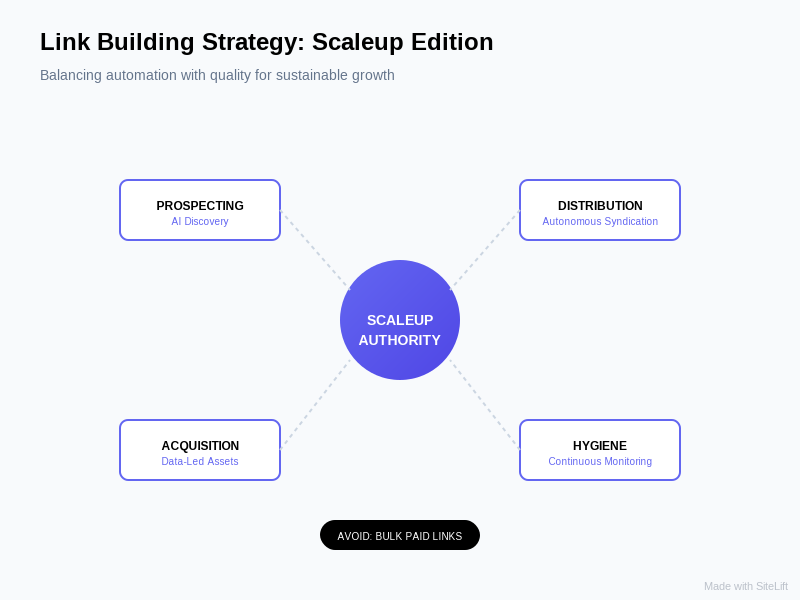
| Strategic Focus | Manual Approach | Scaled / Autonomous Approach | Scaleup Risk Level |
|---|---|---|---|
| Prospecting & Outreach | Manual list building & template pitches | AI prospect discovery & automated workflows | Low (when personalized) |
| Content Distribution | Pitching guest posts one-by-one | Autonomous syndication across curated networks | Low (on trusted platforms) |
| Link Acquisition | Buying cheap packages from agencies | Earning links via data reports & product integration pages | High (for paid packs) / Low (for assets) |
| Anchor Text Management | Manual spreadsheets and random targets | Automated ratio monitoring across branded & exact terms | Low |
| Backlink Hygiene | Periodic manual disavows | Continuous health monitoring to avoid toxic backlinks | Low |
What Does Strategic Link Building Look Like for Scaleups?
Scaleups operate under constraints that traditional enterprise brands rarely face. You need high link velocity to compete with established incumbents, but you rarely have a 20-person dedicated SEO outreach team.
At this stage, high-level backlink strategy advice centers on building an authority engine that runs efficiently alongside product development.
Shifting Focus from Quantity to Domain Authority and Relevance
In the early growth phases, many founders assume every link carries equal weight. That assumption is costly. According to benchmark research from Ahrefs, 66.3% of web pages have zero backlinks pointing to them, which leaves them virtually invisible in organic search.
Backlink Distribution Across the Web:
[================== 66.3% Zero Backlinks ==================][ 33.7% Has Backlinks ]
To break out of that invisible 66.3%, scaleups cannot rely on low-tier directory submissions. You need high-authority, topically relevant links. A single backlink from a trusted industry publication moves the needle far more than fifty links from obscure blogs. Scaleup link building requires prioritizing domain authority (DA/DR), thematic alignment, and contextual indexation over raw link counts.
The Operational Bottlenecks of Manual Backlink Acquisition
Manual outreach relies on a fragile sequence: prospecting, finding email addresses, writing customized pitches, handling follow-ups, negotiating terms, and writing guest content.
If your team spends 15 hours securing a single backlink, your customer acquisition cost (CAC) for organic search spikes unnecessarily. Scaleups that succeed with organic growth build workflows where asset creation and distribution are streamlined. By replacing manual administrative tasks with automated workflows, teams free up valuable time to focus on high-impact strategic growth.
Essential Link Building Advice: What Tactics Should Scaleups Automate?
Automation in link building often gets a bad reputation because early tools were used to spam webmasters. However, modern automated platforms streamline workflow bottlenecks while maintaining strict quality standards.

Automated Prospecting and Pitch Personalization at Scale
Finding target publications and extracting contact details manually is inefficient. Modern SEO stacks use automated prospecting engines to find contextual outreach opportunities based on domain authority, organic traffic trends, and topic relevance.
Automated personalization tools let you ingest dynamic variables—like a target site's recent articles or specific industry focus—into tailored email templates. This gives your outreach team scale without sounding like an uninspired mass blast.
Autonomous Content Syndication across Curated Premium Networks
Content creation and distribution represent two of the largest resource sinks for growth teams. According to data from HubSpot, companies that blog regularly and distribute content strategically receive 97% more inbound links to their website than those that do not.
Inbound Link Advantage by Content Strategy:
Standard Sites:      [=== 100% Base Links ===]
Strategic Publishers: [=================== 197% Inbound Links ===================]
Rather than pitching each article manually, scaleups leverage autonomous link building technology. Platforms like sitelift.io streamline this process by automatically generating targeted, top-tier content and distributing it across a curated network of authoritative sites. This automated pipeline ensures consistent content velocity without manual outreach fatigue.
To understand how third-party domain trust impacts your broader search footprint, explore our breakdown of External Link Building Explained: Earn Authority That Sticks.
Real-Time Backlink Health and Rank Tracking
Once you acquire links, maintaining them requires continuous monitoring. Pages get deleted, webmasters alter link attributes to nofollow, and target URLs change during site redesigns.
Automated rank and backlink tracking systems alert your team the moment an earned link drops or changes status. Automating backlink health checks lets you recover lost link equity quickly without conducting tedious manual link audits every quarter.
High-Risk Link Building Advice: What Tactics Must Scaleups Avoid?
Automating the administrative side of link building creates efficiency, but cutting corners on link quality creates long-term risk. Scaling quickly requires knowing exactly which shortcuts to avoid.
Buying Low-Quality Bulk Links and Private Blog Networks (PBNs)
The market is filled with vendors offering "50 DR 50+ Backlinks for $500." Taking these offers is one of the fastest ways to trigger an algorithmic penalty.
Google's Web Search Spam Policies, documented on Google Search Central, explicitly penalize paid link schemes designed to manipulate PageRank. Bulk packages typically rely on Private Blog Networks (PBNs) or compromised domains.
+-----------------------------------------------------------------------+
| WARNING: Paid PBN & Bulk Link Schemes                                 |
+-----------------------------------------------------------------------+
|  [!] Instant Link Spike  -->  [!] Spam Algorithm Trigger              |
|  [!] Manual Action Risk   -->  [!] Total De-indexation of Domain      |
+-----------------------------------------------------------------------+
When Google detects these patterns during spam updates, the artificial authority evaporates overnight, often taking your organic rankings with it.
Over-Optimizing Exact-Match Anchor Text Distributions
When scaleups try to rank for competitive keywords, they often push hard for exact-match anchor text (e.g., forcing external sites to link using the precise keyword "cloud accounting software").
Unnatural anchor text distributions signal manipulation to search algorithms. A natural backlink profile consists mostly of branded terms, neutral phrases, and partial-match variations.
| Anchor Text Type | Example | Healthy Profile Percentage | Risk Factor |
|---|---|---|---|
| Branded | "SiteLift", "sitelift.io" | 50% – 70% | Extremely Low |
| Partial-Match / Contextual | "automated SEO platforms like SiteLift" | 20% – 30% | Low |
| Generic / Bare URL | "visit site", "https://sitelift.io" | 10% – 15% | Low |
| Exact-Match Target | "link building advice" | < 5% | High (if over-optimized) |
Infographic by SiteLift
Failing to Audit and Avoid Toxic Backlinks
As your domain authority grows, your site naturally attracts low-quality web scrapers, automated directory bots, and spam sites. If left unchecked, accumulating bad link signals undermines your domain reputation.
According to backlink analysis documentation on Moz, a high concentration of incoming spam links negatively impacts a domain's trust signals.
Pro Tip: Set up automated alerts for incoming backlinks. If you notice a sudden spike of hundreds of links from unrelated foreign-language domains or adult/gambling networks, flag them immediately to maintain clean backlink hygiene.
How Can Scaleups Build High-Authority Links Without Excessive Manual Overhead?
Building genuine domain authority doesn't require choosing between slow outreach and dangerous shortcuts. Scaleups can earn authoritative backlinks at scale by building smart assets and automated distribution systems.
Publishing Data-Driven Reports and Original Scaleup Research
Original data is one of the most reliable link magnets available. Scaleups process unique user data, proprietary platform metrics, and customer behavior insights every day.
By aggregating and anonymizing this data into an annual industry report, you create an authoritative reference asset. Writers, industry analysts, and journalists naturally link to original research as a primary source when drafting their own content.
   [ Proprietary User Data ]
             │
             ▼
   [ Aggregated Report ] ──────► Cited by Journalists ──► High-DA Backlinks
             │
             ▼
   [ Visual Assets ]    ──────► Embedded by Blogs    ──► Organic Attribution
Leveraging Integration Partners and SaaS Ecosystem Directories
If your SaaS platform integrates with other software platforms (like Slack, HubSpot, Salesforce, or Shopify), you have access to high-authority link opportunities right away.
Partnership link building strategies include:
- Creating co-marketing blog posts with integration partners.
- Getting listed on official App Marketplaces and integration directories.
- Contributing guest case studies to partner engineering blogs.
These links carry high topical relevance and domain authority because they represent real commercial partnerships. If you manage an online store or multi-product marketplace, review our actionable strategies for Ecommerce Link Building: Scale Product Authority & Revenue.
Implementing Autonomous SEO and Distribution Engines
The most sustainable way to scale link velocity is by deploying an end-to-end autonomous publishing pipeline. Instead of constantly chasing individual link placements, scaleups build continuous authority engines.
Platforms like SiteLift help teams automate content generation, contextual link insertion, and distribution across vetted, high-performing publishing channels. This enables scaleups to build steady backlink momentum while keeping internal team members focused on core product initiatives.
How Do Backlinks Impact AI Search Visibility and Generative Engine Optimization (GEO)?
Link building is no longer just about ranking on page one of traditional Google search results. The rise of conversational AI engines has changed how web authority is calculated.
The Role of Domain Citation in Large Language Model (LLM) Answers
Search platforms like Perplexity, Google AI Overviews, and ChatGPT rely on underlying index authority when generating answers to user prompts. Research from Backlinko highlights that the top-ranking result on Google has an average of 3.8x more backlinks than positions 2 through 10.
Traditional SERP vs. AI Engine Discovery:

Traditional Google:  Query ──► Index Rank ──► Clicks Top Link
AI Search (GEO):     Prompt ──► LLM Synthesis ──► Cites High-Trust Entities
                                                  (Driven by Backlink Profile)
LLMs prioritize sources that are frequently cited across authoritative web properties. When multiple trusted sites link to your domain as an industry reference, LLMs identify your brand as an established entity, leading to frequent citations in generated answers.
Future-Proofing Your Authority Profile for Search and AI Engines
To prepare your brand for both traditional SERPs and AI search engines, focus your link building tips on entity authority.
- Build citations on recognized industry platforms: AI models pull heavy context from platform directories, industry news outlets, and Wikipedia/Wikidata entities.
- Diversify co-occurrence terms: Ensure third-party articles mention your brand alongside your primary software category.
- Maintain white-hat compliance: AI engines extract citations from trusted sources. Algorithmic penalties in traditional search will also drop your visibility in AI summaries.
For an in-depth look at staying compliant across evolving algorithms, read our guide on White Hat Link Building Techniques That Work for AI & Google.
My Unfiltered Opinion: Why Autonomous Syndication Beats Traditional Outreach Every Time
I have spent years managing organic growth strategies across SaaS platforms, and I've watched countless scaleup teams waste massive budgets on manual cold email outreach.
Sending 1,000 cold emails to get three guest post acceptances on low-traffic blogs is an inefficient use of resources. The ROI on manual outreach has dropped significantly as webmasters get overwhelmed with automated email blasts.
Manual Outreach ROI vs. Autonomous Syndication:

Manual Cold Email:     [1,000 Pitches] ──► 3 Links  (High Overhead, Slow)
Autonomous Network:    [System Publishing] ──► Consistent Stream of Tier-1 Links
The future of authority scaling belongs to autonomous distribution pipelines. When you plug your publishing strategy into an automated platform like sitelift.io, you eliminate cold-email negotiation entirely. You produce targeted content, distribute it automatically across high-authority networks, and watch your domain metrics compound over time.
Stop wasting engineering and marketing bandwidth on low-yield outreach. Build systems that handle distribution automatically so your team can focus on product innovation.
— sitelift.io
Scaling Authority on Autopilot with SiteLift
Building continuous search and AI engine authority shouldn't require a massive internal outreach team.
SiteLift is an autonomous SEO and AI visibility growth platform built for companies that want to dominate search results without manual bottlenecks. SiteLift automates your publishing pipeline by generating targeted content, distributing it across a premium partner network, and monitoring ranking momentum in real time.
If you are ready to stop chasing backlinks manually and start building compound domain authority on autopilot, explore how sitelift.io can accelerate your organic growth today.
FAQ
What is the best link building advice for fast-growing scaleups?
The most effective link building advice for scaleups is to balance high-value asset creation (such as original data reports) with automated content distribution pipelines. Focus heavily on domain authority and topical relevance rather than raw link volume, and avoid low-quality link packages that risk search engine penalties.
Which link building processes can be safely automated?
You can safely automate prospect discovery, initial outreach workflow personalization, rank and backlink health tracking, and content distribution through verified partner networks. Avoid automating unpersonalized spam emails or generating low-quality content on untrusted web networks.
How do you identify and avoid toxic backlinks?
To avoid toxic backlinks, use automated backlink monitoring tools to track incoming links. Watch out for sudden link spikes from unrelated foreign domains, PBNs, or low-trust sites with high spam scores. Disavow suspicious links if you notice targeted spam attacks affecting your domain metrics.
Why is link velocity important for SaaS and cloud companies?
Link velocity—the rate at which your site earns new backlinks—signals to search engines that your brand is gaining industry traction. For fast-growing SaaS and cloud companies competing against established incumbents, maintaining steady, positive link velocity is essential for steadily climbing keyword rankings.
How does autonomous link building differ from traditional link outreach?
Traditional outreach relies on manual prospecting, individual email pitches, and one-off negotiations to secure backlinks. Autonomous link building uses intelligent platforms to automate content creation and distribution across established premium networks, delivering steady authority gains without manual overhead.
Topics Covered:
- link building advice
- link building tips
- backlink strategy advice
- avoid toxic backlinks
- autonomous link building
More from SiteLift

How Long Should Meta Descriptions Be in 2026? Length, CTR and AI Snippets
Learn how long meta descriptions should be in 2026. Discover exact pixel limits, desktop vs mobile rules, CTR strategies, and AI snippet optimization.
Define Crawler: How Search and AI Bots Read the Web
Learn to define crawler, spider & bot. See how Googlebot and AI bots like GPTBot work and control them.

Blog Pagination and SEO: Prevent Crawl Traps and Ranking Dilution
Learn how to optimize blog pagination for SEO. Stop crawl traps, implement self-referential canonicals, and optimize infinite scroll for higher rankings.