External Link Building Explained: Earn Third-Party Authority That Sticks

Mastering external link building remains the single biggest differentiator between websites that languish in search engine obscurity and those that dominate competitive search engine results pages (SERPs). If you run an online publication or SaaS platform, you already know that stellar content alone does not guarantee rankings. Without independent third-party endorsements vouching for your content, search algorithms have little reason to treat your domain as an authoritative source.
Yet, link acquisition remains one of the most misunderstood aspects of search engine optimization. Marketers regularly mix up their link directions, waste thousands of dollars on dead-end cold outreach campaigns, or purchase low-tier links that trigger spam filters.
In this guide, we break down how external link building operates today, clarify the mechanics of inbound versus outbound references, explore modern tactics for acquiring sustainable authority, and examine how the rise of generative AI search changes the equation.
What Is External Link Building and Why Is It Critical for Modern SEO?
At its core, external link building is the intentional process of acquiring hyperlinks from independent, third-party websites pointing back to your own domain. These incoming hyperlinks—commonly called backlinks—act as digital votes of confidence. When a reputable site links to your resource, it tells search engines that your content is accurate, valuable, and worthy of citation.
Decades after Larry Page and Sergey Brin formulated PageRank at Stanford, the presence of verified external citations remains the cornerstone of information retrieval. Search engines do not simply read what you say about yourself; they evaluate what the rest of the web says about you.
Outbound vs Inbound Links: Clearing the Terminology Confusion
A frequent point of confusion among website operators is the difference between outbound links and inbound links. Both fall under the broader umbrella of "external linking," but their directional mechanics serve fundamentally different functions:
- Inbound External Links (Backlinks): These occur when an external domain places a hyperlink pointing toward your website. This is the primary target of any external link acquisition campaign, as these links pass authority, drive referral traffic, and boost your site's ranking potential.
- Outbound External Links: These are links you place on your own pages pointing away to external third-party sites. While they do not pass equity to your site, strategic outbound links help search crawlers understand your topical neighborhood and validate that your claims rest on reputable sources.
Confusing the two leads to flawed optimization strategies. While a balanced link architecture requires both, inbound links are the engine that compounds your domain's organic authority.
How Search Engines and AI Answer Engines Evaluate Third-Party Signals
Search algorithms have grown substantially more sophisticated than simple link-counting scripts. Platforms like Google evaluate incoming links based on entity validation, topical clusters, and user behavior.
According to extensive research by Ahrefs, over 90% of all published web pages receive zero organic search traffic from Google, predominantly due to a lack of referring domains. When crawlers map a website, they examine the relationships between recognized digital entities. If prominent, established entities in your industry consistently reference your brand, your site gains topical authority.
Modern AI answer engines like Perplexity, ChatGPT Search, and Google Gemini apply this same foundational logic. Rather than displaying ten blue links, these engines synthesize direct answers from the web. When deciding which sources to extract facts from and display as attribution footnotes, generative engines rely heavily on the authoritative graph established by external backlink networks.
How Does an External Backlinks Strategy Influence Search Visibility?
A deliberate external backlinks strategy transforms isolated content pieces into sustained traffic engines. Understanding the underlying mechanics helps you avoid common pitfalls and focus your resources on acquisition channels that actually move the needle.

Passing Equity: Understanding PageRank and Topical Relevance
Link equity—often colloquially termed "link juice"—represents the authority transferred from one page to another through hyperlinks. When a high-authority publication links to your article, a fraction of its equity flows through that connection.
However, raw authority is no longer the sole metric that matters. Contextual and topical relevance now carry equal, if not greater, weight. A backlink from a mid-tier niche publication dedicated entirely to your industry often passes more ranking power than an irrelevant link from an enormous general-news site. Google assesses the surrounding paragraph text, the anchor text, the overarching theme of the source page, and the topical consistency of the host domain.
Establishing E-E-A-T Through Independent Third-Party Validation
Google's quality rater guidelines heavily emphasize Experience, Expertise, Authoritativeness, and Trustworthiness (E-E-A-T). Trust is the core pillar holding these elements together.
Because anyone can publish on the web, self-declared expertise carries minimal algorithmic weight. Independent external links serve as third-party proof. When industry leaders, academic institutions, or established trade journals link to your analyses, they provide an unforgeable signal that your domain represents a trusted resource within its space.
Direct Referral Traffic vs Algorithmic Compounding
While search engine rankings are usually the primary goal of link building, high-quality links deliver an immediate secondary benefit: qualified referral visitors.
When your company is cited inside a popular industry analysis, interested professionals click through directly to read your perspective. These visitors arrive with high intent, having already consumed context that paints your brand as an expert. This creates an algorithmic compounding effect: direct engagement signals (such as low bounce rates and longer dwell times) validate the quality of the backlink to search crawlers, reinforcing your upward momentum in organic rankings.
What Are the Most Effective Tactics for Authority Link Acquisition?
Securing top-tier links requires shifting away from mass spam outreach toward value-driven asset creation and scalable distribution. Modern search engines penalize aggressive, low-tier link schemes outlined in the official Google Search Central documentation. Sustainable authority link acquisition demands tactics that naturally attract real editorial citations.
Data-Led Digital PR and Original Research Assets
Original data is the premier link magnet on the modern web. Journalists, industry bloggers, and content writers frequently need statistics to back up their claims. When they search for numbers, they cite the original publisher.
A landmark study by SparkToro revealed that content containing unique data and primary research earns over 3x more editorial backlinks than standard opinion or aggregate pieces.
To capitalize on this:
- Aggregate your internal platform data to identify unexpected user trends.
- Run targeted pulse surveys on controversial or evolving industry debates.
- Publish benchmark reports that establish the baseline metrics for your sector.
Make your data easy to consume. Provide clear summary charts, quotable snippets, and embed codes. When creators discover your page while researching, they naturally attribute the findings with an external link back to your study.
Leveraging a Curated Third Party Distribution Network
Relying exclusively on organic discovery is slow. Many high-growth teams amplify their reach through a curated third party distribution network.
Instead of pitching hundreds of individual editors via cold email, strategic syndication and multi-platform distribution pipelines place your high-value assets across established industry hubs, affiliated partner portals, and publisher networks simultaneously.
By systematically placing your insights across a distributed publisher infrastructure, you accelerate the rate at which editorial teams, analysts, and content creators encounter your work.
Pro Tip: When syndicate-distributing long-form content across partner sites, ensure appropriate canonical tags or delayed republishing windows are established. This guarantees that search engines recognize your primary URL as the definitive source of truth.
Reclaiming Unlinked Brand Mentions and Broken Backlinks
Reclamation tactics offer some of the highest conversion rates in link acquisition because the context is already half-built.
- Unlinked Brand Mentions: Writers frequently mention innovative software platforms, specific products, or proprietary frameworks without hyperlinking the name. Using alert tools to monitor brand keywords allows you to reach out with a quick note thanking the author and asking if they would consider hyperlinking the mention for their readers' convenience.
- Broken Link Building: Web pages move, companies rebrand, and URLs rot over time. By crawling resource libraries and deep guides within your niche, you can identify dead 404 links. When you spot a broken link that previously pointed to a resource similar to one you own, contact the webmaster, point out the dead link, and suggest your live URL as an updated replacement.
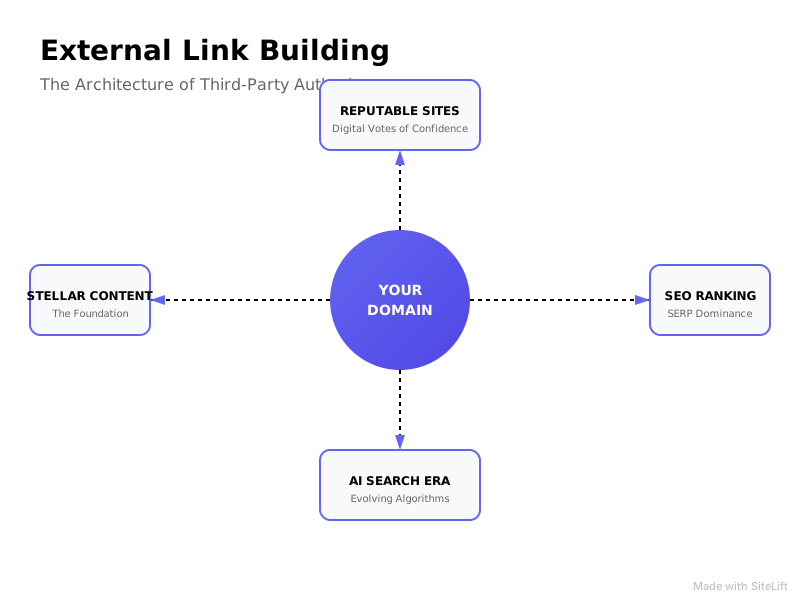
Infographic by SiteLift
Outbound vs Inbound Links: How Do You Balance Your Link Architecture?
Optimizing your site's link profile involves managing the directional flow of equity across every page you publish. Understanding how outbound and inbound links complement each other prevents algorithmic penalties and keeps your crawl paths clean.
| Attribute | Inbound Links (Backlinks) | Outbound External Links |
|---|---|---|
| Origin | Third-party website | Your own domain |
| Destination | Your own website | Third-party website |
| Primary SEO Benefit | Transfers link equity; boosts domain rankings | Contextualizes content; validates research |
| Optimal Anchor Text | Varied (branded, partial-match, URLs) | Clear, descriptive text describing destination |
| Control Level | Low to moderate (editorial discretion) | High (fully controlled by your team) |
| Technical Attributes | Standard followed (rel="dofollow") preferred | Dofollow for sources; sponsored/ugc where appropriate |
Best Practices for Citing Authoritative External Sources
Many site owners fall into the trap of link hoarding, refusing to link outbound because they fear losing PageRank. This fear is unfounded. Linking out to high-authority references signals to search engines that your page belongs to a credible network of knowledge.
When linking out:
- Link directly to the primary source of a study rather than secondary aggregator blogs.
- Point to reputable research foundations, educational portals, or industry-standard publications.
- Keep outbound links to a natural cadence—typically one to three authoritative outbound citations per 1,000 words is plenty to ground your content without driving users away unnecessarily.
Managing Anchor Text Diversity to Prevent Algorithmic Penalties
Anchor text—the clickable text string housing a hyperlink—communicates the subject matter of the destination page. In the early days of SEO, webmasters manipulated rankings by building thousands of inbound links using exact-match commercial keywords.
Today, unnatural anchor text distributions trigger algorithmic filters like Google's Penguin update. To keep your link profile natural, aim for a balanced distribution across these primary categories:
- Branded Anchors (40–50%): Links using your company name, brand variations, or domain name (e.g., "SiteLift", "SiteLift.io").
- Partial-Match & Topical Anchors (20–30%): Phrases that include your target concept naturally alongside other words (e.g., "using this external backlinks strategy", "modern distribution networks").
- Generic & Naked URLs (15–20%): Web addresses pasted raw (e.g.,
https://example.com) or conversational directions (e.g., "read the source", "visit this site"). - Exact Match (Under 5%): The exact keyword you want to rank for. Keep this low to avoid looking artificial.
For a deeper dive into penalty-free link acquisition, explore these proven white-hat link building techniques.
Evaluating Link Health: Nofollow, Sponsored, and UGC Attributes
Understanding technical link attributes defined by the World Wide Web Consortium and search engines helps you properly manage equity. According to educational guides from Moz, these relational attributes tell crawlers how to treat the link:
- Dofollow (Standard): The default link state. It passes equity and full ranking signals.
- rel="nofollow": Originally introduced to curb blog comment spam. It tells crawlers not to endorse the destination URL. Search engines now treat this as a hint rather than an absolute directive.
- rel="sponsored": Explicitly required for paid placements, sponsored collaborations, and affiliate links.
- rel="ugc": Designed for user-generated content, such as forum posts, community threads, and public comments.
Pro Tip: Never pay for dofollow links masquerading as editorial references. If search algorithms detect paid links lacking the rel="sponsored" tag, both the linking and receiving domains risk manual action penalties.
Why the Traditional Approach to External Link Building Is Fundamentally Broken
Let’s be honest about the state of SEO outreach: manual cold emailing has reached a breaking point.
Over the past decade, the standard playbook has been the "Skyscraper Technique" and cold outreach templates. We've all seen the emails: "Hey, I noticed you linked to X, but our guide is longer and has prettier graphics. Mind swapping the link?"
Editors and site owners receive dozens of these generic pitches every single day. Response rates for cold link outreach have plummeted below 2%, and open rates continue to slide. Most outreach messages end up marked as spam within seconds.
Spending forty hours a week manually scraping email addresses and sending semi-personalized pitches is an inefficient use of marketing capital. Search engines have evolved, but outreach workflows remained stuck in 2015.
The future belongs to automated ecosystems, data-driven utility assets, and algorithmic publishing networks. Instead of begging individual webmasters for a backlink, sustainable growth comes from building distribution architectures that continuously expose your content to audiences, editors, and answer engines simultaneously. Modern growth teams focus on automated syndication, programmatic publishing, and native ecosystem distribution.
Relying entirely on manual email outreach for link equity is like running a modern logistics operation with carrier pigeons. The brands dominating search are building automated, continuous distribution networks that capture visibility on autopilot. — sitelift.io
Key Takeaways: Mastering External Link Building
Before you scale your link operations, review these core realities of modern link acquisition:
| Principle | Core Takeaway | Action Item |
|---|---|---|
| Topical Relevance | Context beats raw Domain Rating every time. | Prioritize niche-aligned sites over generic high-DR domains. |
| Data as Leverage | Original research earns recurring editorial links. | Publish surveys, proprietary metrics, and benchmarks. |
| Anchor Text Health | Over-optimization triggers algorithmic spam filters. | Keep exact-match anchors under 5% across your profile. |
| Distribution Scale | Cold outreach produces diminishing returns. | Use syndication and automated multi-channel distribution. |
| AI Citations | LLMs rely on external link graphs for retrieval. | Build authority signals to rank in generative search engines. |
How Will External Link Building Evolve with AI Search and Automated Publishing?
As generative search interfaces replace traditional search result layouts, the way external citations function is shifting dramatically.
How Generative Engines (Perplexity, ChatGPT, SGE) Choose Cited Sources
Generative engines do not generate answers out of thin air; they utilize Retrieval-Augmented Generation (RAG) to ground their language models in real-time web facts.
When a user submits a query to Perplexity or ChatGPT Search, the engine runs an instantaneous search across its index, identifies the most authoritative and contextually relevant documents, and passes those snippets into the language model to synthesize the final answer. Research by Backlinko reveals that the number of unique referring domains pointing to a page is the single factor with the highest correlation to top Google rankings.
Because AI search engines rely on these underlying indices to pull their raw retrieval snippets, the sites holding the strongest external backlink authority are the exact domains selected for inclusion and citation in AI-generated answers.
Moving Beyond Manual Outreach to Scalable Ecosystem Distribution
Given the speed at which AI platforms absorb and summarize content, manual link acquisition cannot keep pace. High-performing digital brands are moving toward scalable ecosystem distribution.
By integrating automated content pipelines that publish directly to CMS platforms and distribute content across verified publishing networks, businesses eliminate the bottlenecks of manual link outreach. To see how automated workflows solve this challenge without risking manual penalties, read our deep dive on auto link building.
Future-Proofing Your Backlink Profile Against Algorithm Shifts
To ensure your link profile withstands major algorithm updates, run your link strategy through this simple vetting checklist:
- Topical Alignment: Does the referring domain publish content relevant to your specific market?
- Traffic Verification: Does the linking domain receive real, organic search traffic, or is it an artificial link farm?
- Anchor Text Diversity: Is your backlink profile dominated by natural brand variations rather than forced keywords?
- Editorial Placement: Is the link integrated seamlessly within the body of an article, or is it relegated to a footer, sidebar, or author bio?
- Link Longevity: Are you building links on durable, high-retention properties, or ephemeral platforms prone to link rot?
Scaling Your Authority on Autopilot with SiteLift
Building authority through traditional link building often feels like a full-time job. Between identifying target sites, producing long-form assets, coordinating guest placements, and monitoring links for decay, marketing teams can easily exhaust their resources before seeing a return on investment.
This is where SiteLift changes the game. SiteLift provides an autonomous SEO and AI visibility growth platform engineered to put organic search dominance on autopilot.
Rather than wasting hours on manual outreach, SiteLift's automated publishing pipeline generates targeted, topical content and distributes it through a curated third party distribution network. By integrating directly with popular CMS platforms, SiteLift compounds your organic visibility, earns sustained domain authority, and secures brand mentions inside generative AI search engines without manual intervention.
Frequently Asked Questions
What is the difference between an external link and a backlink?
An external link is any hyperlink that connects two completely different root domains. The term "backlink" simply describes an external link from the perspective of the receiving website. If Domain A links to Domain B, Domain B has earned an external inbound backlink, while Domain A has published an external outbound link.
Why are outbound external links important if they direct users away from my site?
Outbound external links provide context to search engines about your subject matter. Citing reputable third-party sources, research institutions, and primary data demonstrates that your content is thoroughly researched. Search algorithms recognize pages that reference credible sources as more trustworthy than isolated pages that cite no external verification.
How long does it take for external link building to show organic ranking results?
External link building typically takes anywhere from 4 to 12 weeks to reflect in search engine rankings. Search engine crawlers must discover the linking page, process the backlink, update the link graph, and recalculate PageRank and topical authority scores across the affected URLs.
Can third-party content syndication harm my SEO with duplicate content penalties?
Google does not have a formal "duplicate content penalty," but it will filter duplicate URLs out of search results to display only the canonical version. When syndicating content across a third-party distribution network, protect your rankings by including a rel="canonical" tag pointing to your original URL, or ensure the partner site links back to your original article as the primary source.
How do AI search engines like ChatGPT and Perplexity use external backlinks?
AI answer engines use web indexes to retrieve up-to-date facts via Retrieval-Augmented Generation (RAG). To choose which web pages to synthesize into answers, these AI engines rely on domain authority, topical relevance, and link equity. Pages with strong external backlink profiles are far more likely to be selected as primary citations in AI-generated answers.
Topics Covered:
- external link building
- outbound vs inbound links
- external backlinks strategy
- third party distribution network
- authority link acquisition
More from SiteLift

What Is AI Search? How ChatGPT and Google AI Answer Differently Than Google
Discover what is AI search, how ChatGPT and Google AI Overviews answer differently than traditional search, and how to optimize for LLM visibility.

SEO Programs Free: 9 Free Workflows to Audit, Plan and Publish Faster
Discover 9 powerful workflows using free SEO programs to audit technical health, track keywords, write content with AI, and automate your publishing.

Google AI Search Change: What SGE and AI Overviews Mean for Your Traffic
Understand the Google AI search change. Learn how SGE and AI Overviews impact organic traffic, zero-click searches, and how to optimize for LLM citations.