The Modern Guide to White Label SEO: Automating Client Success at Scale

Agency growth hits a predictable, painful wall. You sign three new retainers, celebrate the revenue spike, and immediately run into fulfillment quicksand. Technical audits stall, copywriters miss deadlines, and account managers spend half their week wrestling with rank trackers. Scaling an agency organically often feels like running a marathon in combat boots.
This operational ceiling explains why white label seo has evolved from an obscure outsourcing tactic into a foundational growth lever. Instead of building expensive internal production teams from scratch, modern digital agencies partner with specialized providers to fulfill search campaigns under their own brand flag.
Done right, an agency reseller partnership transforms organic search fulfillment from an expensive operational drag into a high-margin, predictable revenue engine. Done poorly, it creates disconnected client deliverables and threatens hard-won reputations.
Here is what it takes to leverage white label search engine optimization, white label content marketing, and automated fulfillment systems to scale client results without burning out your team.
What Is White Label SEO and Why Do Agencies Use It?
At its core, white label SEO is a business arrangement where a specialized provider delivers search engine optimization services—audits, on-page optimization, content production, link acquisition, and reporting—while your agency rebrands those deliverables as its own. Your client never sees the provider's brand, systems, or staff; they interact solely with your team, your dashboard, and your domain.
The global search market continues to expand rapidly. Statista's SEO industry report reveals consistent double-digit growth in search spend worldwide, cementing organic visibility as a non-negotiable line item for businesses of all sizes. Yet while demand surges, delivering consistent organic results across dozens of unique verticals requires an exhausting breadth of specialized skills.
Defining the White Label Model in Digital Marketing
In a classic agency reseller seo framework, your agency acts as the strategic and client-facing layer, while the partner functions as the production engine.
[ Client ]
    │ (Contracts, Strategy, Client Management)
    ▼
[ Your Agency ]
    │ (White Label Ordering, Automated Rules, Brand Standards)
    ▼
[ White Label / Reseller Infrastructure ]
    │ (Audits, Technical Execution, Content, Outreach, Reports)
    ▼
[ Deliverables Rebranded as Your Agency's Own Work ]
The division of labor is straightforward:
- The Reseller (You): Handles business development, client relationship management, discovery calls, pricing, invoice collection, and overall marketing strategy.
- The Provider (The Fulfillment Partner): Executes keyword research, writes and optimizes copy, fixes technical crawl errors, coordinates outreach, and generates real-time performance analytics.
According to data from the American Association of Advertising Agencies (4A's), nearly 60% of modern agencies now outsource some form of marketing service to increase operational agility and focus on core strengths.
The Core Benefits: Scalability, Margins, and Focus
Why take this route instead of hiring internal talent? It boils down to economics and bandwidth:
- Elimination of Payroll Overhead: An experienced technical SEO specialist, a senior copywriter, an outreach strategist, and a data analyst command significant salaries. When you outsource through a reseller model, payroll turns into a variable cost linked directly to revenue.
- Predictable Profit Margins: Most white label providers charge flat wholesale rates (e.g., $600/month for a managed package). If you resell that package for $1,800 to $2,500/month, you instantly lock in gross margins exceeding 65% without carrying operational liabilities.
- Immediate Service Breadth: A creative branding agency or paid media shop can launch full-service organic search campaigns overnight, preventing client churn to competitors offering all-in-one packages.
- Automated Agency Fulfillment: Modern platforms allow agencies to plug client accounts into automated agency fulfillment pipelines, eliminating repetitive coordination tasks and manual follow-ups.
White Label SEO vs. In-House Teams: A Strategic Comparison
Deciding between building an in-house SEO department and utilizing a white label partner comes down to capital, velocity, and management capacity.
| Factor | In-House Team | Traditional White Label Agency | Autonomous SEO Platform |
|---|---|---|---|
| Upfront Capital | High ($50k–$150k hiring/salaries) | None to Low | Low software subscription |
| Time-to-Market | 3 to 6 months | Immediate (days) | Immediate (hours) |
| Gross Margin | 30% – 45% (fluctuates with churn) | 50% – 65% | 70% – 85% |
| Fulfillment Bottlenecks | High (tied to staff headcount) | Medium (subject to human SLAs) | Minimal (software-driven automation) |
| Quality Consistency | Variable (depends on individual hires) | Variable (requires provider vetting) | High (algorithmic & rule-based) |
| Tool Stack Expenses | Expensive ($1,500+/mo for licenses) | Included in wholesale rate | Built into the platform |
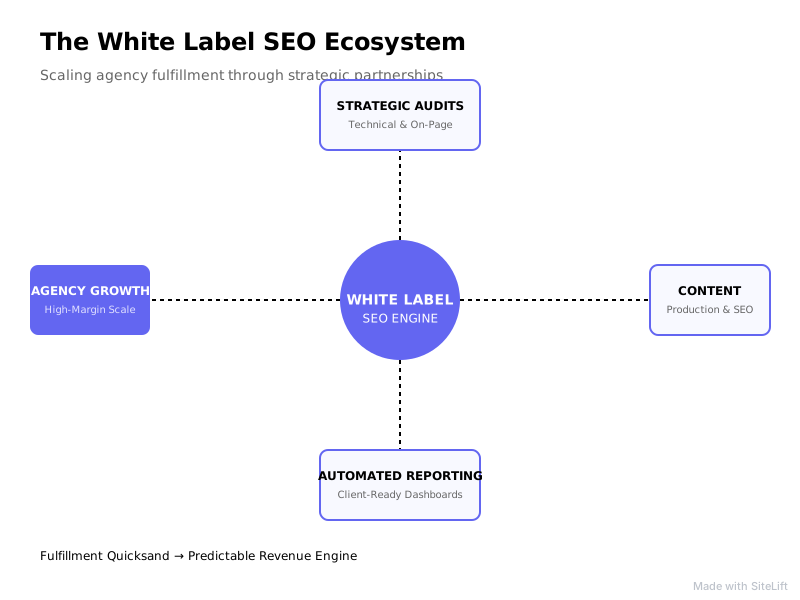
Infographic by SiteLift
For a detailed financial breakdown of personnel costs versus technology-driven alternatives, consult our guide comparing search engine optimization cost structures across agencies, in-house teams, and automation.
How Does White Label Content Marketing Drive Organic Growth?
Search engines reward topical authority, freshness, and relevance. As explained in Search Engine Land's guide on SEO fundamentals, search algorithms continuously refine how they interpret content quality, technical health, and user intent signals.
Delivering consistent, research-backed editorial at scale is where most agency fulfillment breaks down. This makes white label content marketing the most critical component of any reseller arrangement.
The Role of High-Quality, Targeted Content in SEO
To rank competitively, an agency cannot rely on generic 500-word blog posts stuffed with awkward keywords. Modern search demands comprehensive topical clusters that address informational, navigational, and transactional search intents.
White label content services handle the complete content development cycle:
- Identifying semantic keyword variations and long-tail query gaps.
- Structuring articles with clear heading hierarchies (H1, H2, H3), schema markup, and metadata.
- Integrating contextual internal links that distribute domain authority across key conversion pages.
- Sourcing relevant citations and original data points to satisfy quality evaluators.
When executed consistently, this steady flow of authoritative material allows client sites to capture incremental search impressions, creating a compounding growth curve that stabilizes retainers.
Automating Content Creation with AI and Curated Networks
The traditional model of relying on freelance marketplaces to deliver white label articles has become obsolete. It is slow, unpredictable, and prone to endless revision cycles.
Modern white label ecosystems leverage sophisticated artificial intelligence paired with human-in-the-loop oversight and curated publishing networks. These systems do not merely output raw text; they analyze top-ranking SERP competitors, map content gaps, generate contextually relevant prose, and deploy that content across established, authoritative networks.
A benchmark study by Gartner's digital marketing research indicates that organizations utilizing AI in their marketing operations experience a 20% to 30% reduction in customer acquisition costs, driven primarily by operational efficiencies in content delivery.
Ensuring Brand Consistency Across Distributed Content
A persistent fear among agency owners considering white label content is losing control of the client's brand voice. A B2B enterprise SaaS company cannot sound like a local plumbing contractor, and an artisanal retailer cannot sound like an academic journal.
Leading white label setups solve this through deep customization profiles established during onboarding:
- Style Archetypes: Setting parameters for reading level, sentence length, and terminology preferences.
- Negative Keyword Lists: Defining competitor names, forbidden claims, and off-brand vernacular.
- Autonomous CMS Integration: Connecting publishing pipelines directly into client content management systems (like WordPress, Webflow, or Shopify) via webhooks or native integrations, eliminating the copy-paste dance from Google Docs.
Pro Tip: Never deploy white label content directly to a client’s live environment without an initial 30-day calibration phase. Review the first batch of articles manually to adjust programmatic prompt parameters and editorial filters, ensuring tone alignment before setting publishing to full autopilot.

What Are the Best Practices for White Label Reporting?
Rankings and traffic graphs are vanity metrics if they do not communicate commercial value to your clients. The client churn rate at most digital agencies is directly linked to poor communication rather than poor rankings. When a client cannot clearly see how your retainers contribute to their bottom line, your monthly invoice is viewed as an expense to trim rather than an investment to protect.
This makes white label reporting your agency's ultimate client-retention shield.
Creating Client-Facing Dashboards That Impress
Static, bloated 40-page PDF reports that get generated at 11:59 PM on the last day of the month are officially obsolete. Clients skim them once, feel overwhelmed by technical jargon, and eventually stop opening them altogether.
High-impact client reporting dashboards incorporate three structural elements:
- Unmistakable Agency Branding: Custom subdomains (e.g.,
analytics.youragency.com), crisp logos, brand palettes, and tailored favicon assets. - Executive Summaries First: High-level key performance indicators (KPIs) placed prominently at the top—total organic sessions, goal conversions, pipeline value, and month-over-month trendlines.
- Drill-Down Granularity: Interactive modules that allow curious marketing directors to inspect specific keyword movements, backlink acquisitions, and landing page performance at their own pace.
If you are currently evaluating reporting infrastructure, take time to explore our analysis of next-generation SEO reporting software and why agencies are abandoning static PDF decks.
Key Metrics to Track: Beyond Just Rankings
Keyword rank tracking matters, but it does not tell the full story. Algorithmic personalization, localization, and dynamic SERP features mean that a user in Dallas sees a vastly different result than a user in London.
Effective white label reports prioritize a balanced metric scorecard:
- Keyword Momentum: Tracking groups of keywords shifting up from positions 11–20 into positions 1–3, demonstrating forward progress before conversions spike.
- Organic Conversion Actions: Form fills, demo requests, phone calls, and direct transactions attributed directly to organic landing pages.
- Topical Visibility Index: Aggregate visibility scores across entire keyword families, showing overall search market share rather than volatile single-keyword rankings.
- Crawling & Indexation Health: Fast confirmation that technical updates are keeping crawl errors near zero and core pages indexed.
For technical teams that want absolute freedom over their visualization stack, building custom SEO dashboards via a ranking API gives you total ownership over client data presentation while drastically reducing third-party software licensing fees.
Transparency and Trust in Automated Reporting
Automation must never become an excuse for detachment. Providing a live dashboard does not mean abandoning the relationship; it changes your agency's role from an overworked data gatherer to an insightful growth partner.
Research from HubSpot's marketing statistics demonstrates that companies that systematically automate their marketing and reporting operations experience up to a 451% increase in qualified lead engagement. When data updates in real time, client check-ins pivot from defensive questions ("What did we do last month?") to offensive growth planning ("Which vertical should we tackle next quarter?").
How to Scale Your Agency with Automated Fulfillment?
The holy grail of agency operations is decoupling client intake from internal headcount. In traditional agency models, every four to five new clients require hiring an additional account coordinator or SEO associate. This creates lumpy margins, constant recruitment friction, and sudden capacity shortfalls if two senior employees resign concurrently.
Embracing automated agency fulfillment solves this by using algorithmic systems to execute predictable, repeatable tasks.
Integrating White Label Tools into Your Workflow
True scaling requires clean system architecture. Connecting your customer relationship management (CRM) platform, project tracking tools, and white label fulfillment engine eliminates operational friction.
Consider this automated fulfillment flow:
[ New Client Closed in CRM ]
            │
            ▼
[ Automated Zapier / Webhook Trigger ]
            │
    ┌───────┴────────────────────────┐
    ▼                                ▼
[ Workspace Provisioned ]    [ Onboarding Brief Sent ]
    │                                │
    ▼                                ▼
[ CMS API Connected ]        [ Keywords & Targets Seeded ]
    │                                │
    └───────┬────────────────────────┘
            ▼
[ Autonomous Engine Begins Publishing, Outreach, and Tracking ]
- Contract Signed: An agency closes an inbound deal via HubSpot or Close.
- Automated Onboarding: A webhook automatically passes client domain parameters, competitor URLs, and primary service themes to the fulfillment platform.
- Autonomous Setup: The system runs an automated baseline technical audit, pulls historical keyword data, and provisions a branded client dashboard.
- Publishing Pipeline Active: Weekly content cadences, technical remediation tasks, and authority outreach initiate automatically according to predefined package logic.
Managing Multiple Clients Without Burnout
Burnout hits agency account managers when they get trapped mediating between impatient clients and unresponsive production staff.
To break this cycle, standardize your service packages into modular "tiers":
- Growth Tier (Small/Local Business): Fixed cadence of localized content, automated technical checks, core citations, and basic visibility tracking.
- Scale Tier (Mid-Market): Accelerated topical cluster publishing, active technical repair queues, content syndication, and multi-channel attribution tracking.
- Enterprise Tier (Aggressive Expansion): High-volume automated publishing, bespoke API reporting feeds, deep competitive gap analysis, and dedicated campaign strategy calls.
Standardization prevents the scope creep that quietly kills agency profitability.
Choosing the Right Technology Stack for Autopilot Growth
Not all white label platforms are built the same. First-generation reseller networks still rely on manual labor pools located in disparate time zones, leading to communication delays, inconsistent output quality, and missed deadlines.
Next-generation platforms are software-first. They use automated publishing engines, sophisticated content distribution mechanics, and programmatic rank validation to deliver identical—or superior—deliverables at a fraction of the traditional cost and turnaround time.
According to research from Forrester, 72% of modern marketers note that personalization and real-time execution directly dictate marketing effectiveness. Choosing a fulfillment engine capable of programmatically tailoring content to specific market dynamics is the difference between retaining clients for six months or five years.
Common Pitfalls to Avoid When Starting a White Label SEO Partnership
While the economics of white label delivery are attractive, outsourcing your agency's core product delivery carries real risks. If your fulfillment partner cuts corners, buys toxic backlinks, or churns out incoherent spun text, your agency bears 100% of the reputational damage.
Vetting Providers: Quality vs. Cost
The lowest price per deliverable is rarely the best deal. If a white label provider promises 500 links, 30 blog posts, and a full site audit for $199/month, they are cutting corners:
- The Backlink Trap: Cheap providers routinely leverage private blog networks (PBNs), spam forum profiles, or hacked sites. These tactics violate the principles outlined in Moz's beginner guide to search engine mechanics and can trigger algorithmic demotions or manual penalties that ruin your client's organic profile.
- Content Quality Failures: Low-cost providers often rely on unedited, poorly prompted generative AI output that reads like a bland marketing dictionary. Search algorithms easily detect and deprioritize low-effort, derivative material.
Pro Tip: Before signing an agency reseller agreement, order a test campaign for an internal agency-owned asset or a sandbox domain. Audit the backlinks, run the content through rigorous quality checks, and evaluate their customer support response speed before trusting them with a live paying client.
Communication Breakdowns and Service Gaps
A white label partnership fails when expectations lack operational clarity. You must establish firm Service Level Agreements (SLAs) covering:
- Turnaround Windows: How many business days for technical audits, content approvals, and link deployments?
- Revision Limits: What happens if a client requests structural changes to a content asset?
- Escalation Paths: Who steps in when a critical technical error occurs during CMS publishing?
Without documented SLAs, your account managers end up spending more time chasing down the provider than they would spend doing the work themselves.
Data Security and Client Privacy Concerns
When operating as a reseller, you are passing sensitive client credentials, analytics access, and strategic roadmaps to a third party. Ensure your chosen provider operates under strict confidentiality:
- Non-Disclosure Agreements (NDAs): Explicitly binding the provider never to contact, market to, or claim your clients publicly.
- Role-Based Access: Utilizing delegated API access and Google Search Console user permissions rather than handing over raw master login credentials.
- Data Encryption: Ensuring that client project briefs, competitive intelligence, and business databases are encrypted at rest and in transit.
Key Takeaways: White Label SEO at a Glance
| Strategic Dimension | Critical Imperative | Agency Impact |
|---|---|---|
| Model Selection | Choose software-driven, automated platforms over legacy manual gig-mills. | Reduces fulfillment turnaround time from weeks to hours; lowers costs. |
| Content Operations | Enforce clear voice archetypes and automated CMS pipeline integrations. | Guarantees consistent topical authority without manual copy-paste overhead. |
| Client Reporting | Deploy branded, real-time dashboards focused on visibility and revenue metrics. | Slashes monthly churn; eliminates time-consuming manual PDF creation. |
| Operational Scaling | Standardize deliverable tiers and connect CRM triggers directly to fulfillment APIs. | Allows agencies to scale from 10 to 100+ clients without linear hiring. |
| Risk Management | Establish strict SLAs, run sandbox audits, and verify security protocols. | Safeguards client trust, domain authority, and agency reputation. |
Why the Traditional Agency Reseller SEO Model Is Broken
For the past decade, the agency reseller ecosystem operated on a flawed assumption: that white label fulfillment simply meant outsourcing tedious manual labor to the cheapest available contractor overseas.
Agency owners know the misery of that model. You sell a client on an ambitious vision of market dominance. You order a "Platinum SEO Package" from a popular reseller marketplace. Two weeks later, you receive a poorly written Word document with awkward phrasing, alongside an Excel sheet containing 20 forum profile links that haven't moved a ranking needle since 2012.
You end up spending six hours fixing the content, apologizing to the client for the delay, and manually fixing formatting errors inside WordPress. You didn’t buy leverage—you bought yourself an unpaid management headache.
Real leverage is not cheap outsourced manual labor; it is intelligent, autonomous infrastructure.
The search landscape has moved beyond manual bookmarking, mechanical directory submissions, and robotic outreach emails. Today's search rankings are won by relentless topical coverage, clean technical execution, and immediate responses to algorithmic changes. If your agency is relying on human-powered agency reseller setups that take three weeks to draft four articles, you are operating at an insurmountable disadvantage against competitors using autonomous publishing pipelines.
The future belongs to agencies that act as strategic brand directors while deploying modern, automated fulfillment software to manage the heavy lifting on autopilot.
— sitelift.io
Automate Your Agency's Fulfillment with SiteLift
Scaling organic search results across a roster of demanding clients no longer requires expanding your payroll or micromanaging freelance copywriters.
SiteLift provides the modern infrastructure digital agencies need to deliver enterprise-grade search performance completely hands-free:
- Autonomous Topical Content Engine: Automatically identify target search intent, generate deeply researched content, and deploy it across a curated network of authoritative sites.
- Seamless CMS Synchronization: Connect your clients' platforms—including WordPress and Webflow—to establish automated, continuous publishing schedules that compound organic authority.
- Real-Time Visibility Tracking: Monitor dynamic keyword momentum, search landscape changes, and topical performance through an intuitive dashboard interface built for modern growth.
- Uncompromising Margins: Eliminate third-party freelance bloat and deliver predictable, high-retention search growth that scales with your agency's ambitions.
Turn your agency's SEO fulfillment from an operational headache into your most profitable growth vertical with sitelift.io.
FAQ: Frequently Asked Questions About White Label SEO
Is white label SEO legal and ethical?
Yes, white label SEO is a legal, widely accepted, and ethical business practice throughout the digital marketing industry. It functions identically to white labeling in manufacturing, software (SaaS), and consumer goods. Clients hire your agency for your strategic leadership, brand standards, and ability to drive business outcomes; how you source the underlying fulfillment engine is an operational business decision.
How much does it cost to start a white label SEO service?
Starting an agency reseller offering requires minimal upfront capital compared to hiring an in-house team. Traditional white label agency retainers typically range from $400 to $1,500 per client per month, while modern autonomous platforms like SiteLift allow you to launch subscription-based fulfillment at a fraction of that cost. You only pay for fulfillment when you sign a paying client, ensuring immediate cash-flow positive operations.
Can I use white label SEO for local businesses?
White label solutions work well for local businesses, regional multi-location brands, and national campaigns. Fulfillment providers can automate localized landing page generation, local directory management, Google Business Profile optimization, and geo-targeted topical content designed to rank in localized search packs and maps.
What software is best for white label reporting?
The best reporting tool depends on your agency's technical resources. For automated end-to-end dashboards, purpose-built platforms provide branded client-facing portals out of the box. For agencies managing enterprise clients that require bespoke visualizations, combining a search engine ranking API with Looker Studio or custom web interfaces offers maximum flexibility and data ownership.
How do I find a reliable white label SEO provider?
Vet prospective providers by examining verifiable case studies, requesting live sample deliverables (including content drafts and backlink acquisition examples), and testing their responsiveness on a trial project. Ensure they do not rely on toxic tactics like private blog networks (PBNs) and require clear contractual Service Level Agreements (SLAs) governing delivery timelines and client data security.
Topics Covered:
- white label seo
- white label content marketing
- agency reseller seo
- white label reporting
- automated agency fulfillment
More from SiteLift

International Organic Expansion: Scaling Global SEO Without Massive Agency Retainers
Execute international search expansion with proven technical steps, automated localization, and cross-border growth tactics. Start scaling today.

Why B2B SaaS Brands Are Replacing Traditional B2B SEO Agencies with AI Workflows
Stop paying retainers for stale reports. See how AI workflows drive b2b lead generation, automate content pipelines, and outperform traditional b2b seo agency models.

Scaling E-Commerce Search Traffic: Agency Retainers vs Content Automation
Compare a traditional ecommerce seo agency with automated content scaling. Discover how to grow your e-commerce organic traffic at scale.