SEO Organic Traffic: How to Compound Clicks Without Manual Publishing

Building predictable seo organic traffic is the closest thing digital marketing has to an interest-bearing asset. Unlike paid media, where every visitor carries an immediate marginal cost, organic search visibility accumulates value over time. A single well-architected cluster of pages can drive qualified leads for years after publication.
Yet, most marketing teams hit an operational wall. They treat content like artisanal craft work, publishing one or two articles a week while their target addressable search market demands hundreds of touchpoints. The math simply stops working.
To unlock compounding organic search growth, you have to stop treating publishing as a manual editorial chore and start treating it as an automated, programmatic pipeline. Here is how modern growth teams decouple traffic acquisition from headcount, capturing high-intent search demand on autopilot.
What Is SEO Organic Traffic and Why Does Compounding Growth Matter?
At its core, seo organic traffic refers to unpaid, algorithmic visits originating from search engine results pages (SERPs). When a user inputs a query into Google, Bing, or an AI-powered conversational search platform, the engine matches that intent against indexed documents to serve the most authoritative, relevant answers.
The true power of this channel lies in how its unit economics diverge from every other growth channel.
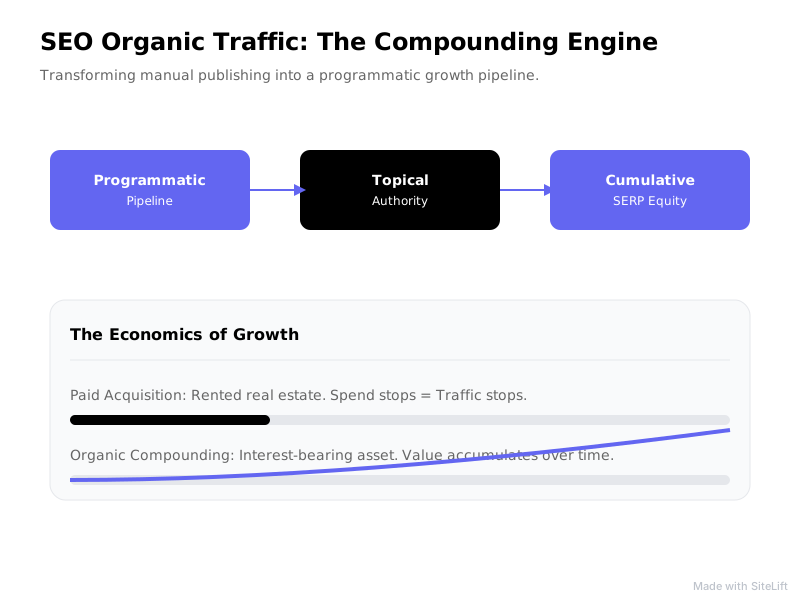
Organic Search vs. Paid Acquisition: The Long-Term Economics
Paid acquisition is rented real estate. The moment you decrease ad spend on Google Ads or LinkedIn, acquisition drops to zero overnight. Customer acquisition costs (CAC) inevitably creep up as ad auctions grow more competitive.
Paid Acquisition:
Spend ($$$)  ──────► Immediate Traffic ──────► Stop Spend ──────► Zero Traffic

Organic Compounding:
Asset Build  ──────► Topical Authority ──────► Cumulative SERP Equity ──────► Perpetual Inbound
Organic traffic behaves like equity. A research report from BrightEdge revealed that organic search accounts for 53.3% of all trackable website traffic across industries, outperforming paid search and organic social combined. When you invest in organic infrastructure, you build digital assets that yield recurring dividends without ongoing per-click fees.
The Mechanics of Compounding: How Authority Accumulates Over Time
Compounding does not happen by accident; it happens through topical coverage and internal link equity. When you publish a cluster of related articles, each new page strengthens the context of surrounding pages.
- Topical Completeness: Search engines evaluate whether a domain covers an entire subject domain or just a few isolated head terms.
- Internal Equity Flow: New URLs pass authority back to core conversion pages through structured internal links.
- Engagement Signals: As a larger library satisfies long-tail search intent, aggregated user engagement signals (dwell time, repeat visits) validate the domain's authority.
This produces a flywheel: historical pages continue ranking and pulling in searchers, while newly published URLs index faster and rank higher because the root domain already carries topical trust.
Key Metrics That Define Sustainable Organic Search Growth
Tracking raw pageviews is an easy way to deceive yourself. Sustainable growth focuses on leading indicators of authority and conversion readiness:
| Metric Category | Primary Metric | What It Actually Tells You |
|---|---|---|
| Visibility Velocity | Impressions in Google Search Console | How quickly search engines recognize new topical entities across your domain. |
| Keyword Breadth | Long-tail query footprint | The total surface area of unique queries driving at least one click. |
| Authority Lift | Average position of page clusters | Whether the domain is earning contextual trust across an entire vertical. |
| Pipeline Efficiency | Clicks-to-signup conversion rate | How cleanly search intent aligns with your product’s value proposition. |
Infographic by SiteLift
Why Do Traditional Manual Publishing Workflows Hit an Organic Growth Ceiling?
If the compounding economics of search are so attractive, why do so many SaaS and B2B organizations fail to capture them? The failure lies almost entirely in operational bottlenecks.
A comprehensive study by Ahrefs' content research team discovered that 90.63% of all published web pages receive zero organic search traffic from Google. The overwhelming majority of manual content initiatives fail to generate any return because they fall into predictable operational traps.
The Editorial Bottleneck: Production vs. Market Demand
In a traditional manual workflow, launching a content campaign requires:
- Keyword research spreadsheets managed by an SEO strategist
- Brief writing and back-and-forth reviews
- Freelance or in-house draft writing (taking 5–10 days per piece)
- Editing, formatting, image sourcing, and manual CMS staging
- Post-publishing link building outreach
Under this model, publishing 10 articles a month requires a small army. Meanwhile, your addressable market searches across tens of thousands of hyper-specific semantic variations. The manual approach guarantees you capture less than 5% of your available organic footprint.
The Long-Tail Deficit: Why Hand-Crafted Calendars Leave Money on the Table
Because manual production is expensive and slow, teams gravitate toward "head terms"—broad, high-volume keywords like "project management software" or "CRM tools."
These head terms are brutally competitive, dominated by multi-billion-dollar incumbents, and convert poorly due to mixed user intent. Conversely, specific long-tail queries (e.g., "automated recurring task tracking for remote dev agencies") have clear commercial intent and low keyword difficulty. Manual teams cannot justify spending $500 to produce a hand-crafted post for a query with 70 searches per month, yet capturing 500 of those precise variations creates an unstoppable, high-converting moat.
Pro Tip: Never ignore low-volume keywords with explicit commercial intent. An automated pipeline targeting 100 queries searching for specific integrations or use cases will almost always generate more qualified pipeline than a single top-of-funnel guide aimed at a 10,000-volume head term.
Maintenance Friction: The Hidden Cost of Content Decay
Search rankings are never permanent. Competitors launch new pages, industry terminology evolves, and algorithms recalibrate. In manual workflows, updating historical content requires deliberate calendar scheduling and human rewriting.
Inevitably, marketing teams prioritize new articles over historical refreshes. Older pages decay, lose their rankings, and the net traffic curve flattens. You end up running on an editorial treadmill just to maintain baseline traffic numbers.

How Does Autonomous SEO Traffic Scale Clicks Without Manual Friction?
Escaping this operational trap requires moving to autonomous seo traffic systems. Autonomous SEO replaces fragmented manual tasks with an integrated, programmatic engine that maps demand, writes structured answers, handles technical schema, and pushes production directly to your CMS.
Instead of asking “What should we write next week?”, autonomous systems establish continuous data pipelines that systematically answer every permutation of customer intent across your niche.
Algorithmic Topic Clustering and Entity Optimization
Search engines no longer rely on simplistic keyword frequency. As documented in Google Search Central documentation, modern search algorithms rely heavily on natural language processing, entity recognition, and semantic relationships to evaluate relevance.
Autonomous systems construct structured topic clusters:
- Core Entity Identification: Pinpointing your product's underlying capabilities, target verticals, and technical features.
- Semantic Graph Generation: Mapping parent-child relationships between core solutions and long-tail use cases, integrations, and comparison queries.
- Structured Entity Markup: Automatically applying Schema.org definitions (e.g., SoftwareApplication, TechArticle, FAQPage) so search spiders instantly parse page context.
By deploying smart SEO tech to handle entity clustering, you ensure full topical coverage across your entire market segment without manual research fatigue.
End-to-End Publishing Pipelines: From Generation to CMS Integration
The true operational unlock is eliminating human copy-pasting and staging. When you connect programmatic discovery engines directly to platforms like WordPress, Webflow, or custom headless CMS setups via webhooks and REST APIs, deployment delays disappear.
Demand Discovery Engine
        │
        ▼
Semantic Context & Entity Assembly
        │
        ▼
Autonomous Production (Deep Intent-Match)
        │
        ▼
Automated CMS Publishing (Webflow / WordPress / API)
        │
        ▼
Instant Indexing via IndexNow & API Protocols
New pages are published the moment search demand is detected, dramatically shortening the cycle between keyword discovery and search engine indexation. To see how these automated pipelines identify viable queries without human effort, review our breakdown on how to target high-value organic search keywords.
Maintaining Editorial Quality and Search Intent Alignment at Scale
A common misconception is that automated publishing leads to generic, repetitive filler. When properly calibrated, autonomous engines generate far more accurate, intent-aligned answers than generalist freelance writers.
By constraining generation algorithms with:
- Strict brand voice parameters and negative phrasing constraints
- Fact-checking mechanisms that extract verified industry data
- Algorithmic alignment to specific search intent categories (Informational, Commercial Investigation, Transactional)
The output directly satisfies Google’s Helpful Content criteria. The platform answers the searcher's question within the first two paragraphs, supplies structured comparison data, and eliminates fluff.
What Is the Role of a Content Distribution Network in Amplifying Organic Search?
Publishing on your own domain is only half the battle. A truly automated organic engine must distribute context across the wider web to build off-page authority and capture modern search behavior.
A curated content distribution network functions as an algorithmic amplifier, distributing derivative assets, syndicating contextual references, and signaling to search engines that your domain is an active authority.
Syndication and Off-Page Signals in a Multi-Engine Ecosystem
Google's ranking algorithms rely heavily on external verification. If an insight exists solely on your isolated domain, confirming its accuracy takes search algorithms longer.
A specialized distribution network:
- Syndicates key data points and summaries to partner publications and thematic niche hubs.
- Establishes contextual backlinks with relevant anchor text naturally embedded in narrative editorial content.
- Generates continuous social and referral signals that prompt search engine bots to recrawl your primary URLs.
This constant discovery loop shortens the latency between publishing a new URL and having it earn competitive rankings in search results.
Feeding AI Answer Engines and Large Language Models
The search landscape is splintering. Audiences no longer search solely via traditional 10-blue-link SERPs; they query generative AI platforms like ChatGPT, Perplexity, Claude, and Google Gemini.
Research from SparkToro indicates that zero-click searches account for nearly 60% of search queries across the web. When users ask an AI engine for a product recommendation, the engine does not crawl the entire web in real time. It retrieves data from its training corpus and real-time retrieval-augmented generation (RAG) indexes.
Traditional Engine:  User Query ──► Keyword Index ──► Ranked SERP Links
AI Answer Engine:    User Query ──► RAG / Model Weight ──► Direct Synthesized Answer
If your brand's entities and solutions are broadly syndicated across a high-authority content distribution network, your probability of being cited as the recommended solution inside AI-generated answers skyrockets. Continuous external syndication creates the ambient authority that LLMs require to quote your product with confidence.
Tracking Keyword Velocity and Visibility in Real Time
Autonomous growth loops require dynamic feedback. You cannot wait for quarterly analytics reviews to determine if your keyword strategy is working.
By monitoring keyword velocity—the speed at which new URLs enter the top 100, climb into the top 20, and capture top-3 positions—automated systems identify which topical clusters have gained search engine traction. Underperforming clusters can automatically receive secondary content nodes and internal link updates, reinforcing topical coverage without human intervention. To dig deeper into measuring these SERP shifts, read our guide on mastering organic search analytics.
How to Implement an Autopilot Organic Traffic Strategy: A Practical Blueprint
Transitioning from an exhausting manual calendar to an automated compounding system follows three implementation phases.
Step 1: Establishing Semantic Foundations and Core Entities
Before turning on automated pipelines, define the boundaries of your domain's topical authority:
- Catalog Core Capabilities: List every feature, use case, audience segment, and integration your product supports.
- Conduct Entity Mapping: Use semantic analysis tools to determine what supporting concepts Google associates with your primary niche.
- Map the Conversion Logic: Define the exact call-to-action or product demonstration path that matches each user intent level.
Step 2: Automating Multi-Channel Production and Distribution
With your entity framework in place, connect the technical infrastructure:
- Integrate Your CMS: Establish secure API keys or webhook connections between your CMS and your publishing engine.
- Define Production Cadence: Set your publication pipeline to release content at a consistent, natural velocity rather than massive, erratic batch dumps.
- Activate External Distribution: Plug your publication flow into a content distribution network to ensure every post receives immediate external syndication and contextual entity signals.
Step 3: Measuring Compounding Clicks and Iterating on Winners
Once production runs autonomously, your team's role shifts from content creation to portfolio optimization:
- Monitor the Indexation Rate: Ensure newly deployed pages are indexed within 48 to 72 hours via Search Console.
- Double Down on High-Velocity Clusters: When an automated cluster starts winning positions 4–10, trigger automated supplemental child pages to build out edge cases and secure the top 3 spots.
- Prune Non-Performers: If specific queries fail to earn impressions within 90 days, let your system rewrite or consolidate those URLs algorithmically.
Pro Tip: Treat your SEO content library like a programmatic software application. Don't fall in love with individual paragraphs. Focus entirely on whether the page answers search intent accurately and whether the site's overall topic cluster is gaining aggregate rank velocity.
Why Treating SEO as an Engineering Problem Is the Most Underrated Growth Strategy
Key Takeaways
| Strategic Focus | Manual Editorial Model | Autonomous SEO System |
|---|---|---|
| Primary Bottleneck | Writer availability and human editing capacity | System configuration and semantic accuracy |
| Target Keywords | 10–20 broad head terms per quarter | Hundreds of hyper-specific long-tail queries monthly |
| Publishing Latency | Weeks from ideation to live staging | Minutes from demand detection to CMS indexing |
| Scale Economics | Linear cost growth (more content = higher spend) | Deflationary marginal cost per asset created |
| Search Engine Target | Traditional SERP rankings only | Dual-surface: Traditional SERPs + Generative AI engines |
An Editorial Perspective: The Death of the Artisanal Blog Post
I have watched brilliant companies spend tens of thousands of dollars every month paying agencies to write "thought leadership" blog posts that zero people ever read. The reality of modern search is brutally indifferent to your feelings: search engines do not reward literary indulgence. They reward clarity, structure, topical authority, and immediate answers to user intent.
The stubborn insistence on manual, hand-crafted publishing for every single top-of-funnel and mid-funnel search query is an obsolete relic. It belongs to an era when search engines relied on basic lexical matching and publishing was gatekept by complex development teams.
Treating organic search acquisition as a software engineering discipline—where keyword discovery, content assembly, CMS deployment, and syndication operate as an automated pipeline—is the only way to compete. It frees your human team to focus on brand storytelling, proprietary research, and product engineering, while your autonomous engine systematically wins every valuable query across your market.
— sitelift.io
Build Your Autopilot Search Engine with SiteLift
Scaling organic acquisition should not require ballooning your marketing payroll or spending entire workweeks managing freelance writers.
SiteLift provides a complete, autonomous SEO and AI visibility growth platform engineered to put your inbound acquisition on autopilot. By combining programmatic entity discovery, natural content generation calibrated to search engine guidelines, continuous CMS integration, and an integrated premium content distribution network, SiteLift turns your domain into a compounding traffic engine.
Whether you are targeting traditional Google SERPs or looking to dominate citations across generative AI engines, SiteLift automates the entire publishing pipeline from start to finish.
Frequently Asked Questions
What is the difference between direct and organic search traffic?
Direct traffic occurs when a visitor navigates directly to your URL by typing it into a browser address bar, clicking a browser bookmark, or clicking an untracked link in an email or offline document. SEO organic traffic refers exclusively to clicks originating from unpaid search engine results pages (like Google, Bing, or Yahoo) after a user enters a search query.
How can businesses increase organic traffic without a large editorial team?
To increase organic traffic without expanding headcount, businesses must transition to autonomous SEO workflows. By leveraging platforms that automate topic clustering, generate structured content mapped to user intent, and publish directly to content management systems via APIs, a lean team can systematically target thousands of long-tail search queries without manual writing or formatting friction.
How long does it take for autonomous SEO traffic to compound?
While new websites typically take 3 to 6 months to establish domain trust, an autonomous strategy accelerates this process by deploying comprehensive topical clusters quickly. Search engines recognize complete topical authority faster than sporadic, piecemeal posting. Most companies operating an automated pipeline see search impressions accelerate within 30 to 60 days, with meaningful click compounding and revenue attribution occurring within 90 to 180 days.
Does automated publishing violate search engine webmaster guidelines?
No. Search engines like Google evaluate content based on its utility, accuracy, and user experience, not whether humans or machines assembled the text. As clarified in Google Search Central documentation, automated or programmatic content only violates guidelines if it is generated primarily for search manipulation without adding value or satisfying user intent. High-quality autonomous systems that deliver accurate, well-structured, and comprehensive answers fully comply with webmaster guidelines.
What is a content distribution network in the context of organic search growth?
In the context of organic search, a content distribution network is an ecosystem of high-authority partner sites, industry hubs, and digital publications used to syndicate derivative insights, data points, and contextual references. This network amplifies organic search performance by driving referral traffic, creating natural authority signals, and providing Large Language Models (LLMs) and search spiders with verifiable external citations of your brand's core entities.
Topics Covered:
- seo organic traffic
- increase organic traffic
- organic search growth
- autonomous seo traffic
- content distribution network
More from SiteLift

Building a Scalable Backlinks SEO Strategy Through Premium Content Distribution
Learn a scalable backlinks seo strategy using premium distribution to earn white-hat links, grow authority and rank faster.

White Hat Link Building Techniques That Still Work for Google and AI Search
Discover 5 proven white hat link building techniques that earn top Google rankings and AI search citations. Master ethical link building today.

Ecommerce Link Building: Scale Product Authority and Revenue on Autopilot
Master ecommerce link building. Learn how to secure product page backlinks, execute digital PR, fix redirect leaks, and automate your store authority.