Link Building Marketplace vs Premium Distribution: Which Is Safer to Scale?

Every growing marketing team eventually hits a brutal ceiling: you publish stellar content, optimize technical architecture, but your organic growth plateaus because you lack referring domains. When you need to scale domain authority rapidly, turning to a link building marketplace feels like the most accessible path forward. You open a catalog, filter by Domain Rating (DR), add a few guest posts to your cart, and check out.
Yet, as algorithmic scrutiny intensifies, scaling through transactional directories carries hidden risks that can quietly dismantle your organic search visibility.
At the same time, forward-thinking brands are turning to premium distribution networks—closed, programmatic media ecosystems designed to build contextual authority without the risks of public link lists.
If you are deciding how to deploy your link acquisition budget, you are not just choosing a vendor. You are choosing a risk profile. Here is an honest, data-backed comparison of how an open link building marketplace compares to automated premium distribution, and which strategy is genuinely safer to scale.
At a Glance: Marketplace vs. Premium Distribution
| Evaluation Factor | Link Building Marketplace | Premium Distribution Network |
|---|---|---|
| Primary Mechanism | Public databases of pay-to-play publishers | Closed, curated syndication ecosystems |
| Footprint Exposure | High (search crawlers easily scrape public inventory) | Near Zero (isolated editorial networks) |
| Editorial Oversight | Variable to none; often pay-for-placement | Automated, programmatic editorial alignment |
| Operational Effort | High (requires manual vetting and negotiation) | Minimal (automated, hands-off pipeline) |
| Average Per-Placement Cost | $80 – $350 (plus internal vetting hours) | Tier-based subscription or managed syndication |
| AI Visibility Readiness | Poor (isolated links with minimal semantic context) | High (rich contextual citations recognized by LLMs) |
| Best For | Short-term tactical bursts, niche affiliate sites | Scaling SaaS, cloud platforms, and brand entities |
Why Link Building Strategy Matters More Than Ever for Scale
Acquiring backlinks is not an optional vanity exercise. According to Ahrefs' study on search traffic, 90.63% of all web pages receive zero organic search traffic from Google, largely driven by a lack of quality referring domains. Furthermore, research by Backlinko reveals that the top-ranking result on Google averages 3.8 times more backlinks than positions two through ten.
Because organic search continues to generate 53.3% of all trackable website traffic across industries according to BrightEdge research, securing third-party validation remains non-negotiable. However, the nature of that validation has fundamentally shifted.
The Evolving Definition of Link Building Risk
Historically, link risk was binary: you either received a manual action notification in Google Search Console, or you slipped by unnoticed.
Today, risk is algorithmic, silent, and cumulative. Search engines rarely bother sending manual penalty notices to sites buying low-tier links. Instead, systems like Google's SpamBrain simply devalue manipulative links at scale. When you purchase placements from flagged vendor sheets, the link equity disappears overnight, dragging your rankings down without any explicit warning.
Search Engine Algorithm Shifts: From PageRank to Entity Authority
Legacy SEO treated links like raw votes: more links equaled higher rankings. Modern search engines, however, evaluate web graphs through natural language processing and entity validation. Search engines map whether your brand is logically connected to your industry's topic cluster through reputable, topical nodes.
Throwing generic, commercial guest posts into unrelated lifestyle blogs no longer establishes authority. Algorithms evaluate:
- The semantic relationship between the referring entity and your brand.
- The editorial legitimacy of the host domain.
- The absence of transactional footprints across the linking page.
This shift highlights the tension between scaling quickly through public vendor lists and building defensible, long-term authority.

How to Evaluate Scalable Backlink Acquisition Methods
Before comparing these two approaches, we need an objective framework. Scaling backlink acquisition requires balancing speed against exposure. To evaluate safety, focus on four criteria:
1. Footprint Transparency and Network Isolation
Every link acquisition method leaves a digital trail. The question is whether that trail is isolated or public. If an SEO analyst can easily identify that a group of sites sells links, search engine crawlers can do it faster. Safety requires network isolation, preventing cross-linking penalties from cascading across your domain.
2. Editorial Integrity and Contextual Relevance
A safe backlink sits within content that real human beings actually read. The host site must maintain strict editorial standards rather than operating as a link farm that sells placements to gambling, crypto, and SaaS platforms side by side.
3. Operational Overhead and Scalability
Can the process scale without demanding forty hours of manual labor per week? If your team spends dozens of hours vetting metrics, verifying live links, and negotiating with webmasters, your real cost per link skyrockets. True scalability requires programmatic or automated execution.
4. AI Search Visibility and Citation Readiness
Search is moving beyond the traditional ten blue links. Modern search experiences, including Google AI Overviews and answer engines like ChatGPT, rely on contextual authority to generate brand citations. Backlinks must be embedded within comprehensive topical frameworks to serve as reliable training and citation data for Large Language Models (LLMs).
What Is a Link Building Marketplace and How Does It Perform?
A link building marketplace is an open, self-serve transactional platform connecting digital marketers with website owners willing to publish sponsored content or niche edits. In these marketplaces, you browse through hundreds or thousands of websites, filter by third-party metrics like Domain Rating (DR) or Domain Authority (DA), select target URLs, and pay a direct fee for placement.
While convenient on the surface, analyzing an open marketplace against our core evaluation criteria reveals critical vulnerabilities.
+-----------------------------------------------------------+
|               Typical Marketplace Architecture            |
|                                                           |
|   Buyer ----> [ Open Public Marketplace / Reseller ]      |
|                               |                           |
|       +-----------------------+-----------------------+   |
|       |                       |                       |   |
|   Publisher A             Publisher B             Publisher C  |
| (Sells to 100s)       (Sells to 100s)         (Sells to 100s)  |
|       |                       |                       |   |
|       +-----------------------> Algorithmic Footprint!    |
|                                (SpamBrain flags network)  |
+-----------------------------------------------------------+
1. Footprint Transparency: The Open Database Dilemma
The defining characteristic of an open marketplace is that anyone with a credit card can access the inventory. That includes search engine quality engineers and automated crawlers.
According to the official Google Search Essentials spam policies, buying or selling links that pass PageRank constitutes a direct violation of webmaster guidelines. When a site openly sells placements on a marketplace, its outbound link profile quickly deteriorates. It starts linking out to hundreds of unrelated commercial domains with aggressive exact-match anchor text.
Once search engines flag a domain as a commercial link broker, every outbound link from that domain loses value—or worse, acts as a negative signal against the target site.
2. Editorial Integrity: Reseller Arbitrage and Inflated Metrics
Many domains listed on open marketplaces do not belong to legitimate media publishers. Instead, they are run by middlemen practicing link arbitrage. A reseller buys an expired domain with historical authority, spins up a generic WordPress theme, and lists guest posts across several link marketplaces.
Worse, third-party authority metrics can be manipulated. Black-hat operators artificially inflate DR or DA using automated redirect loops and link injection networks, selling links on a site that carries virtually zero actual organic traffic. You might pay $250 for a DR 65 link, only to discover the site ranks for zero meaningful search queries and has an audience of none.
Pro Tip: Before purchasing any placement from an open vendor list, drop the domain into an organic research tool. If the site has a high Domain Rating but flatlined or plummeting organic traffic, the domain is likely penalized or algorithmically devalued. Never buy a link from a domain that Google refuses to rank.
3. Operational Overhead: Vetting Fatigue
Marketplaces claim to save time, but they shift the burden to quality control. To avoid toxic placements, your team must manually inspect every single domain:
- Auditing outbound link velocity.
- Checking the ratio of inbound to outbound links.
- Reviewing anchor text distribution for spam signals.
- Verifying historical organic traffic trends.
This overhead creates vetting fatigue. Over time, teams skip these steps to hit monthly link targets, allowing low-quality links into their profile. Understanding these hidden labor costs is essential when analyzing link building prices and their real ROI.
4. AI Visibility Readiness: Low Semantic Value
Marketplace placements are typically transactional. Articles are often spun, low-effort content written solely to house an anchor tag. These pages lack true topical depth, entity validation, and engagement signals. As a result, AI discovery engines disregard them when generating citations.
What Is a Premium Distribution Network and How Does It Stack Up?
A premium distribution network takes a fundamentally different architectural approach. Instead of a public, pay-per-link broker directory, it operates as a closed, curated syndication ecosystem. Content is programmatically distributed across an exclusive, vetted network of authoritative editorial sites, industry hubs, and media properties.
This model treats authority building as an automated publishing pipeline rather than a series of transactional one-off purchases.
+-----------------------------------------------------------+
|              Premium Distribution Architecture            |
|                                                           |
|   Target Content ----> [ Contextual Editorial Engine ]    |
|                               |                           |
|       +-----------------------+-----------------------+   |
|       |                       |                       |   |
|   Closed Media Node A     Closed Media Node B    Closed Media Node C |
|   (Curated Relevance)     (Context-Rich Entity)   (Original Content)  |
|                               |                           |
|       +-----------------------> Safe, Compounding Equity  |
|                                 (No Public Inventory)     |
+-----------------------------------------------------------+
1. Footprint Transparency: Complete Network Isolation
The primary safety feature of a premium distribution network is network isolation. The inventory is not displayed in a public database for anyone to browse or scrape.
Because the publisher relationships are closed and governed by consistent editorial rules, the participating sites do not suffer from the unnatural outbound link patterns typical of open marketplaces. Placements blend naturally into the publisher's existing content ecosystem, avoiding the repetitive linking footprints tracked by search updates.
2. Editorial Integrity: Context-Rich Syndication
In a premium network, placements are tied to genuine, well-researched editorial content. The system matches the source brand with topically relevant publisher nodes based on semantic context rather than arbitrary metric filtering.
The content published across these networks delivers genuine value to readers, covering real topics with depth. When search crawlers evaluate the page, they find a natural, logically structured article where the link serves as an authentic reference point. This approach aligns directly with the core mechanics of effective external link building.
3. Operational Overhead: Hands-Off Scalability
The major advantage of premium distribution is the elimination of manual negotiation. Rather than coordinating with dozens of individual bloggers or evaluating suspicious marketplace listings, distribution is handled programmatically.
Content generation, topical alignment, link insertion, and distribution occur seamlessly through an integrated pipeline. This hands-off process frees internal marketing teams from tedious vendor management, allowing them to focus on conversion rates and product marketing.
4. AI Visibility Readiness: Optimized for Entity Discovery
Because premium distribution networks circulate contextually rich, comprehensive articles, they help train modern search systems on your brand's core competencies. LLMs and semantic search engines prioritize brands that appear consistently across authoritative, topically unified sources.
When your brand is syndicated across a verified network alongside related concepts and industry terminology, you build the semantic associations needed to earn prominent spots in AI Overviews and LLM responses.
Link Building Marketplace vs Premium Distribution: Direct Feature Comparison
To see the operational differences clearly, let's look at how both approaches perform across standard campaign metrics:
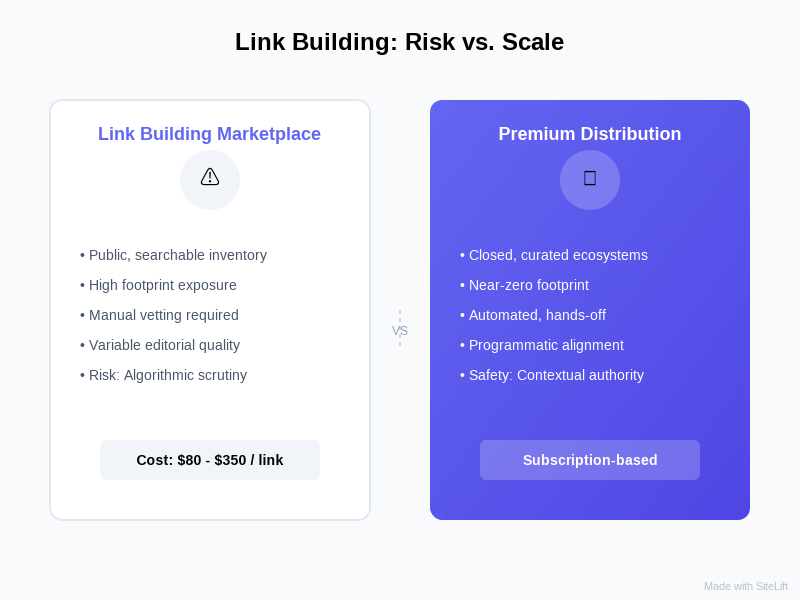
Infographic by SiteLift
| Feature / Metric | Link Building Marketplace | Premium Distribution Network |
|---|---|---|
| Inventory Accessibility | Public: Anyone can sign up, inspect the site list, and buy placements. | Private: Closed ecosystem; no public vendor lists available to crawlers. |
| Risk of Algorithmic Devaluation | High: Sites often devalued by updates due to unnatural link patterns. | Low: Natural link density, isolated footprints, and consistent editorial standards. |
| Metric Authenticity | Variable: Often inflated with expired domains, PBNs, or redirect loops. | Verified: Domains evaluated on real topical authority and stable search traffic. |
| Turnaround Time | 7 to 21 days per link (dependent on webmaster responsiveness). | Near-instant programmatic deployment via automated pipelines. |
| Management Labor | Extensive (manual vetting, anchor text tracking, QA reviews). | Zero to minimal (automated, continuous, and hands-off). |
| Cost Predictability | Unpredictable (volatile pricing, constant upsells, reseller markups). | Flat, predictable operational model based on syndication volume. |
Total Cost of Ownership: Unit Cost vs. Risk-Adjusted Cost
A major mistake teams make when evaluating a link building marketplace is looking only at the upfront price tag. A placement listed for $120 looks cheaper on paper than a managed software distribution plan.
However, the real math tells a different story. Consider the Total Cost of Ownership (TCO) of marketplace links:
- Vetting Overhead: An in-house SEO or content lead spending 45 minutes vetting each domain, checking anchor profiles, and reviewing historical metrics adds considerable internal labor costs to every placement.
- Quality Decay: Industry tracking reveals that up to 20% of low-cost marketplace links disappear, get redirected, or break within 12 to 18 months as webmasters abandon domains or scrub sponsored content.
- The Cleanup Bill: If a marketplace domain gets caught in a link spam cleanup, your team must spend hours running backlink audits, preparing disavow submissions, or working to recover lost rankings.
Marketplace Real Cost = Listing Price ($150) + Internal Vetting Labor ($75) + Cleanup & Churn Risk ($$$)
vs.
Premium Distribution = Predictable Cost + Automated Delivery + Zero Manual Vetting Overhead
When adjusted for risk and internal operational overhead, transactional marketplaces are often far more expensive over a 12-month horizon than automated premium syndication.
Why Relying Purely on Manual Outreach Is a Hidden Bottleneck
Industry traditionalists often argue that the only safe alternative to a link marketplace is purely manual, cold-email guest post outreach.
In my experience, manual outreach is one of the most inefficient growth channels in digital marketing. Conversion rates for cold PR emails have cratered over the past three years. Webmasters receive dozens of generic pitch templates every single day, leading to low open rates and aggressive demands for payment.
Scaling a brand requires predictable acquisition channels. Relying exclusively on manual outreach leads to high agency retainers, delayed publishing schedules, and volatile link velocity.
Premium distribution bridges this gap. It provides the programmatic scale, speed, and cost efficiency of an automated system, while delivering the editorial safety, footprint isolation, and contextual relevance of high-tier PR.
Which Model Is Right for Your SEO Growth Stage?
Choosing the right approach depends on your brand's risk tolerance, business model, and operational resources.
When an Open Link Marketplace Makes Tactical Sense
While risky for primary brand assets, an open link marketplace can be a viable tactical option under specific circumstances:
- Short-Term Niche Sites: If you run affiliate sites designed to capture quick seasonal trends, the speed of buying direct placements can outweigh long-term footprint risks.
- Testing and Throwaway Domains: If you are testing the impact of aggressive anchor text in a controlled environment outside your core brand entity.
- Highly Localized Directories: If you only need straightforward, hyper-local business directory citations without high editorial standards.
When Premium Distribution Is Non-Negotiable
For sustainable, high-growth businesses, open marketplaces create too much strategic risk. Premium distribution is essential if:
- You Are Scaling a SaaS or Cloud Brand: Enterprise software brands cannot afford the reputational and financial hit of an algorithmic penalty. Organic search stability is vital for valuation and customer acquisition.
- You Run a Lean Marketing Team: If you lack dedicated internal link builders to audit dozens of publisher sites each week, you need an automated, reliable system.
- You Are Optimizing for Modern Search and AI Visibility: If your goal is to be indexed, understood, and cited by AI answer engines, you need your brand contextually integrated across cohesive media networks, not buried on a low-quality guest post farm.
Pro Tip: If your primary revenue depends on maintaining your core domain's organic traffic, avoid pointing open-marketplace links directly to your money pages. Protect your core domain by using high-authority, curated distribution channels for primary equity, keeping transactional experiments confined to sandbox domains.
Safe Authority Building on Autopilot with SiteLift
Scaling organic visibility should not require choosing between risky link directories and exhausting manual outreach. Modern search demands a steady, automated publishing pipeline that pairs contextual content creation with safe, high-authority distribution.
This is where SiteLift changes the equation. SiteLift is an autonomous SEO and AI visibility platform built to help businesses dominate search and answer engines without manual friction.
Instead of dealing with unreliable link vendors or negotiating with webmasters, SiteLift handles the entire organic growth lifecycle automatically:
- Autonomous Content Creation: Produces comprehensive, search-optimized content tailored to your target keyword clusters and brand entity.
- Curated Premium Network Distribution: Distributes content across an isolated, high-authority media network, building safe contextual authority without unnatural footprints.
- Direct CMS Integration: Seamlessly connects with platforms like WordPress, Webflow, and custom stacks to publish directly to your site.
- Real-Time Momentum Tracking: Continuously monitors keyword rankings, backlink health, and AI visibility shifts across both traditional search and LLM answer engines.
By combining deep content production with automated, high-tier syndication, SiteLift lets you bypass the risks of open link marketplaces, driving compounding traffic and domain authority on autopilot.
Scale your organic traffic safely without manual vendor spreadsheets, high agency retainers, or penalty risks. — sitelift.io
Frequently Asked Questions
What is the main difference between a link building marketplace and a premium distribution network?
A link building marketplace is a public, open directory where anyone can buy individual sponsored guest posts or niche edits directly from registered publishers. A premium distribution network is a closed, curated syndication ecosystem that programmatically circulates context-rich content across an isolated media network, avoiding public footprints and manual negotiation.
Can Google detect and penalize backlinks purchased from link marketplaces?
Yes. Google uses AI-driven systems like SpamBrain to continuously identify unnatural link profiles, repetitive outbound linking patterns, and domains known for selling links. Sites that sell placements on public marketplaces often see their outbound links devalued, which can cause purchasing domains to lose organic rankings without a formal manual penalty notice.
How does automated premium distribution keep backlink profiles safe from penalties?
Automated premium distribution maintains safety by eliminating public footprints. Because the publisher networks are closed and privately curated, they avoid the unnatural outbound linking schemes common on public vendor platforms. Placements are embedded naturally within comprehensive, semantically relevant content, mirroring authentic editorial syndication.
Is managed link building via an agency safer than using an open link marketplace?
It depends on the agency's fulfillment process. Many traditional agencies simply buy their inventory from the very same open link marketplaces, marking up the price by 100% to 300% without doing deeper quality vetting. A managed agency is only safer if they use custom editorial outreach or operate secure, closed distribution networks with strict footprint isolation.
How do modern backlink strategies affect visibility in AI engines like ChatGPT and Google AI Overviews?
AI answer engines look for contextual entity validation across trustworthy, authoritative sources. Isolated links placed in generic, low-effort guest posts provide little semantic context for LLMs to analyze. Premium editorial distribution ensures your brand is mentioned alongside relevant industry terminology and complementary entities across authoritative networks, increasing your likelihood of being sourced in AI-generated answers.
Topics Covered:
- link building marketplace
- buy backlinks marketplace
- link marketplace risks
- premium backlink network
- managed link building
More from SiteLift

Link Building Examples That Earned Real Authority (And How to Replicate Them)
Explore 5 real-world link building examples from HubSpot, Canva, and Wise. Learn how to build high-authority linkable assets and scale organic rankings.

Link Building Advice From Scaleups: What to Automate and What to Avoid
Practical link building advice for scaleups. Learn what tactics to automate, high-risk strategies to avoid, and how to scale domain authority on autopilot.

How Long Should Meta Descriptions Be in 2026? Length, CTR and AI Snippets
Learn how long meta descriptions should be in 2026. Discover exact pixel limits, desktop vs mobile rules, CTR strategies, and AI snippet optimization.