Scaling E-Commerce Search Traffic: Agency Retainers vs Content Automation

If you run an online store with thousands of SKUs, you know that scaling e-commerce organic traffic is a constant battle against catalog size. Every new product launch, seasonal shift, and category update demands fresh, optimized copy. Historically, the default playbook has been to hire an ecommerce seo agency to manage this workload. But as catalogs grow, the manual math of agency retainers breaks down.
Is a traditional agency retainer still the best way to dominate search engines, or is autonomous content automation the unfair advantage your brand needs?
Let's look at how these two models stack up at a glance before diving into the core criteria you should use to evaluate them.
At-a-Glance: Agency Retainer vs. Content Automation
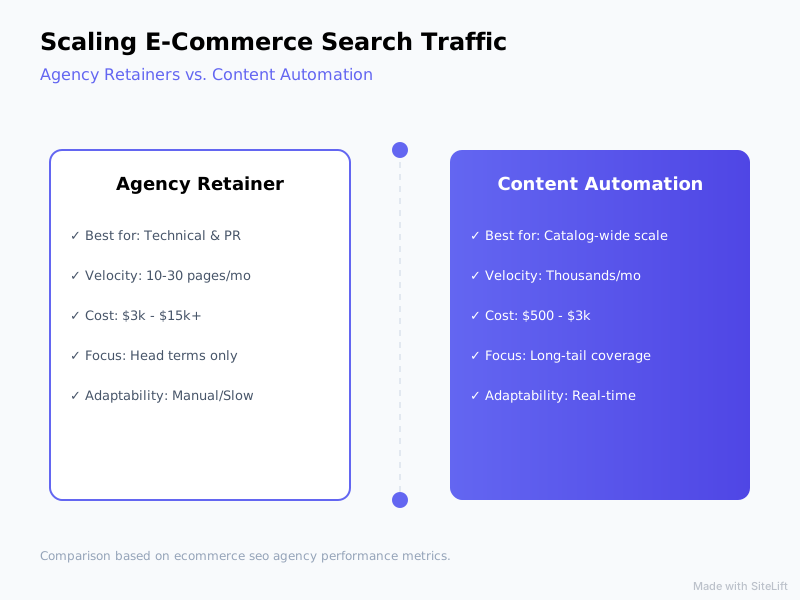
Infographic by SiteLift
| Evaluation Criteria | Traditional Ecommerce SEO Agency | Autonomous Content Automation |
|---|---|---|
| Best For | Complex technical migrations, custom PR link building, and brand positioning. | Catalog-wide SKU optimization, real-time indexation, and scaling category page rankings. |
| Content Velocity | Low (typically 10–30 manual pages optimized per month). | Programmatic (thousands of product and category pages optimized simultaneously). |
| Average Monthly Cost | $3,000 to $15,000+ per month. | $500 to $3,000 per month (software-based pricing). |
| Long-Tail SKU Coverage | Minimal; agencies focus only on top-tier "head" terms. | Comprehensive; systematically eliminates thin content across the entire catalog. |
| Adaptability to Search Updates | Slow; requires manual audits and manual content rewrites. | Near-instant; algorithmic updates can be deployed across the CMS in real time. |
How Should You Evaluate E-Commerce SEO Solutions? 4 Core Criteria
Selecting the right execution engine for your organic growth isn't just about comparing prices. It is about understanding how search engines interact with massive retail catalogs. When evaluating an ecommerce seo agency against automated platforms, you should filter every decision through these four core criteria:
1. Velocity and SKU Coverage
E-commerce SEO is fundamentally a game of scale. If your store has 5,000 SKUs, an execution model that only optimizes 20 pages a month will take over twenty years to touch your entire catalog. You must evaluate how quickly a solution can deploy high-quality product page seo across your entire long-tail inventory.
2. Category Page Ranking and Content Freshness
Category pages are your highest-intent organic entry points. To win a competitive category page ranking, those pages require structured content, strategic internal linking, and real-time updates. If your collection copy remains static while your inventory changes, search engines will slowly devalue those pages due to a lack of freshness.
3. Cost Predictability and Unit Economics
Your monthly burn rate must align with your revenue upside. You need to calculate the marginal cost per optimized page. If scaling your organic traffic requires a linear increase in manual copywriting hours, your unit economics will eventually degrade.
4. Adaptability to AI Search and SGE
Search is shifting rapidly from traditional blue links to AI-driven summaries and generative answers. As search engines evolve, your content must be structured so that LLMs can easily parse, cite, and recommend your products. This shift, often covered by search authorities like Search Engine Land, requires structured data agility that manual workflows struggle to keep up with.
The Scaling Dilemma: Why Manual SEO Stalls in E-Commerce
To understand why traditional approaches struggle, we have to look at how modern search engines view retail websites.
The Anatomy of E-Commerce Growth: Products, Collections, and Search Engines
According to Wolfgang Digital's E-Commerce KPI Report, organic search generates an average of 33% of total e-commerce revenue, making it the dominant revenue-driving channel across the retail sector. Furthermore, research published by Think with Google indicates that over 50% of shoppers use search engines to discover new brands and research products before making a purchase decision.
[Search Query] ➔ [Category Page (High Intent)] ➔ [Product Page (Conversion)]
       │                                                 ▲
       └─────────── Systemic Internal Linking ───────────┘
For search engines to index and rank your store, they must navigate a complex web of product variants, tags, and collection pages. When you have thousands of dynamic pages, search engine crawlers allocate a "crawl budget" to your site. If your site is bogged down with thin product descriptions, duplicate content, or broken internal links, crawlers leave before indexing your high-margin products.
The Reality of Agency Retainers vs Modern Algorithmic Demands
The traditional agency model was built for an era of static websites. Agencies work in monthly sprint cycles: they perform an audit in month one, write a few keyword-focused blog posts in month two, and optimize a handful of metadata tags in month three.
But search algorithms do not wait for monthly agency deliverables. If a competitor drops thousands of programmatically optimized pages overnight, or if Google rolls out a core update that penalizes thin product pages, a manual agency retainer cannot pivot fast enough to protect your market share.
Option 1: Evaluating the Traditional Ecommerce SEO Agency Model
Working with an agency has been the industry standard for decades. Let’s break down where this model shines and where it hits a wall.
High-Touch Strategy, Human Brainpower, and Bespoke Audits
A great agency brings seasoned human strategists to the table. They can sit down with your executive team, understand your brand’s unique positioning, and construct a bespoke marketing roadmap. They look at search not just as a technical puzzle, but as a component of your broader brand narrative.
The Bottlenecks: Hourly Scarcity, High Retainers, and Slow Turnaround
The primary limitation of an agency is that its business model is built on selling human hours. Because human labor does not scale infinitely, agencies must charge high premiums. A survey by Search Engine Journal found that over 48% of SEO agencies charge between $1,000 and $5,000 per month, with enterprise e-commerce retainers frequently exceeding $10,000 per month.
When you pay a $10,000 monthly retainer, a significant portion of that budget goes toward account management, status calls, and administrative overhead rather than direct optimization. Because manual copywriting is slow, agencies are forced to prioritize only your top 5% of pages. The remaining 95% of your catalog—the valuable long-tail product pages—remains unoptimized, plagued by manufacturer-provided duplicate descriptions that Google ignores.
Where Agencies Excel: Technical Migrations and Custom PR Link Acquisition
Where agencies truly earn their keep is during high-stakes structural changes. If you are migrating your store from Magento to Shopify, or consolidating multiple international domains, you need experienced technical SEOs overseeing the redirects.
Agencies are also uniquely suited for high-tier digital PR. Securing placements in major publications like The New York Times or Vogue requires manual outreach, relationship building, and creative pitching—tasks that software cannot replicate.
Option 2: Autonomous Content Automation Platforms
On the other side of the spectrum are autonomous content platforms designed to handle the heavy lifting of catalog-wide optimization without human bottlenecks.
Programmatic Scale: Automated E-Commerce Content Across Millions of SKUs
Autonomous platforms solve the scale problem by integrating directly with your CMS (such as Shopify, BigCommerce, or Custom API). Instead of optimizing pages one by one, these platforms use AI and structured data pipelines to deploy automated ecommerce content across your entire site instantly.
This includes generating unique, high-converting product descriptions, optimizing title tags, and creating contextual internal links that guide search crawlers naturally through your catalog.
Real-Time Indexing and Category Page Ranking Optimization
To rank category pages, you need more than just a list of products. You need descriptive, context-rich copy that explains the collection's value. Autonomous platforms monitor your inventory levels in real time. If a product goes out of stock, the platform automatically adjusts the category copy and internal links to point toward active products, preserving your link equity.
This programmatic precision aligns perfectly with Google Search Central guidelines, which emphasize structured merchant data, clear product attributes, and the elimination of thin or duplicate page architectures. By systematically enriching thin pages, automation platforms turn low-value utility pages into high-ranking search assets.
The Trade-Offs: Algorithmic Oversight and Integration Setup
While automation offers massive leverage, it is not a "set it and forget it" magic wand. It requires:
- Brand Voice Guardrails: You must feed the platform clear rules, vocabulary restrictions, and style guidelines so the generated copy matches your brand's tone.
- Technical Integration: Unlike an agency that just sends you a Google Doc, automation requires setting up secure CMS pipelines to publish changes automatically.
Pro Tip: When deploying automated e-commerce content, always run a pilot program on a single collection page or a subset of 100 SKUs first. Monitor indexation rates and search impressions for 14 days to fine-tune your brand voice parameters before pushing changes site-wide.
Head-to-Head: Traditional Ecommerce SEO Agency vs. Content Automation
To truly understand the operational differences, we have to look at the math behind both approaches.
Total Cost of Ownership (TCO) and Time-to-Value Comparison
Let's assume you run an e-commerce storefront with 5,000 active product pages and 150 category pages.
[Traditional Agency Model]
$8,000/mo Retainer ➔ 12 Months ➔ 300 Pages Optimized ➔ Cost per Page: $320.00

[Autonomous Automation Model]
$1,500/mo Platform ➔ 3 Months ➔ 5,150 Pages Optimized ➔ Cost per Page: $0.87
If you hire an agency on an $8,000 monthly retainer, they might commit to optimizing 25 pages per month. Over a year, you will spend $96,000 to optimize just 300 pages. Your cost per optimized page is a staggering $320, and 94% of your catalog remains untouched.
If you deploy an autonomous content automation platform at $1,500 per month, the platform can scan, optimize, and publish updated metadata and descriptions for all 5,150 pages within the first month. Over a year, your total software spend is $18,000, bringing your cost per optimized page down to $3.49.
Furthermore, unlike traditional agencies that rely on slow, static monthly PDF decks—which we discuss in our deep dive on next-generation SEO reporting software—automation platforms provide real-time dashboards that show indexing momentum and keyword growth as it happens.
Why Category Page Optimization is the Most Underrated Lever in E-Commerce
"In my experience advising mid-market retail brands, I've noticed a glaring blind spot: most SEO teams spend 80% of their marketing budget writing generic blog posts that never convert, while completely ignoring their collection pages.
Category pages are the true powerhouses of retail search. They inherit the most backlink authority and target broad, high-volume transactional keywords. If you aren't programmatically injecting contextually relevant, dynamically updated copy onto these pages, you are leaving millions in search revenue on the table for your competitors to grab."
— sitelift.io
Which Model Fits Your Brand? Strategic Decision Framework
Choosing between an agency and automation isn't an all-or-nothing decision. It depends entirely on your operational scale, catalog complexity, and internal capabilities.
When Hiring an E-Commerce SEO Agency Makes Sense
You should partner with a specialized agency if:
- You have a small, curated catalog of fewer than 100 high-margin products where every single word requires manual, multi-layered executive sign-off.
- You are preparing for a massive, complex website migration (e.g., merging three legacy brands into one Shopify Plus storefront).
- Your primary SEO bottleneck is a complete lack of high-authority backlinks, and you need a dedicated digital PR team to run manual outreach campaigns.
When Content Automation Delivers Unfair Scaling Advantages
You should deploy an autonomous content platform if:
- You manage a catalog of 500 to 100,000+ SKUs with frequent inventory changes, seasonal rotations, or multi-brand distribution.
- You have hundreds of category pages that are currently empty of copy, suffering from thin-content penalties, or failing to rank for target keywords.
- You want to maximize your marketing efficiency by reducing your reliance on expensive human retainers for repetitive, programmatic tasks.
The Hybrid Approach: Augmenting Boutique Strategy with Autonomous Execution
The most sophisticated retail brands are moving toward a hybrid model. They retain a boutique agency or an in-house SEO director to handle high-level brand strategy, technical site health, and digital PR.
Then, they deploy an autonomous platform like SiteLift to execute the massive, daily operational tasks: optimizing product page seo, refreshing category copy, and maintaining internal link distribution across thousands of URLs.
This allows human talent to focus on creative strategy, while software handles the relentless execution of catalog-wide visibility.
Autonomous SEO: The Future of E-Commerce Scaling
As search engines become more algorithmic and AI-driven, scaling your organic channel manually is no longer viable. The rapid growth of global e-commerce, as documented by market research on Statista, means that search real estate is more competitive than ever.
If you are ready to move past the limitations of manual copywriting and expensive agency retainers, SiteLift offers a fully autonomous SEO and content automation platform built for modern retail. By integrating directly with your store, SiteLift automatically generates high-quality content, optimizes your product and category pages, and builds systemic authority across your entire catalog on autopilot.
Don't let your long-tail catalog sit in the dark. Let software do the heavy lifting so you can focus on scaling your brand.
FAQ
How much does a typical ecommerce SEO agency cost per month?
For mid-market to enterprise retail brands, a typical retainer ranges from $3,000 to $15,000+ per month. These costs are driven by human hourly rates, account management fees, and the manual nature of traditional SEO deliverables.
Can automated ecommerce content rank as well as human-written copy on Google?
Yes. Google’s helpful content guidelines focus on the quality, structure, and utility of the information provided, not whether a human or a machine wrote it. Highly structured, context-rich automated copy that provides accurate product specifications, answers user questions, and improves page UX frequently outranks manual copy that lacks technical optimization.
How does content automation handle product page SEO for seasonal or out-of-stock items?
Autonomous platforms integrate directly with your product inventory feed. When an item goes out of stock, the platform can automatically update the page metadata to reflect availability, modify internal links to redirect search equity to similar active products, or dynamically add a "related products" block to keep users engaged.
Should fast-growing DTC and retail brands choose an agency or an automated platform?
Fast-growing brands with catalogs exceeding 500 SKUs should prioritize an automated platform to build a scalable foundation quickly. If the brand has complex technical debt or requires high-tier public relations, they can hire a specialized agency to work alongside the automation software.
Topics Covered:
- ecommerce seo agency
- ecommerce organic traffic
- product page seo
- category page ranking
- automated ecommerce content
More from SiteLift

International Organic Expansion: Scaling Global SEO Without Massive Agency Retainers
Execute international search expansion with proven technical steps, automated localization, and cross-border growth tactics. Start scaling today.

The Modern Guide to White Label SEO: Automating Client Success at Scale
Learn how to scale your agency with white label SEO. Discover automated fulfillment, content marketing, and reporting strategies that maximize profit.

Why B2B SaaS Brands Are Replacing Traditional B2B SEO Agencies with AI Workflows
Stop paying retainers for stale reports. See how AI workflows drive b2b lead generation, automate content pipelines, and outperform traditional b2b seo agency models.