International Organic Expansion: Scaling Global SEO Without Massive Agency Retainers

If you’ve ever tried to scale your brand across borders, you’ve likely been handed a proposal from a global seo agency promising overnight rankings in Tokyo, Berlin, and São Paulo. The pitch sounds flawless until you see the monthly invoice. Most international expansion strategies fail not because of bad ideas, but because they’re built on bloated retainers, generic playbooks, and zero technical infrastructure. You don’t need a team of account managers sending you polished PDFs every Friday. You need a systematic, automated pipeline that handles localization, technical validation, and authority building while you sleep.
This guide walks you through the exact operational framework top-performing brands use to execute international search expansion. We’ll cover everything from URL architecture and hreflang deployment to transcreation workflows and cross-border link acquisition. By the end, you’ll have a replicable blueprint for cross-border organic growth that scales efficiently without burning through six-figure budgets.
Prerequisites: What You Need Before Beginning International Search Expansion
Before you touch a single line of code or commission a single piece of content, you need to validate whether your current setup can actually support global scaling. Rushing into new markets without this foundation guarantees technical debt down the road.
Auditing Existing Search Footprint and Global Market Demand
Start by pulling your Google Analytics 4 and Google Search Console data. Filter impressions and clicks by country to identify which regions are already organically discovering your brand. Don’t guess your next target market; let the data dictate it. Look for territories showing consistent impression growth despite minimal localized optimization. Those are your low-hanging fruit.
Simultaneously, validate commercial demand using tools like SEMrush, Ahrefs, or SimilarWeb. Cross-reference search volume with local purchasing power and competitor saturation. Setting realistic international search goals means mapping out three tiers: Tier 1 (high volume, moderate competition), Tier 2 (moderate volume, low competition), and Tier 3 (niche markets requiring heavy localization). Compare these targets against what a typical enterprise contract would promise versus what your actual technical capacity can deliver.
Evaluating Tech Stack Readiness for Multilingual SEO
Your CMS isn’t just a content editor; it’s the backbone of your global footprint. Assess whether your platform supports dynamic localization, server-side rendering for speed, and seamless hreflang deployment. If you’re running on a rigid enterprise CMS that requires developer tickets to change metadata, you’ll bottleneck your expansion.
You also need a CDN configured for geo-targeted delivery and a structured data layer that can handle multiple languages simultaneously. Run a quick crawl (Screaming Frog or Sitebulb) to check for hard-coded URLs, missing alt tags, and inconsistent date/number formatting. If your stack doesn’t natively support parameter routing or automatic language switching, prioritize upgrades before writing a single localized page.
Step 1: Choose the Right International URL Architecture
How you structure your URLs dictates how search engines distribute authority, how crawlers budget their time, and how easily you can manage content at scale. Get this wrong, and you’ll spend years fighting duplicate content penalties.
ccTLDs vs. Subdirectories vs. Subdomains: Trade-offs Explained
The debate between .com.br vs. example.com/br/ vs. br.example.com is eternal, but the answer depends entirely on your resources. ccTLDs offer maximum local trust and domain separation, but they fracture link equity and require independent maintenance, hosting, and security setups. Subdomains split authority more aggressively than subdirectories and often trigger stricter indexing scrutiny. Subdirectories (domain.com/de/) consolidate domain authority, simplify technical management, and align perfectly with modern automated publishing pipelines.
For businesses focused on rapid scaling without massive overhead, subdirectories remain the industry standard. They preserve your root domain’s PageRank across all locales, reduce crawl budget waste, and allow centralized CMS management.
Implementing Scalable Subdirectory Routing
Configure your web server to route traffic based on Accept-Language headers or IP geolocation, but never rely on client-side JavaScript redirects for initial routing. Use 301 server-side redirects that respect user choice while remaining fully visible to bots. Always include a manual language switcher in your navigation to override auto-detection, which satisfies both user experience guidelines and crawler best practices.
Pro Tip: Always pair subdirectory routing with explicit locale parameters in your analytics and tagging systems. Otherwise, your performance reports will blend globally, making it impossible to isolate which markets are actually converting.
Step 2: Execute Nuanced Multilingual Keyword Research (Beyond Machine Translation)
Direct machine translation of English keywords into Spanish, Mandarin, or Arabic is a fast track to ranking for zero traffic. Search behavior varies drastically across cultures, and algorithmic preferences shift accordingly.
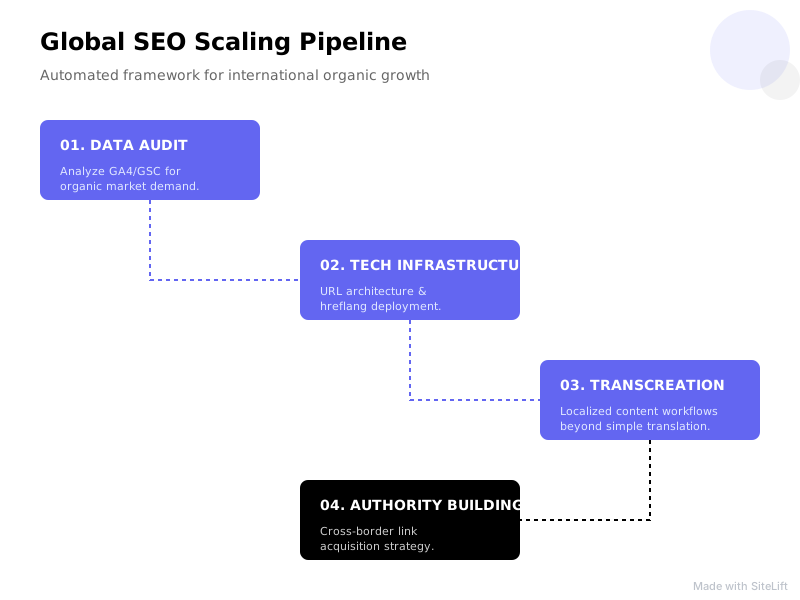
Infographic by SiteLift
Uncovering Localized Search Intent and Regional Search Engines
Google dominates much of the Western world, but according to Statcounter, Google accounts for less than 70% of search engine market share in several major international economies such as Russia, South Korea, and China. In those regions, you must optimize for Yandex, Naver, and Baidu respectively. Each engine prioritizes different signals: Yandex favors social engagement and domain age, Naver relies heavily on blog ecosystems and curated hubs, and Baidu demands strict domestic hosting and licensing compliance.
Map your keyword clusters to local intent patterns. A transactional query in English might translate to an informational journey in another market. Use local autocomplete suggestions, forum discussions, and regional competitor audits to build authentic term lists.
Transcreation vs. Direct Word-for-Word Translation
Translation preserves words. Transcreation preserves intent. When adapting headlines, meta descriptions, and product copy, work with native speakers who understand cultural nuance, idioms, and buying triggers. According to CSA Research (formerly Common Sense Advisory), 76% of online shoppers prefer purchasing products with information presented in their native language. That preference extends beyond grammar; it encompasses measurement units, currency formatting, seasonal references, and trust signals.
Build language-specific keyword matrices that separate commercial, navigational, and informational queries. Group them by funnel stage and assign them to dedicated landing pages rather than stuffing multiple intents onto a single URL.
Step 3: Deploy Accurate Hreflang and Technical Localization Tags
Hreflang implementation is where most international SEO projects derail. One misplaced tag can send users to the wrong locale, confuse crawlers, and tank your indexing rate.
Generating XML Hreflang Sitemaps Programmatically
Manual hreflang entry is a nightmare at scale. Instead, automate sitemap generation directly from your CMS or publishing platform. Each localized URL must declare itself and all its variants, including the inverse references. If your French page points to the English version, the English page must reciprocate. Break that chain, and Google will ignore your signals entirely.
Validate your implementation against official documentation from Google Search Central, which provides clear guidelines on managing multi-regional and multilingual sites. Automated generation eliminates human error, ensures consistency, and allows instant updates when you launch new locales.
Configuring Self-Referencing and X-Default Fallback Tags
Every localized page must contain a self-referencing hreflang tag pointing to itself. Omit this, and crawlers struggle to determine which version to index. Additionally, implement an x-default tag that routes users to a neutral fallback page when no matching locale is detected. This usually looks like an English or regional hub page with clear country selectors.
Pay strict attention to ISO language and country code pairings. en-US and en-GB are not interchangeable. Mixing them up causes content dilution and triggers internal cannibalization. Align your hreflang pairs precisely with your server routing and analytics segmentation.

Step 4: Scale Localized Content Distribution and Transcreation
Once your technical foundation is solid, you need a reliable pipeline to produce and publish high-quality localized assets. Manual freelancing won’t scale. You need autonomy.
Establishing an Autonomous Publishing Workflow
Move away from sporadic content commissions. Build a repeatable system that generates topic clusters, drafts localized copy, optimizes on-page elements, and publishes directly to your CMS. Modern platforms can handle this entire loop, complete with quality checks and regional compliance filters.
Automated publishing doesn’t mean robotic content. It means removing friction from the production cycle so your team can focus on strategy, cultural adaptation, and performance optimization instead of chasing translations. When you streamline the workflow, velocity increases without sacrificing accuracy.
Integrating Local Cultural Context and Currency/Measurement Standards
Localized content distribution goes far beyond swapping keywords. Your metadata, structured data, and on-page copy must reflect native target-country standards. Dates should follow DD/MM/YYYY where appropriate, prices must display local currency symbols, and testimonials should feature recognizable regional names or contexts.
Distribute your localized content across authoritative regional networks to accelerate early indexing. Syndication to trusted local publishers, guest posting on niche blogs, and leveraging community platforms builds topical relevance faster than waiting for organic discovery.
Step 5: Build Cross-Border Organic Authority and In-Market Backlinks
Domain authority doesn’t transfer automatically across borders. A .com site with a thousand US backlinks won’t magically dominate German search results. You need local endorsement.
Securing Country-Specific Referring Domains
Search algorithms heavily weight backlinks from domains registered and hosted within the target country. Prioritize acquiring links from .de, .fr, .jp, or other ccTLDs operating in your niche. Focus on resource pages, industry directories, university citations, and regional press mentions. Quality always outweighs quantity; ten relevant local links beat fifty generic directory submissions.
Automating relationship building with niche publishers in non-English markets requires outreach templates that respect local communication norms. Formality levels, response times, and value propositions vary widely across cultures. Personalize your approach, highlight mutual audience benefits, and offer genuinely useful assets rather than hollow link requests.
Digital PR and Localized Syndication Tactics
Launch targeted digital PR campaigns timed to regional holidays, industry events, or economic announcements. Pitch data-driven studies, expert commentary, or case studies to local journalists and trade publications. When secured, embed contextual links within culturally relevant narratives rather than forcing branded anchors.
Monitor inbound anchor texts across varied languages to ensure natural link distribution. Over-optimization in any single language triggers spam filters. Diversify your anchor profile with branded terms, naked URLs, partial matches, and conversational phrases that mirror how locals actually discuss your brand.
Step 6: Track Regional SERP Momentum and AI Search Visibility
International SEO isn’t a set-it-and-forget-it strategy. Markets shift, competitors adapt, and algorithm updates ripple differently across regions. Continuous measurement keeps you ahead.
Monitoring Geo-Specific Rankings and LLM Citations
Standard rank trackers often return skewed results due to proxy location mismatches or cached SERPs. Use country-specific proxies or distributed monitoring tools to capture authentic local rankings. Track keyword movements weekly, segment by locale, and correlate fluctuations with content deployments or algorithm shifts.
Equally important is measuring brand visibility in regional AI search engines and answer bots. Large language models increasingly source answers from indexed websites. Ensure your localized pages are cited by training data aggregators and featured in AI-overview snippets by structuring content clearly, answering common questions directly, and maintaining consistent factual accuracy.
Refining Underperforming Locales with Real-Time Analytics
Don’t spread resources evenly. Double down on markets showing positive impression-to-conversion ratios and pause or restructure underperforming ones. Identify content gaps by comparing your published pages against top-ranking competitors in each locale. Update outdated statistics, refresh stale headlines, and rebuild internal linking structures to push equity toward priority pages.
Iterate based on regional impression spikes and conversion patterns. What works in Brazil may flop in Sweden. Treat each market as a distinct experiment with its own control variables.
Troubleshooting Common International SEO Pitfalls (And When a global seo agency Won't Save You)
Even with a solid plan, execution hiccups happen. Here’s how to diagnose and fix the most frequent breakdowns.
Resolving Hreflang Conflict Errors in Google Search Console
When you see “no-return-tag” or “invalid hreflang” warnings, audit your XML sitemaps and HTTP headers. Missing self-referential links are the most common culprit. Ensure every variant points to itself and all others. Validate syntax against W3C Internationalization standards for language codes and web architecture. Once corrected, request recrawling and monitor resolution within 48 hours.
Preventing Internal Cannibalization Across English Variants
US, UK, Canadian, and Australian audiences often search identical phrases but expect different spelling, pricing, and legal disclaimers. If you serve the same page to all four, Google struggles to pick a winner, and you dilute rankings. Create distinct localized versions with tailored metadata, schema markup, and region-specific content blocks. Route traffic appropriately and eliminate overlapping URL parameters.
Managing Automated CDN Caching to Ensure Regional Users See Appropriate Localized Versions
CDNs cache aggressively, which can trap users in the wrong locale after a configuration change. Implement cache-busting rules for locale-switching endpoints, purge regional caches immediately after hreflang updates, and test routing thoroughly using incognito windows and device simulators before rolling out globally.
Why Automation Beats Agency Playbooks Every Time
Let me be direct: most international SEO agencies aren’t solving complex technical problems. They’re selling access to spreadsheets, monthly reporting decks, and junior specialists who stitch together basic keyword lists. I’ve seen teams burn $15,000 a month for half a dozen translated blog posts and a handful of low-authority directory links. Meanwhile, the technical foundation rots from improper hreflang handling and fragmented URL structures.
Real cross-border success comes from systematization. When you automate content generation, enforce technical validation at the publishing level, and distribute assets through curated regional networks, you remove the human bottleneck. You stop paying for overhead and start paying for infrastructure. The brands dominating global SERPs aren’t working harder; they’re working smarter with integrated pipelines that compound authority month over month.
Expected Outcomes: Measuring International Organic Growth vs. a global seo agency
Scaling internationally isn’t instantaneous, but the trajectory becomes predictable when you replace reactive agency tactics with proactive automation.
Timeline to Organic Impact across Multi-Region Deployments
Expect measurable traction within 30 days as newly localized pages get indexed and begin capturing long-tail queries. By day 60, you’ll typically see impression growth in Tier 2 markets and initial click-through improvements from optimized meta assets. Day 90 marks the inflection point: internal linking equity stabilizes, local backlinks mature, and geographic SERP features (like local packs or language-specific rich results) start appearing consistently.
Full dominance takes longer, but compounding effects kick in once you’ve established consistent publishing cadences across five or more locales. Authority transfers faster when your technical signals remain clean and your content velocity stays high.
Cost-Efficiency Analysis: In-House Automation vs. Global SEO Agency
The math speaks for itself. A survey by Ahrefs revealed that 73.6% of SEO professionals charge a monthly retainer, with top-tier international and enterprise agencies regularly charging between $5,000 and $25,000+ per month. Those fees cover account management, reporting, and outsourced labor—not guaranteed rankings.
Autonomous publishing platforms operate on fixed subscription models that scale linearly with added locales. You get programmable hreflang validation, automated multilingual SEO workflows, real-time performance dashboards, and direct CMS integration without incremental consulting fees. The unit economics favor infrastructure over retainers, especially when you factor in opportunity costs: slower time-to-market, delayed indexing, and missed regional trends.
Ready to stop outsourcing your international expansion and start owning the pipeline? Platforms like sitelift.io provide end-to-end autonomous publishing that handles localization, technical validation, and regional distribution without manual intervention. Whether you’re targeting European markets, Asian economies, or Latin American territories, building a scalable organic footprint starts with removing friction from your workflow. Explore how autonomous SEO solutions can transform your cross-border visibility and capture GEO-ready traffic at scale.
FAQ
Why hire a global seo agency when you can automate international organic expansion?
Agencies excel at strategy and creative direction, but they rarely provide the technical infrastructure needed for sustained global scaling. Their retainers cover reporting, account management, and outsourced labor, not automated validation or continuous publishing pipelines. Automation platforms handle hreflang enforcement, localized content generation, and regional distribution at a fraction of the cost, eliminating human bottlenecks and delivering consistent velocity without monthly billing surprises.
What is the difference between translation and transcreation in multilingual seo?
Translation converts words from one language to another while preserving literal meaning. Transcreation adapts concepts, tone, cultural references, and buying triggers to match local intent. In SEO, transcreation ensures headlines, meta descriptions, and product copy resonate with regional search behavior rather than awkwardly mirroring English phrasing. It’s the difference between ranking for zero traffic and capturing genuine commercial intent.
How long does it take to rank in international search results?
Initial indexing typically occurs within two to four weeks after proper hreflang deployment and sitemap submission. Meaningful impression growth appears around day 30 to 60, depending on content depth and local competition. Full competitive positioning in Tier 2 markets usually requires 90 to 180 days of consistent publishing, localized backlink acquisition, and iterative optimization. Faster results come from prioritizing low-competition niches and maintaining technical cleanliness from day one.
Do I need a separate domain (ccTLD) for every country I target?
Not necessarily. Subdirectories (example.com/fr/) consolidate domain authority, simplify technical management, and align better with automated publishing workflows. ccTLDs offer maximum local trust but fragment link equity, require independent hosting, and multiply maintenance overhead. Use subdirectories for rapid scaling and reserve ccTLDs for markets where regulatory compliance, local branding, or extreme competitive density demands full domain separation.
How do hreflang tags affect crawl budget and page indexing?
Correctly implemented hreflang tags help search engines understand which page serves which audience, reducing duplicate content confusion and improving indexing efficiency. Incorrect or missing tags force crawlers to guess locale mapping, wasting budget on redundant scans and potentially triggering soft 404 errors. Proper self-referencing, reciprocal linking, and x-default fallbacks keep your crawl allocation focused on unique, high-value localized pages.
— sitelift.io
Topics Covered:
- global seo agency
- multilingual seo
- international search expansion
- cross-border organic growth
- localized content distribution
More from SiteLift

The Modern Guide to White Label SEO: Automating Client Success at Scale
Learn how to scale your agency with white label SEO. Discover automated fulfillment, content marketing, and reporting strategies that maximize profit.

Why B2B SaaS Brands Are Replacing Traditional B2B SEO Agencies with AI Workflows
Stop paying retainers for stale reports. See how AI workflows drive b2b lead generation, automate content pipelines, and outperform traditional b2b seo agency models.

Scaling E-Commerce Search Traffic: Agency Retainers vs Content Automation
Compare a traditional ecommerce seo agency with automated content scaling. Discover how to grow your e-commerce organic traffic at scale.