Navigating Search Engines Without AI: How to Maintain Visibility Across All Platforms

Have you noticed how cluttered your search results have become lately? You type a quick query, hoping for a straightforward list of links, but instead, you are greeted by a massive, slow-loading block of AI-generated text that may or may not be accurate. Across Europe, a growing number of web users are feeling the same fatigue. This frustration has sparked a quiet but significant shift toward search engines without ai, as people look for cleaner, faster, and more reliable ways to browse the web.
For businesses and marketers, this shift presents a unique challenge. How do you maintain organic visibility when a portion of your audience is actively opting out of the AI-driven web?
To help you navigate this changing landscape, we have broken down the core differences between traditional search, AI-driven summaries, and alternative search platforms, along with the precise strategies you need to capture traffic from both sides of the fence.
Key Takeaways: Navigating the Non-AI Search Landscape
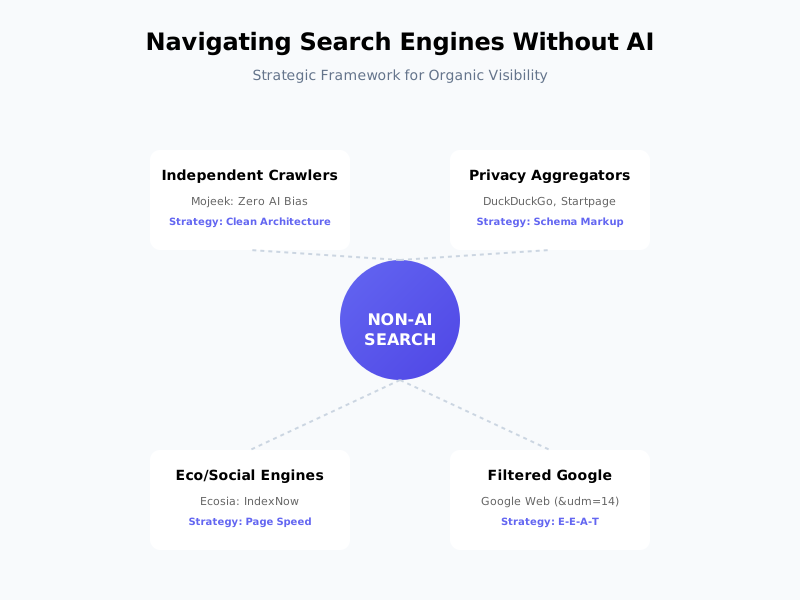
| Platform Category | Key Examples | Primary User Benefit | Core Optimisation Strategy |
|---|---|---|---|
| Independent Crawlers | Mojeek | Zero AI bias, complete privacy, independent index | Clean site architecture, direct sitemap submission |
| Privacy Aggregators | DuckDuckGo, Startpage | Clean traditional Google/Bing results without tracking | Schema markup, high-quality backlinks, Bing Webmaster Tools |
| Eco/Social Engines | Ecosia | Tree planting, privacy-focused, powered by Bing | Local SEO, IndexNow protocol, fast page speeds |
| Filtered Google | Google Web (&udm=14) |
Traditional Google search without AI Overviews | Classic technical SEO, high domain authority, E-E-A-T |
Why Are Users Actively Seeking Search Engines Without AI?
The promise of generative AI in search was supposed to be a revolution. Instead, for many users, it has felt more like an intrusion. The European market, in particular, has shown a distinct skepticism toward AI-driven search results, driven by three main factors.
The Rise of AI Overviews and Searcher Fatigue
When Google rolled out AI Overviews, the goal was to provide quick answers to complex questions. However, the reality has often been a mix of slow loading times, layout shifts, and outright hallucinations (such as famously suggesting users put glue on pizza).
Many users simply want to find a direct source, read an expert opinion, or make a purchase without having to scroll past a massive block of AI-synthesised text. A 2024 survey by Pew Research revealed that 68% of users prefer direct web links over AI-generated summaries when looking for factual or transactional information. This fatigue is driving power users back toward a cleaner, more traditional Google search experience.
Privacy Concerns and Data Harvesting in AI Models
To feed hungry Large Language Models (LLMs), tech giants require astronomical amounts of data. Every search query, click, and browsing habit is treated as training material.
For privacy-conscious individuals, this is a step too far. Users are increasingly turning to privacy search engines that do not log search history, build user profiles, or use personal data to train proprietary AI models.
The European Context: GDPR and the Digital Markets Act (DMA)
Europe has always been a global leader in user privacy and market competition. The strict enforcement of the General Data Protection Regulation (GDPR) makes the data-hungry nature of AI models highly legally sensitive in EU member states.
Furthermore, the European Commission's implementation of the Digital Markets Act (DMA) has forced major operating systems to present users with "choice screens" for browsers and search engines. According to research from the European Commission, these choice screens increased the adoption of alternative search platforms by up to 30% in select EU countries within just months of implementation.
While Statcounter data shows that Google still holds over 90% of the European search market, alternative search engines like Ecosia and DuckDuckGo have successfully captured millions of active monthly users across Germany, France, and the UK.
What Are the Top AI-Free Search Engines and Alternative Platforms?
If users are opting out of AI-heavy search, where are they going? The alternative search ecosystem is diverse, consisting of independent crawlers, privacy-focused proxies, and eco-conscious platforms.
European Privacy Leaders: Qwant, Ecosia, and Mojeek
Europe is home to some of the most successful alternative search engines in the world:
- Qwant (France): A privacy-first search engine that does not track your searches or sell your personal data. It is highly popular in French-speaking markets and prides itself on delivering unbiased, non-profiled search results.
- Ecosia (Germany): Known as the search engine that plants trees. While its search results are primarily powered by Microsoft Bing, Ecosia strips away invasive tracking and uses its profits to fund global reforestation projects.
- Mojeek (UK): Unlike most alternative engines that rely on big tech infrastructure, Mojeek is a true independent crawler-based search engine. It has built its own index of billions of pages, offering a completely independent, AI-free search experience.
Global Alternatives: DuckDuckGo, Brave Search, and Startpage
Beyond European borders, several global players have established massive footprints within the European continent:
- DuckDuckGo: The undisputed giant of privacy search. While it offers a modern interface, users who want an absolutely stripped-back, script-free experience often use the DuckDuckGo Non-JS / Classic interface.
- Brave Search: Built by the creators of the Brave Browser, this engine uses its own independent index (rather than relying on Google or Bing) and offers a clear toggle to turn off its "Answer with AI" features.
- Startpage: Based in the Netherlands, Startpage acts as a privacy buffer. It delivers traditional Google search results but strips out all user-identifying trackers and IP logging.
Specialized Indexes vs. Aggregators: How They Source Results
To optimise for these platforms, you must understand how they get their data.
Aggregators (like DuckDuckGo, Startpage, and Ecosia) pull their search results from major indexes like Bing or Google. If you rank well on Bing and Google, you will naturally rank well on these platforms.
Independent Indexes (like Mojeek and Brave Search) write their own web crawlers to map the internet. To appear on these platforms, your website must be easily accessible to non-standard crawler bots, requiring a return to technical SEO fundamentals.
How Can Businesses Maintain Search Visibility Across Search Engines Without AI?
Optimising for search engines without ai does not require throwing out your existing marketing playbook. Instead, it requires a renewed focus on clean, accessible, and highly structured web design.
Mastering Traditional SEO Fundamentals for Standard Crawlers
When search engines do not rely on AI models to guess user intent, they fall back on classical algorithmic ranking factors. This means your technical SEO must be flawless:
- Page Speed: Alternative search engines often have fewer server resources than Google. A fast-loading, lightweight website is much easier for their crawlers to parse.
- Clean Site Architecture: Ensure your internal linking is logical. Avoid deep nesting of pages; a flat site structure helps alternative crawlers discover your content quickly.
- High-Quality Backlinks: Traditional link equity (PageRank) remains the primary trust signal for non-AI indexes. Focus on earning natural links from authoritative European domains.
Optimising for Alternative Search Engine Indexing
Because many alternative platforms rely on Bing's index, you must treat Bing Webmaster Tools with the same level of respect as Google Search Console.
Pro Tip: Implement the IndexNow protocol. This is an open-source tool supported by Bing, Yandex, Seznam, and various alternative engines that instantly notifies search crawlers when content on your site is created, updated, or deleted.
Additionally, do not block alternative crawlers in your robots.txt file. While it is common practice to block aggressive AI scraping bots, make sure you are not accidentally blocking independent, privacy-focused search crawlers like MojeekBot.
Leveraging Structured Data and Direct Authority Signals
Without AI to synthesise and interpret poorly structured pages, search engines rely heavily on schema markup and semantic HTML.
Using clear header tags (H1, H2, H3) and nested schema (such as Article, Product, or LocalBusiness) tells traditional crawlers exactly what your content is about. This structured approach is also the foundation of modern search optimization. For a deeper look at how to align your content with user intent across different search experiences, check out our What is Search Experience Optimization (SXO)? Europe Guide.
How to Force Traditional Google Search Without AI Overviews
Many power users, journalists, and researchers do not want to abandon Google entirely, but they do want to escape the AI clutter. Fortunately, there is a simple way to force Google to act like a traditional search engine.
Utilizing the Google 'Web' Filter (&udm=14)
In mid-2024, Google quietly introduced a "Web" filter that strips away AI Overviews, shopping grids, video carousels, and local packs, leaving only the classic "blue links."
You can trigger this filter manually by adding the parameter &udm=14 to the end of your Google search URL.
For example:
https://www.google.com/search?q=best+organic+coffee&udm=14
Browser Extensions and Custom Search Engines Settings
Because manually typing a URL parameter is tedious, many European users are setting up their browsers to append this parameter automatically.
In browsers like Firefox, Brave, or Vivaldi, users can set up a custom search engine with the query URL set to https://google.com/search?q=%s&udm=14. There are also popular browser extensions (like "Hide Google AI Overviews") that do this automatically.
Why Marketers Must Track Both AI and Standard Search Rankings
As a marketer, you cannot assume everyone is seeing the same search engine results page (SERP). If a significant portion of your target audience is using the udm=14 filter or privacy-first alternatives, your "AI Overview" visibility metrics only tell half the story.
You need to monitor your classic organic search rankings alongside your AI visibility footprint to ensure you are not losing ground in the traditional index.
Why the AI-Free Search Movement is Underrated (My Take)
In my experience, the digital marketing industry has developed severe tunnel vision. We are so obsessed with optimizing for AI search engines, LLM mentions, and zero-click answers that we are completely ignoring a highly lucrative, high-intent segment of the market.
I believe the shift toward AI-free search engines is one of the most underrated trends in modern digital marketing.
The users who actively seek out these platforms are not casual browsers. They are developers, executives, researchers, and privacy-conscious consumers. These are individuals with high purchasing power who value directness, authenticity, and transparency.
By building a website that is fast, structured, and free of over-optimised AI fluff, you aren't just catering to alternative search engines—you are building a better experience for your most valuable human users.
Pro Tip: Always test how your website renders without JavaScript enabled. Platforms like DuckDuckGo HTML rely on clean, server-side rendered HTML. If your site is a heavy client-side React or Vue application that displays a blank screen when JavaScript is turned off, you are invisible to these users and their preferred crawlers.
Future-Proofing Your Brand Across AI and Traditional Search
The future of search is not a winner-take-all game. We are moving toward a fragmented search ecosystem where users choose their platform based on their immediate needs and personal values.
To maintain visibility across all platforms, businesses must adopt a dual-track strategy:
- For AI Engines: Produce authoritative, original research and secure brand mentions across reputable industry publications.
- For Traditional & Privacy Engines: Double down on technical SEO, clean semantic HTML, rapid page speeds, and direct index submission.
Managing this level of distribution manually can quickly become overwhelming. This is where SiteLift can help.
As an autonomous SEO and content visibility platform, SiteLift is built to handle the complexities of the modern, fragmented web. It automatically generates high-quality, structured content designed to appeal to traditional search crawlers, while distributing it across a premium network to build the authority signals that both AI models and classic search engines demand.
By automating your publishing pipeline, you can ensure your brand remains highly visible to every user—whether they are searching with advanced AI or browsing the web completely AI-free.
FAQ
Can you turn off AI Overviews in Google Search?
There is no official "turn off" toggle in Google's settings. However, you can force Google to display only traditional text links by clicking the "Web" filter on the search results page, or by adding the parameter &udm=14 to your search URL.
What is the best search engine without AI summaries?
For an entirely independent experience, Mojeek is the best option as it uses its own non-AI crawler and index. For those who want Google-quality results without tracking or AI summaries, Startpage is highly recommended.
How do alternative search engines rank websites without AI algorithms?
They rely on traditional algorithmic ranking factors. These include keyword density, page speed, mobile-friendliness, semantic HTML structure, and the quality and quantity of inbound backlinks (PageRank).
Why are European users shifting to privacy-focused search engines?
European users are highly sensitive to data privacy due to cultural factors and legislative frameworks like GDPR. The rollout of AI search, which requires massive data harvesting to train models, has accelerated the shift toward platforms that protect user data.
Does traditional SEO still work for AI-free search platforms?
Yes, traditional SEO is actually more effective on these platforms. Because they do not use generative AI to interpret unstructured pages, they rely heavily on clean technical execution, fast load times, and structured schema markup.
— Marcus Thorne, Lead Search Architect at SiteLift
Article generated by SiteLift
Topics Covered:
- search engines without ai
- privacy search engines
- traditional Google search
- AI-free search engines
- alternative search platforms
More from SiteLift

AI for SEO: How to Automate Research, Content Creation and Distribution
Learn how to use AI for SEO to automate keyword research, generative content creation, CMS publishing, and search engine visibility.

SEO Tools in 2026: How to Build an Autonomous Stack That Grows Traffic on Autopilot
Discover how to build an autonomous stack with modern AI SEO tools, automated publishing workflows, and real-time rank tracking to grow organic traffic.

Repurposing Content for SEO: How to Multiply Organic Reach Across Channels
Learn how repurposing content for SEO multiplies organic reach. Discover step-by-step strategies for syndication, AI visibility, and automation.