Best Accurate Data Platform for AI Search Optimization: How to Pick a Winner in 2026

Shopping for the best accurate data platform for ai search optimization feels a lot like buying a scale that lies to you. If the numbers are off, every decision after that is off.
I’ve spent the last few months testing how brands actually show up in ChatGPT, Gemini, Perplexity, and Google AI Overviews. The difference between a good dashboard and a trustworthy one comes down to methodology, not marketing. This guide gives you a transparent framework to judge accuracy, then puts Profound, Goodie, Peec AI, Scrunch, and SiteLift head-to-head on the same criteria.
What Is an Accurate Data Platform for AI Search Optimization?
An ai search optimization platform monitors, analyzes, and improves how your brand appears across LLMs and AI-generated answers. Think of it as rank tracking rebuilt for conversational search.
Traditional SEO tools tell you where you rank on 10 blue links. An AI platform tells you whether ChatGPT mentions you, whether Gemini cites you, how Perplexity frames you, and whether Google’s AI Overviews pull from your site.
The search intent behind best accurate data platform for ai search optimization is simple: buyers don’t want another vanity dashboard. They want measurement they can trust before they invest in content, PR, or site changes.
Core functions you should expect:
- llm visibility tracking across major models and AI Overviews
- ai search rank tracker for prompts, not just keywords
- Citation and source monitoring to see who AI trusts
- Sentiment analysis to see how AI talks about you
- share of voice ai search to benchmark against competitors
How AI Search Optimization Differs From Traditional SEO
Traditional SEO is deterministic. Same query, same location, you get a ranked list you can scrape.
AI search is probabilistic. Ask ChatGPT the same question twice and you can get two different wordings, different sources, different winners. A real platform runs prompts multiple times, clusters intent, and measures presence over time.
It also tracks influence, not just clicks. According to SparkToro and Datos, approximately 58.5% of Google searches in the U.S. ended without a click in 2024, in research covered on the SparkToro zero-click search study. AI answers accelerate that trend. You can win the answer and get zero traffic if you don’t understand citations.
Why Data Accuracy Matters for ChatGPT, Gemini, Perplexity and AI Overviews
Inaccurate data is worse than no data. If your tracker only tests five synthetic prompts once a month in one location, you’ll miss how real users ask.
Scale matters now because adoption is mainstream. OpenAI reported that ChatGPT reached 400 million weekly active users in February 2025, and Pew Research Center found about one-third of U.S. adults say they have ever used ChatGPT in Pew Research Center analysis of ChatGPT adoption. Gartner has even predicted traditional search engine volume will drop 25% by 2026 as users shift to AI chatbots and virtual agents, detailed in the Gartner prediction on search volume decline from AI chatbots.
When a third of your market is asking AI for recommendations, you need to know exactly what it says.
Pro Tip: Don’t buy any platform that won’t show you the actual prompt, model version, date, and cited sources behind a data point. If you can’t audit it, you can’t trust it.
How Do You Evaluate Accuracy in an AI Search Optimization Platform?
I used the same scorecard for every tool below. Use it yourself on demos and you’ll cut through the hype fast.
Data Methodology and Prompt Coverage
Accuracy starts with prompts. Ask vendors:
- Prompt volume: Are we talking 50 tracked prompts or 5,000? More isn’t always better, but coverage should match your funnel.
- Real vs. synthetic: Are prompts modeled from real user conversations, search data, and sales questions, or made up by AI?
- Repeatability: Does the platform run each prompt multiple times to account for LLM variability?
- Segmentation: Can you split by geography, language, persona, and intent?
Citation-level verification is non-negotiable. The platform should capture which URLs, domains, and pages were cited in the answer, not just whether your brand name appeared.
Freshness, Frequency and Multi-LLM Coverage
AI models change weekly. A monthly snapshot is already stale.
Look for:
- Daily or real-time tracking for priority prompts
- Multi-model coverage: ChatGPT, Claude, Gemini, Perplexity, Copilot, Meta AI, and Google AI Overviews at minimum
- Fresh model versions disclosed in the UI
- Competitor benchmarking on the same prompts
Then check actionability. Great data should connect to share of voice ai search, sentiment trends, content gaps, and integrations. Tracking-only tools stop at charts. Action platforms help you fix what you find. For technical grounding on what Google wants in AI surfaces, I keep the Google Search Central documentation on AI Overviews bookmarked.
Pro Tip: During a trial, pick 10 money prompts your sales team actually hears. Run them manually in ChatGPT and Perplexity, then compare to the platform’s data. The best tools will match 8 out of 10 on brand presence.
At a Glance: Which Is the Best Accurate Data Platform for AI Search Optimization in 2026?
If you’re skimming, here’s my short answer: there is no single winner for everyone. The best accurate data platform for ai search optimization depends on whether you need deep enterprise analytics or autonomous execution.
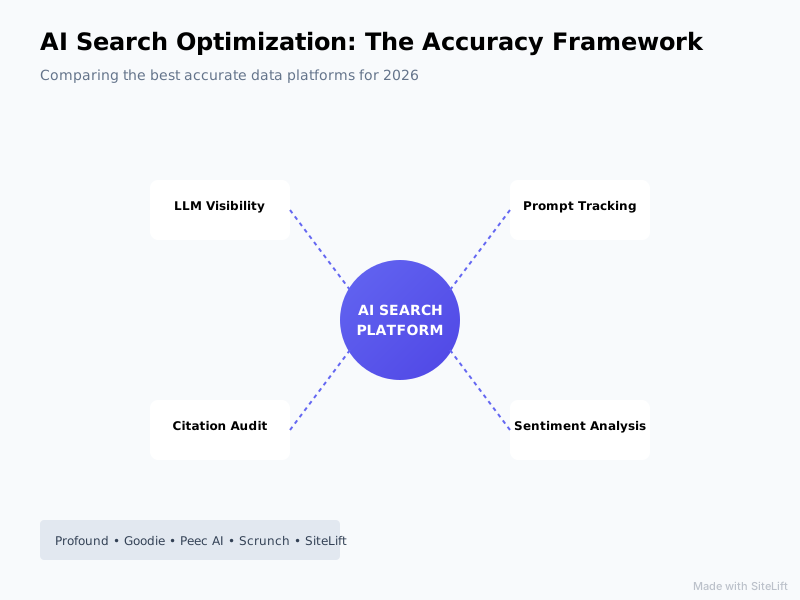
Infographic by SiteLift
| Platform | Accuracy Methodology | LLMs Tracked | Key Features | Share of Voice | Pricing Model | Best For |
|---|---|---|---|---|---|---|
| Profound | High-volume prompt explorer + conversation analytics, repeat runs | ChatGPT, Gemini, Copilot, Perplexity, AI Overviews | Citation tracking, intent analysis, enterprise reporting | Strong competitor SOV dashboards | Custom enterprise, low transparency | Enterprise analytics teams |
| Goodie | AI audit + curated prompt sets, brand-focused | ChatGPT, Perplexity, Gemini, AI Overviews, Claude | Rank tracking, SOV, content recommendations | Excellent brand vs. competitor view | Mid-market SaaS, demo-gated | Mid-market brand teams |
| Peec AI | Daily multi-LLM monitoring, sentiment + traffic lens | ChatGPT, Claude, Gemini, Perplexity, Copilot, AI Overviews | Daily tracking, sentiment, affordable setup | Solid SOV for price | Transparent, startup-friendly | Startups, agencies, EU teams |
| Scrunch | Persona-based testing, journey mapping | ChatGPT, Gemini, Perplexity, Claude, AI Overviews | AI persona testing, agent-ready audits, content briefs | Good topic-level SOV | Tiered SaaS | Content & product marketing |
| SiteLift | Real-time keyword momentum + LLM visibility tracking | ChatGPT, Gemini, Perplexity, Claude, AI Overviews + organic SERP | Autonomous content generation, premium distribution, CMS integrations | SOV tied to publishing pipeline | Growth-oriented SaaS | Teams wanting autopilot growth |
TL;DR winner summary:
- Pick Profound if you need board-ready enterprise analytics and have budget for custom work.
- Pick Goodie if brand presence and clean share of voice ai search reporting are your priority.
- Pick Peec AI if you want fast, affordable llm visibility tracking with daily updates.
- Pick Scrunch if you’re a content team obsessed with personas and AI discovery.
- Pick SiteLift if you want tracking plus autonomous execution that compounds traffic.

How Does Profound Compare as an AI Search Rank Tracker?
Profound built its name as the enterprise ai search rank tracker. It’s the tool I see most often in large-brand RFPs.
Accuracy and Data Methodology
Profound’s strength is scale. Its Prompt Explorer surfaces thousands of AI-generated conversations around your category, not just the keywords you feed it. It runs repeat tests to smooth out LLM randomness and tags intent.
Geographic controls and model transparency are solid. You can see which model version produced an answer and drill into variations. For a global brand tracking 10 markets, that repeatability matters.
The tradeoff: setup is heavy. You’ll need to curate and prune prompts with their team, and pricing is opaque. Small teams often find it overkill for 50-100 core prompts.
LLM Visibility Tracking, Citations and Share of Voice Features
Citation tracking is excellent. Profound shows which domains ChatGPT, Gemini, Copilot, and Perplexity cite for each topic cluster, how often you’re cited vs. mentioned without a link, and how sentiment skews.
Its share-of-voice views are built for executives. You get brand vs. competitor presence by topic, model, and over time. Conversation analytics add context on why you’re losing — missing sources, weak third-party coverage, or negative framing.
Where it falls short is action. You get insights and exports, but you still need writers, PR, and developers to act. Best for enterprise analytics teams with resources to execute separately.
How Does Goodie Compare for LLM Visibility Tracking and Share of Voice?
Goodie positions itself as your AI brand monitor. Less data science lab, more clean command center.
Accuracy and Data Methodology
Goodie starts with an AI audit that maps where you appear today across key models. Prompt sets are curated around brand, competitors, and category questions. Data refreshes regularly, with daily tracking on core plans.
Methodology is trustworthy for brand monitoring, but less transparent on repeat runs and real-user modeling than Profound. I’d put it a notch below for hardcore accuracy nerds, a notch above for usability.
It covers the models that matter — ChatGPT, Perplexity, Gemini, Claude, and AI Overviews — with good U.S. and global coverage.
LLM Visibility Tracking, Citations and Share of Voice Features
This is where Goodie shines. Its share of voice ai search dashboards are the clearest I’ve tested for non-technical stakeholders. You see your slice vs. competitors, top cited sources, and content recommendations to close gaps.
Reporting is client-ready, which agencies love. You can show a CMO exactly how often Perplexity cites Reddit vs. your blog for high-intent queries.
Limitations: automation depth is thin. Recommendations don’t auto-publish or distribute. Best for mid-market marketing teams focused on brand presence and share of voice storytelling.
How Does Peec AI Compare for Accurate AI Search Data?
Peec AI is the scrappy favorite for teams that want accurate data without enterprise procurement hell. It’s especially popular with startups and agencies worldwide.
Accuracy and Data Methodology
Peec runs daily prompt monitoring across ChatGPT, Claude, Gemini, Perplexity, Copilot, and AI Overviews. You add prompts, locations, and competitors, and it starts tracking fast — often same-day.
I like its balance of synthetic and customizable prompts. You can model real customer questions and see answer variations. Sentiment scoring and traffic analytics add useful context on whether mentions actually drive visits.
It won’t match Profound’s prompt discovery scale for a Fortune 500 with 20 product lines. But for 100-500 focused prompts, accuracy is impressively consistent.
LLM Visibility Tracking, Citations and Share of Voice Features
You get daily llm visibility tracking, citation lists, sentiment trends, and competitor comparisons in one clean UI. Share of voice is calculated simply: your brand appearances and citations divided by total opportunities in your prompt set, segmented by model.
Strengths: fast setup, transparent pricing, great for agencies managing multiple clients. Limitations: no autonomous publishing, limited enterprise governance. Best for cost-conscious teams needing fast, reliable tracking.
How Does Scrunch Compare as an AI Search Optimization Platform?
Scrunch thinks like a content strategist, not just a tracker. Its pitch is AI discovery — making sure AI agents find, understand, and recommend you.
Accuracy and Data Methodology
Scrunch uses AI persona testing and customer journey mapping. Instead of only tracking keywords, you test how different personas — beginner, buyer, technical evaluator — experience your brand in AI answers.
Data freshness is good, with recurring audits and agent-readiness checks like structured data, llms.txt, and factual consistency. Multi-LLM coverage includes the big five plus AI Overviews.
Methodology is strong for content intelligence, less rigorous on large-scale repeat-run statistics. Think qualitative depth over quantitative breadth.
LLM Visibility Tracking, Citations and Share of Voice Features
You get topic-level visibility, source gap analysis, and content briefs optimized for AI citation. I particularly like its content optimization workflow that tells writers what entities, stats, and sources to add to earn citations.
It lacks autonomous distribution. You still publish and promote yourself. Best for content and product marketing teams that already have a publishing engine and need smarter direction.
If you’re weighing outside help versus software here, this breakdown of AI search optimization services vs autonomous platforms lays out speed and cost tradeoffs well.
How Does SiteLift Compare as an Autonomous AI Search Optimization Platform?
Here’s where my first-person take comes in: most tools I tested answer what happened. SiteLift is built to answer what’s next — and do it for you.
I’m naturally skeptical of “autopilot” claims. What changed my mind was seeing the loop closed: track keyword momentum in real time, generate targeted content mapped to AI-visible gaps, then distribute it across a curated premium network without waiting on five internal tickets.
Accuracy and Data Methodology
SiteLift combines real-time keyword momentum tracking with llm visibility tracking and ai search rank tracker capabilities for AI surfaces. Instead of monthly reports, you see movement as it happens across organic and AI answers.
Prompt modeling focuses on commercial intent — the questions that precede a purchase — with persona and market segmentation for global teams. Citation monitoring shows which of your pages and network placements AI actually pulls from.
Is it as deep on raw prompt exploration as Profound for a 50,000-prompt enterprise taxonomy? No. For most growth-stage businesses tracking hundreds to low thousands of high-value prompts, I found the data fresh, repeatable, and — crucially — tied to action.
From Tracking to Autonomous Growth: Content Generation and Premium Distribution
This is the differentiator. SiteLift automatically generates targeted, structured content designed for both traditional ranking and AI citation, integrates seamlessly with popular CMS platforms, and distributes it across a curated premium network.
That distribution piece matters more in 2026 than ever. LLMs heavily cite trusted third-party sources, not just your blog. By compounding placements and internal authority on autopilot, you’re not just measuring share of voice ai search — you’re building it.
Best for businesses wanting autopilot growth: SMBs, lean marketing teams, founders, and agencies that need output, not just insights.
Pro Tip: Connect your CMS and let SiteLift publish a small test cluster first — 5 to 10 articles around one use case. Watch citation and momentum lift for 2-3 weeks before scaling. Compounding works when you start narrow.
Which Is the Best Accurate Data Platform for AI Search Optimization for Your Use Case?
The best accurate data platform for ai search optimization is the one that matches your team, budget, and execution capacity.
Best for enterprise: Choose Profound. You get deep prompt discovery, conversation analytics, and executive-grade share of voice. Budget for custom pricing and a dedicated owner to turn insights into tickets.
Best for mid-market brand teams: Choose Goodie. Clean monitoring, strong competitor SOV, and content recommendations your CMO will actually read.
Best for startups and agencies: Choose Peec AI. Daily multi-LLM tracking, sentiment, and transparent pricing with minimal setup. Perfect if you manage multiple brands worldwide.
Best for content-led teams: Choose Scrunch. Persona testing and AI discovery briefs will make your editorial calendar smarter.
Best for autopilot growth: Choose SiteLift. If you don’t have a big SEO team, tracking alone won’t move revenue. You need generation + premium distribution + CMS integration in one loop.
Final Verdict: How to Pick a Winner in 2026
Use this decision checklist before you sign:
- Prompt scale: How many prompts, markets, and personas do you truly need daily?
- Models required: Must-have list from ChatGPT, Gemini, Claude, Perplexity, Copilot, and AI Overviews?
- Accuracy proof: Can the vendor show prompt text, model version, repeat runs, and cited URLs?
- Tracking vs. action: Do you have writers and PR to execute, or do you need autonomous publishing?
- ROI path: How will you tie AI visibility to pipeline? Track citations, branded AI mentions, and assisted conversions.
My opinion after testing: buy accuracy first, but don’t stop at dashboards. In an AI search world with fewer clicks, compounding cited presence is the moat. That’s why tracking-only tools feel incomplete to me now.
If you want to see that closed loop in action, explore sitelift.io and run a pilot on your highest-margin category. Measure share of voice weekly, not quarterly.
— sitelift.io
FAQ About the Best Accurate Data Platform for AI Search Optimization
What is the best accurate data platform for AI search optimization?
The best accurate data platform for ai search optimization is the one that proves accuracy with prompt transparency, repeat runs, daily freshness, and citation-level data across ChatGPT, Gemini, Perplexity, and AI Overviews. Profound leads on enterprise depth, while SiteLift leads if you also want autonomous content and distribution.
How does LLM visibility tracking work?
LLM visibility tracking runs curated prompts in models like ChatGPT and Gemini multiple times, then records brand mentions, citations, sentiment, and position in the answer. The best systems segment by model, market, and persona to show true visibility, not a one-off screenshot.
What is share of voice in AI search and why does it matter?
Share of voice in AI search is your percentage of brand appearances and citations versus competitors across a defined prompt set. It matters because AI answers usually recommend only a few brands. Higher share of voice means you’re recommended more often in buying conversations.
How accurate are AI search rank trackers compared to traditional rank trackers?
AI search rank trackers are less deterministic than traditional rank trackers because LLMs vary answers. Accurate platforms compensate with repeat runs, large prompt sets, and citation verification. Judge them on methodology and consistency over time, not exact rank positions.
Can an AI search optimization platform automatically improve my rankings in ChatGPT and Google AI Overviews?
Tracking-only platforms can’t — they just report. Autonomous platforms like SiteLift can help by generating optimized content, improving structure for AI parsing, publishing via CMS integrations, and earning citations across a premium network, which increases your chances of being cited.
Topics Covered:
- best accurate data platform for ai search optimization
- ai search optimization platform
- llm visibility tracking
- ai search rank tracker
- share of voice ai search
More from SiteLift

White Hat Link Building Techniques That Still Work for Google and AI Search
Discover 5 proven white hat link building techniques that earn top Google rankings and AI search citations. Master ethical link building today.

Ecommerce Link Building: Scale Product Authority and Revenue on Autopilot
Master ecommerce link building. Learn how to secure product page backlinks, execute digital PR, fix redirect leaks, and automate your store authority.

Crawling in SEO: How Google and AI Bots Discover and Rank Your Pages
Master crawling in SEO. Learn how Googlebot and AI scrapers discover pages, compare indexing vs crawling, and optimize your crawl budget.