AI Article Generator That Ranks: Automate Research, Writing and Distribution

Creating content that consistently hits page one requires far more than just hitting "generate." While the web is flooded with low-effort text generators, real organic growth demands context, semantic depth, and strategic distribution. Using a modern ai article generator allows modern growth teams to transform content creation from a manual slog into a streamlined, autonomous system.
Building organic search traffic is no longer about publishing high volumes of generic text. Search engines have evolved to filter out thin, unhelpful copy, placing strict emphasis on real user value and search intent.
Below is an overview of how autonomous publishing platforms stack up against traditional creation models:
| Feature / Metric | Manual Copywriting | Simple AI Prompt Writer | Autonomous AI Platform |
|---|---|---|---|
| Research Depth | High (Hours per draft) | Low (Relies on prompt context) | Deep (Real-time SERP & intent mapping) |
| Publishing Speed | 1-2 articles per week | 3-5 drafts per week | Scalable on demand |
| SEO Optimization | Manual keyword placement | Basic keyword insertion | Semantic NLP & entity integration |
| Distribution | Manual outreach / outreach tools | None | Automated network amplification |
| Indexing Efficiency | Variable | Slow / Unindexed | Rapid via syndication pipelines |
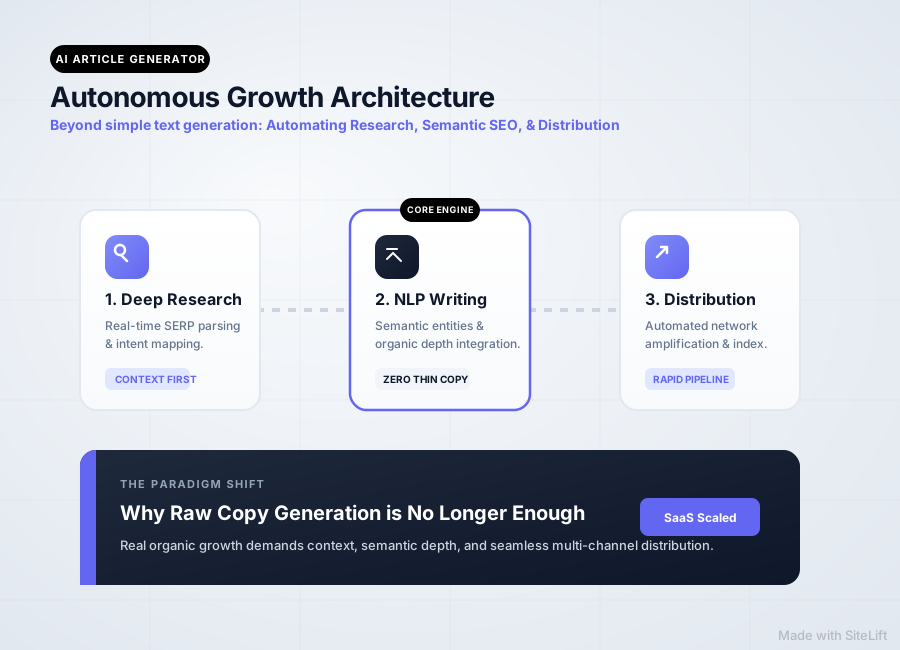
Infographic by SiteLift
Why Relying Only on Draft Creation Is Overrated: An Editorial Perspective
I spent years managing content pipelines the hard way: manually building topic clusters, briefing writers, chasing deadlines, and spending countless hours on manual distribution. When generative text engines first emerged, most marketers assumed the hard part of SEO was solved.
They were wrong. Generating raw copy is actually the easiest part of organic search.
The real bottleneck in modern search optimization is building deep semantic relevance, maintaining real-time factual accuracy, and earning the indexation velocity required to outrank established domain authorities. Simply spitting out 1,500-word blog posts into a draft folder will not move your organic revenue metrics.
True search dominance happens when research, automated article writing, dynamic on-page optimization, and high-authority network distribution operate inside a single closed-loop ecosystem. That is the exact gap an enterprise-grade ai article generator must bridge today.
What Is a Modern AI Article Generator and How Has It Evolved for SEO?
Early generative writing software relied on raw text continuation models. You provided a prompt, and the tool returned plausible-sounding paragraphs. While impressive on the surface, these early outputs failed in competitive search engine results pages (SERPs) because they lacked real-time web awareness, entity recognition, and search intent precision.
Today, an ai article generator built for SEO functions as an autonomous content engine. It continuously crawls top-ranking search results, extracts semantic entities, maps content gaps, and structures outlines that mirror what search algorithms want to reward.
+-----------------------------------------------------------------------------------+
|                        AUTONOMOUS CONTENT ENGINE WORKFLOW                         |
|                                                                                   |
|  [Real-Time SERP Crawl]  -->  [Intent & Entity Mapping]  -->  [Draft Generation]   |
|                                                                         |         |
|  [Automated Distribution] <--  [CMS Auto-Publishing]    <--  [E-E-A-T Injection] |
+-----------------------------------------------------------------------------------+
From Basic Prompting to Autonomous SEO Research
The manual prompt engineering workflow—where marketers copy and paste instructions into standard chat windows—is rapidly becoming obsolete. High-performing growth teams now rely on platform engines that handle deep research automatically.
Instead of asking a tool to "write a blog post about SEO software," modern engines analyze the top 10 positions for target keywords, identify semantic missing links, and generate comprehensive drafts designed to outperform competitors right out of the gate. According to HubSpot research on AI trends, over 60% of marketers report using AI tools to assist in content creation and SEO research.
How Modern AI Content Generators Comply with Search Engine Guidelines
A common misconception is that search engines penalize AI-generated articles purely because of how they were created. Official Google Search Central guidance on AI content makes Google's stance explicit: search algorithms prioritize useful, original, high-quality content regardless of how it is produced.
Search engines evaluate content based on helpfulness and user satisfaction rather than the underlying writing mechanism. When an ai article generator is tuned to satisfy user intent, provide verified details, and follow clear organizational structures, the resulting pages earn top rankings and sustain organic traffic over time.
How Do You Use an AI Article Generator to Rank #1 on Google?

Ranking at the top of search results requires aligning your content creation workflow with the core metrics search engines use to evaluate quality: intent alignment, authority, and structural clarity. Using an ai content generator seo framework ensures your pages satisfy both algorithm requirements and real human readers.
Integrating E-E-A-T and Real-World Context
Google's Search Quality Rater Guidelines highlight Experience, Expertise, Authoritativeness, and Trustworthiness (E-E-A-T). Generic AI content often stumbles here because basic text generators cannot draw from personal experience or real-time business context.
To solve this, modern content platforms infuse generated drafts with verified facts, logical subheadings, contextual data, and specific product or industry insights. When your published pieces include concrete examples and structured citations, they signal true domain expertise to search crawlers.
Pro Tip: Never publish an AI draft without reviewing its internal links and factual anchor points. Ensuring every contextual link points to a specific, relevant resource dramatically improves trust metrics.
Real-Time SERP Analysis and Keyword Intent Alignment
Keywords should never be crammed into sentences for the sake of meeting arbitrary density targets. Modern semantic search relies heavily on Natural Language Processing (NLP) models like BERT and MUM to evaluate context.
An effective ai blog generator scans active ranking pages to surface key secondary concepts, related entities, and user intent sub-topics. For a full breakdown on scaling search-optimized pages, consult our comprehensive AI-generated content ranking guide.
Overcoming Generic AI Footprints and Hallucinations
Search engines and readers alike quickly spot repetitive, fluff-heavy copy. Classic AI footprints include overuse of boilerplate transition phrases, passive phrasing, and generic summaries that offer no actual answers.
Advanced engines mitigate this by applying strict structural frameworks:
- Enforcing concise paragraphs (2–4 sentences maximum) for high readability across mobile devices.
- Integrating structured tables and bullet points to highlight actionable takeaways.
- Verifying claims against active search data to prevent inaccurate claims or hallucinations.
What Does an End-to-End Automated Article Writing Workflow Look Like?
Scaling content manually requires hiring researchers, writers, editors, and SEO managers. A fully integrated platform consolidates this entire pipeline into an automated process.
Manual Workflow:    [Keyword Research] -> [Writer Brief] -> [Drafting] -> [Editing] -> [CMS Post] -> [Manual Links]

Autonomous Pipeline:[ Auto Topic Cluster ] ------------------------> [ Fully Optimized Article Published & Syndicated ]
Phase 1: Autonomous Topic Cluster Research & Intent Mapping
Rather than creating standalone posts in isolation, an autonomous platform plans interconnected topic clusters. It groups target keywords by intent, ensuring every new post targets a distinct query while strengthening your site's overall topical authority.
Predictive data from Gartner predictions on generative AI indicates that by 2025, 30% of outbound marketing messages from large organizations will be synthetically generated. Organizations that combine automated topic clustering with AI generation will capture search market share far faster than manual teams.
Phase 2: Semantic Draft Generation & On-Page SEO Optimization
Once the topic structure is set, the system drafts the article while applying essential on-page SEO elements:
- Primary and secondary keyword integration in key headings (H1, H2, H3).
- Schema markup formatting (such as Article and FAQ metadata).
- Optimized meta titles and meta descriptions tailored to click-through performance.
- Clean HTML layout including structured lists, bold emphasis, and callout sections.
Phase 3: Automated Publishing and Dynamic Internal Linking
Creating an optimized file in a dashboard is only half the battle. High-performing platforms connect directly to your CMS (like WordPress or Webflow) to publish content automatically.
During publication, the engine builds dynamic internal links across your existing content architecture. This distributes link equity across your domain, helping search crawlers discover and index new pages almost instantly.
Why Is Premium Content Distribution Crucial for AI Content Scaling?
Publishing great content on an isolated website is like opening a retail store in the middle of a desert without any road signs. Even the best-optimized AI article needs initial signals of authority to get discovered and indexed quickly by search crawlers.
Bridging the Gap Between Content Creation and Indexation
Search engines assign crawl budgets based on a site's overall domain authority and publishing activity. If a fresh domain publishes dozens of AI-generated pages without incoming referral traffic or backlink signals, search crawlers may take weeks or months to evaluate those pages.
Automated article writing must be paired with immediate distribution. Broadcasting your content across an established publishing network signals to search engines that your new content is active, accurate, and worthy of indexing.
Leveraging Syndication Networks for Faster Domain Authority Growth
Syndicating your articles through high-authority media channels creates natural referral paths and contextual backlinks. This distribution network creates a compounding growth cycle:
[ New AI Article Published ]
             |
             v
[ Automated Syndication Network ]
             |
             v
[ Referral Traffic & Crawler Discovery ]
             |
             v
[ Rapid Indexation & Higher Search Rankings ]
When content distribution is automated alongside generation, your domain accumulates backlink equity and referral traffic on complete autopilot.
How to Choose the Best AI Blog Generator for Your Growth Strategy?
Not all software tools are built equal. When evaluating platforms to power your organic acquisition engine, look past simple copywriting interfaces and assess the complete content lifecycle.
Key Evaluation Factors: Research Depth vs. Raw Text Output
Many cheap subscription tools are simply skins over standard text models. They lack live internet access, competitor extraction capabilities, and programmatic SEO architecture.
When choosing a platform, evaluate:
- Live SERP integration: Does the engine analyze real-time search results before writing?
- Entity & semantic coverage: Does it automatically inject essential secondary keywords?
- Tone consistency: Can it adapt output to match your company's editorial standards without sounding like a generic chatbot?
CMS Integration, Automation Controls, and Scalability
If your marketing team still has to copy, paste, format, and push button after button to publish each draft, your workflow isn't truly scalable.
Look for solutions that offer direct CMS connectors, automated internal linking engines, and built-in visibility tracking. The goal is to build an autonomous organic traffic system, freeing your team to focus on conversion rate optimization and core product innovation.
Turn Your Search Strategy into an Autonomous Growth Engine
Traditional content creation methods are too slow and expensive to keep pace with modern search requirements. On the flip side, flooding your site with thin, unverified text generator drafts will hurt your search standing.
To win in competitive search results today, you need a complete system that handles keyword discovery, competitor research, E-E-A-T content generation, automated CMS publishing, and premium content distribution.
This is exactly why we built SiteLift.
SiteLift is an autonomous SEO and AI visibility platform built to put your organic growth on autopilot. By combining deep search intelligence with automated article publishing and a built-in syndication network, SiteLift turns content creation into a compounding growth driver for your brand.
Pro Tip: Focus on building systemic authority rather than chasing short-term volume. A fully integrated autonomous pipeline ensures every single published article adds measurable value to your site's overall SEO footprint.
FAQ
Does Google penalize AI-generated articles?
Google does not penalize content simply because it is generated by AI. Search algorithms evaluate pages based on quality, relevance, helpfulness, and user experience. As long as your articles satisfy search intent, provide accurate information, and offer high user value, they can rank at the top of search results.
How does an AI article generator handle SEO keyword research?
Advanced platforms conduct live SERP analysis for your target queries. They crawl top-ranking competitor pages, extract primary and secondary keywords, identify content gaps, and map out structured outlines designed to achieve complete topical coverage.
What is the difference between a simple AI writer and an autonomous SEO platform?
A simple AI writer requires manual prompts and returns raw text that you must edit, format, optimize, publish, and link manually. An autonomous SEO platform manages the entire content lifecycle: topic discovery, SERP analysis, optimized drafting, automated CMS publishing, internal linking, and distribution network amplification.
Can AI blog generators automatically publish to my CMS?
Yes. Enterprise platforms integrate directly with popular CMS solutions like WordPress and Webflow via webhooks or native plugins. Once a draft passes quality automated checks, it is published and structured on your domain without manual intervention.
How do I ensure AI content maintains my brand's voice and accuracy?
Platforms maintain brand voice by using structured brand guidelines, custom editorial rules, and context injection. Accuracy is maintained by backing generated content with real-time web research, verified sources, and programmatic entity matching.
— sitelift.io
Topics Covered:
- ai article generator
- ai content generator seo
- automated article writing
- ai blog generator
- premium content distribution
More from SiteLift

White Hat Link Building Techniques That Still Work for Google and AI Search
Discover 5 proven white hat link building techniques that earn top Google rankings and AI search citations. Master ethical link building today.

Ecommerce Link Building: Scale Product Authority and Revenue on Autopilot
Master ecommerce link building. Learn how to secure product page backlinks, execute digital PR, fix redirect leaks, and automate your store authority.

Crawling in SEO: How Google and AI Bots Discover and Rank Your Pages
Master crawling in SEO. Learn how Googlebot and AI scrapers discover pages, compare indexing vs crawling, and optimize your crawl budget.