Preparing for the Voice Revolution: Do You Really Need Voice Search SEO Services?

Key Takeaways
| Strategic Dimension | Traditional SEO | Voice Search SEO / AEO |
|---|---|---|
| Primary Query Type | Short-head, fragment keywords ("CRM software") | Long-tail conversational queries ("What is the best GDPR-compliant CRM for remote teams?") |
| Target Output | Page 1 SERP (10 blue links) | Single audio answer / Featured Snippet (Position Zero) |
| Technical Requirement | Standard Schema (Article, Product) | Speakable Schema Markup (schema.org/SpeakableSpecification) |
| User Intent | Browsing & comparative research | Instant factual answer or immediate action |
| Delivery Model | Manual monthly agency retainers | Autonomous AI content pipelines & structured data automation |
Every few years, search engine marketing undergoes a seismic shift that sends brands scrambling to adjust their budgets. Right now, agencies across Europe are pitching voice search seo services as the next non-negotiable line-item on your marketing ledger. They warn that if you aren't optimizing specifically for Amazon Alexa, Apple Siri, and Google Assistant, your brand will become invisible.
But do you actually need to pay a specialized agency thousands of Euros a month to capture conversational traffic? Or is voice search simply a natural byproduct of modern, well-structured content architecture?
Understanding the mechanics of conversational query optimization—and how automated platforms handle it behind the scenes—helps you make an informed, cost-effective choice for your brand.
What Are Voice Search SEO Services and How Do They Differ from Traditional SEO?
To evaluate whether specialized services are worth the investment, we first need to look under the hood of what agencies actually sell when they offer voice search optimization.
Traditional Search: [User Types] "best analytics platform europe"
                     └──> Google displays 10 blue links + ads

Voice & AI Search:  [User Asks] "Which web analytics software complies with EU privacy laws and offers automated tracking?"
                     └──> Assistant reads 1 single definitive answer (Position Zero)
Understanding Conversational Query Optimization
Traditional SEO focuses heavily on how people type. When sitting at a laptop, a user might type "best email marketing tool UK." However, when speaking to a smart device or mobile phone, that same user adopts natural, full-sentence speech: "What is the highest-rated email marketing platform for small businesses in London?"
Conversational query optimization is the process of structuring website content to match these spoken, multi-word questions. It prioritizes natural phrasing, question-and-answer formats, and explicit contextual definitions over keyword density.
The Shift from Keywords to Answer Engine Optimization (AEO)
Voice search isn't just a different input method—it represents a complete evolution from traditional Search Engine Optimization (SEO) to Answer Engine Optimization (AEO).
When a user asks a voice assistant a question, the underlying algorithm doesn't return a list of links for the user to evaluate. It scans indexed content, extracts the most precise, authoritative statement, and reads it aloud. If your content isn't structured as an authoritative answer, it gets passed over entirely.
Zero-Click Searches and the Single Answer Bottleneck
This introduces what marketers call the "single answer bottleneck." In standard desktop search, ranking on position 2 or 3 still drives substantial organic traffic. In smart speaker search, position 2 is invisible. You either secure "Position Zero" (the featured snippet or spoken answer), or you get zero exposure.
This win-or-lose dynamic is why boutique agencies charge hefty retainers for voice optimization—yet, as we will explore, the technical execution required to rank here relies heavily on structured data principles that modern software can execute automatically.

The European Voice Search Landscape: Is the Market Ready?
Before committing capital to voice-specific strategies, European businesses must ask a fundamental question: Are consumers in our target markets actually using voice to discover products and services?
Smart Speaker Adoption Rates Across UK and Continental Europe
The short answer is yes—but adoption varies wildly by country and context. According to Statista market data on smart speakers, smart speaker hardware adoption has reached critical mass across Western Europe. Research by Strategy Analytics confirms that smart speaker penetration in European households has passed 30% in core markets such as the UK and Germany.
European Smart Speaker Adoption Highlights:
├── UK & Germany: >30% household penetration
├── France & Spain: Rapidly growing mobile voice search adoption
└── Global Context: 27% of online population uses voice on mobile (Think with Google)
Furthermore, research by Think with Google indicates that over 27% of the global online population uses voice search on mobile devices. Gartner takes this a step further, estimating that roughly 30% of web browsing sessions take place without a screen via voice interfaces and ambient computing.
Multilingual Voice Queries and Localisation Challenges
Unlike the United States, where a single English-language strategy covers the vast majority of the addressable market, European businesses face severe linguistic fragmentations:
- A user in Zurich might query an assistant in High German, Swiss German, or French.
- Voice assistants must interpret regional colloquialisms across the UK, Ireland, and Nordic regions.
- Direct translations of English keywords routinely fail in spoken French or Spanish search.
Executing smart speaker SEO across Europe requires localized, native conversational phrasing rather than static translation tables.
Privacy Regulations (GDPR) and Voice Data Processing
European privacy laws add another layer of complexity. Under GDPR, the collection and processing of ambient voice recordings face strict compliance scrutiny. Voice assistants cannot freely leverage hyper-personalized local behavior profiles without explicit user consent. As a result, search algorithms in Europe rely far more heavily on on-page contextual clarity, clean site architecture, and explicit schema markup to deliver accurate voice answers, rather than relying solely on invasive user profiling.
Core Components of Voice Search SEO Services: What Do Agencies Actually Offer?
When you break down a €3,000-a-month proposal from a specialized voice SEO agency, their deliverables usually fall into three core technical buckets.
┌─────────────────────────────────────────────────────────┐
│               CORE VOICE SEO DELIVERABLES               │
├───────────────────────────┬─────────────────────────────┤
│ 1. Schema Architecture    │ Speakable & FAQ Markup      │
├───────────────────────────┼─────────────────────────────┤
│ 2. Content Engineering    │ Long-tail QA Formatting     │
├───────────────────────────┼─────────────────────────────┤
│ 3. Technical Performance  │ Mobile Speed & Core Vitals  │
└───────────────────────────┴─────────────────────────────┘
Schema Markup for Voice and Technical Foundations
The cornerstone of any voice search audit is structured data. Search engines rely on structured microdata to understand which parts of an article are suitable for text-to-speech audio playback.
The primary tool for this is schema markup for voice, specifically the Speakable specification. By tagging specific content blocks (such as concise summaries or introductory paragraphs), you explicitly signal to Google Assistant or Siri that these lines are optimized for audio delivery.
Developers and marketers can reference Google's official Speakable documentation to understand how search engines consume this data, while the full technical parameters are outlined in the Schema.org Speakable specification.
Targeting Long-Tail Conversational Keywords
Agencies spend considerable manual effort identifying long-tail conversational keywords. These are explicit questions that start with Who, What, Where, When, Why, and How.
Rather than writing an article targeting "SaaS billing software," a voice-optimized approach targets: "How do I automate recurring billing for a European SaaS business?" The content is then structured with direct, 40-to-50-word answers directly beneath natural H2 or H3 subheadings.
Pro Tip: Combine Question schema with Speakable markup on key informational pages. This ensures your content is picked up both by screen-based AI previews (like Google Search Generative Experience) and audio-only smart speakers.
Local SEO Integration and Google Business Profile Synergy
For B2C businesses (such as restaurants, legal firms, or local clinics), voice queries are overwhelmingly local: "Find an open organic bakery near me." Agencies handle this by optimizing Google Business Profiles, ensuring NAP (Name, Address, Phone) consistency, and building localized citations.
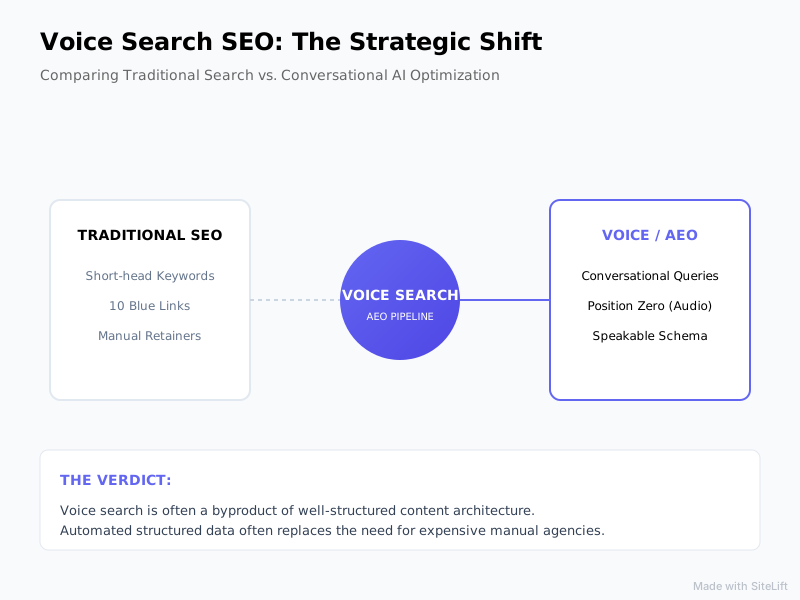
Infographic by SiteLift
Dedicated Voice SEO Agencies vs. Autonomous AI Platforms: Which Model Wins?
This brings us to the core financial dilemma facing modern marketing executives. Should you pay a dedicated voice SEO agency for manual monthly implementations, or can technology solve this problem at a fraction of the cost?
The Cost and Overhead of Specialized Agency Retainers
Boutique agencies in major European business hubs like London, Berlin, or Amsterdam frequently charge between €2,500 and €6,000 per month for voice search optimization retainers.
The reality? Much of this time is spent on repetitive manual tasks: adding JSON-LD schema tags to landing pages, rewriting blog headers into questions, and checking snippet placements manually.
| Feature / Capability | Manual Agency Retainer | Autonomous AI Platform |
|---|---|---|
| Typical Cost | €2,500 – €6,000+ / month | Included in software subscription |
| Schema Deployment | Manual coding per page | Automated, site-wide JSON-LD injection |
| Content Velocity | 2–4 articles per month | Scale on demand with AI pipeline |
| Adaptability to AI Search | Slow quarterly updates | Continuous real-time optimization |
| Multilingual Support | Expensive third-party translation | Native AI multilingual generation |
How Autonomous AI SEO Engines Automate Conversational Content
Modern autonomous platforms handle these technical setups automatically. Instead of paying developers to manually code schema for every new article, platforms like SiteLift build structured data, clear QA formatting, and conversational semantic structures directly into the content generation pipeline.
When content is produced using structured natural language processing, it naturally incorporates the long-tail queries and concise answer blocks that voice engines look for—without requiring a dedicated "voice consultant."
Evaluating Scalability and Continuous Content Updates
Voice search queries shift constantly as consumer terminology evolves. An agency operating on manual workflows can only update a handful of pages each month. An automated end-to-end publishing engine monitors keyword momentum, updates existing content layers, and distributes structured articles continuously across networks without human delay.
Decision Matrix: Do You Really Need Voice Search SEO Services?
Not every company needs to invest heavily in voice optimization. Use this decision framework to assess where your business falls.
                            [Evaluate Your Business Model]
                                          │
                  ┌───────────────────────┴───────────────────────┐
                  ▼                                               ▼
            [B2C / Local]                                   [B2B / SaaS]
                  │                                               │
   High voice intent queries?                      Focus on technical AEO & AI
 ("Find a store near me", prices)                  search visibility over manual
                  │                                    voice agency retainers.
                  ▼                                               ▼
   [Automate Local & Schema]                       [Deploy Autonomous AI Platform]
Audience Profile Audit: B2B SaaS vs. B2C Local Services
- High Need for Voice Alignment (B2C & Local): If you run a local service, hospitality group, or e-commerce store with simple, transactional products, voice discovery is actively happening. Consumers ask their phones for directions, business hours, and immediate product purchases.
- Low Need for Dedicated Voice Agencies (B2B SaaS & Complex Services): If you sell high-ticket B2B software or enterprise consulting, procurement teams are not ordering your services through an Amazon Echo. They do, however, use AI search engines and conversational desktop assistants (like Copilot or ChatGPT). What you need is broader Answer Engine Optimization (AEO)—not a niche smart speaker agency.
Evaluating Your Current Technical and Schema Readiness
Before signing any agency proposal, run through this quick self-assessment checklist:
- Mobile Performance: Does your site load in under 1.5 seconds on mobile connections? (Voice engines will not pull data from slow sites).
- Structured Data: Does your site automatically generate Article, FAQ, and Speakable JSON-LD schema?
- Content Formatting: Do your articles use clear, question-based H2 headers with direct 40-to-50-word answers directly beneath them?
- Local Listings: Is your Google Business Profile verified, accurate, and regularly updated?
If your site already checks these boxes—or if your CMS platform handles them automatically—paying for external voice search SEO services is redundant.
An Editorial Perspective: Why Paying £3,000/Month for "Voice SEO" is Dead Money
Having spent over a decade managing organic search strategies through every major algorithm shift, I've seen agency fluff come and go. When mobile-first indexing arrived, agencies tried selling "Mobile SEO Retainers." When local maps rolled out, they sold "Hyper-Local Signal Management."
Now, it's "Voice Search SEO Services."
Here is the truth that agencies won't tell you: There is no secret technical trick unique to voice search.
Voice search assistants simply consume the cleanest, fastest, most well-structured answer available in Google's index. If you write clear, deeply informative content that answers user queries directly, and you back it up with clean JSON-LD schema, you will rank for voice search automatically.
Paying an agency a monthly retainer purely to "optimize for Alexa" is paying twice for good content hygiene. Invest in robust automation software that bakes structured data into every page from day one, and spend the money you save on actual product growth.
— Julian Vance, Head of Search Strategy
Pro Tip: Instead of auditing for voice alone, audit your site for overall AI visibility. Content structured well enough for an LLM like ChatGPT or Perplexity to parse is automatically optimized for smart speakers as well.
Future-Proofing Your Brand with Autonomous SEO
Rather than managing expensive agencies or trying to manually format hundreds of articles for conversational queries, smart teams are moving toward automated publishing infrastructure.
Platforms like SiteLift remove the manual labor from Answer Engine Optimization. By combining automated content creation with structured publishing, built-in schema architecture, and real-time rank tracking, sitelift.io ensures your brand dominates both traditional SERPs and modern conversational AI engines without adding headcount.
Whether a customer is typing a query into a browser or asking a smart speaker in their living room, your brand should be the single, definitive answer they receive.
FAQ
What are voice search SEO services?
Voice search SEO services are specialized consulting and technical optimization packages offered by digital marketing agencies. They focus on adapting website content, schema markup, site speed, and local business profiles to help brands rank as the spoken "Position Zero" answer on voice assistants like Siri, Alexa, and Google Assistant.
Do B2B companies actually need voice search optimization?
Most B2B companies do not need dedicated smart speaker SEO services, as enterprise purchasing decisions rarely happen via voice assistants. However, B2B companies do need Answer Engine Optimization (AEO) to ensure their content is easily parsed by AI tools, conversational engines, and desktop search previews.
How does schema markup for voice search work?
Voice search schema relies primarily on the Speakable specification from Schema.org. It uses JSON-LD code to identify specific sections of an HTML document (such as key summaries or answer blocks) that are best suited for audio playback by text-to-speech engines.
What is the difference between voice search SEO and traditional SEO?
Traditional SEO targets typed keywords, short phrases, and driving traffic to a page of ten search engine links. Voice search SEO focuses on long-tail conversational questions, context-driven natural language, and securing the single featured answer (Position Zero) that an audio assistant can read aloud.
Can automated software optimize my site for voice search without an agency?
Yes. Modern autonomous SEO platforms automatically structure content with proper headings, incorporate conversational long-tail phrasing, inject appropriate JSON-LD schema markup, and publish directly to your CMS. This renders manual agency retainers for basic voice search optimization largely obsolete.
Topics Covered:
- voice search seo services
- conversational query optimization
- smart speaker SEO
- schema markup for voice
- long-tail conversational keywords
More from SiteLift

LLM Visibility Tool: How to Measure and Grow Your Brand in ChatGPT and Perplexity
Discover how to use an LLM visibility tool to monitor ChatGPT brand mentions, track Perplexity citations, and scale your AI share of voice.

Single Page Application Search Engine Optimization: The Complete Rendering and Indexing Guide
Master single page application search engine optimization: rendering, indexing, Core Web Vitals & audits. Fix your SPA SEO today.

Best Rank Tracking Tool: 7 Must-Have Features for SEO and AI Search in 2026
Discover the best rank tracking tool for modern search. Compare SiteLift, Semrush, Ahrefs, and more across AI visibility, speed, and automated reporting.