The Best SEO Automation Tools to Streamline Your European Digital Strategy
 For European digital teams, scaling SEO has always felt like a high-wire act. You’re balancing intricate multilingual campaigns, navigating GDPR’s tightrope, and trying to outpace competitors who seem to publish content at inhuman speed. The old playbook—manual audits, spreadsheet keyword tracking, and piecemeal publishing—isn’t just slow; it’s a strategic liability.
This is where modern SEO automation tools become your force multiplier. They’re not just about scheduling social posts. We’re talking about platforms that autonomously research, create, optimize, and distribute content, building a compounding organic engine while you focus on strategy.
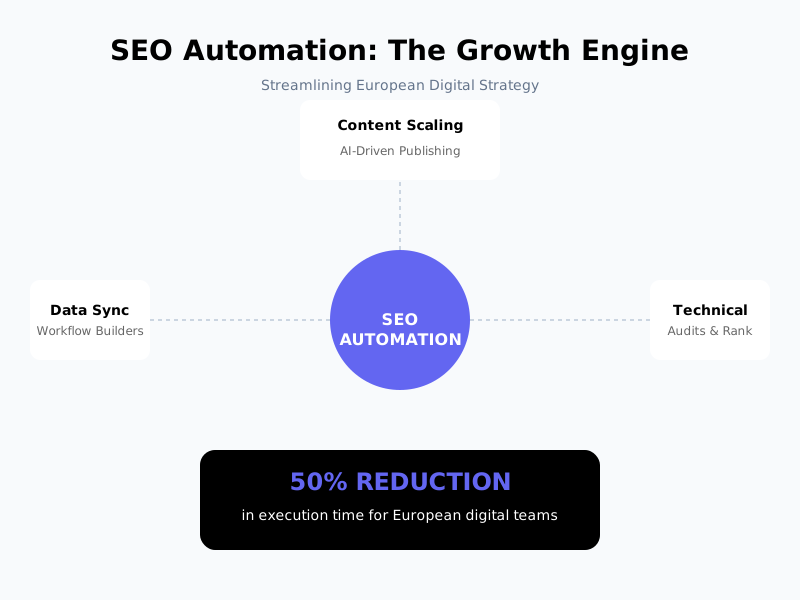
According to HubSpot's State of Marketing report, over 61% of digital marketers in Europe already leverage automation to streamline content and technical SEO workflows. They’re onto something. Research from McKinsey reveals that automating repetitive marketing operational tasks can reduce execution time by up to 50%, freeing teams to pivot toward genuine growth.
Let’s cut through the noise and identify the tools and strategies that actually move the needle for a European audience, transforming SEO from a manual chore into an autonomous growth channel.
Key Takeaways: Choosing Your SEO Automation Stack
Before we dive deep, here’s a quick-reference table to frame what we’ll cover. Choosing the right tool depends on your primary bottleneck.
| Your Primary Challenge | Recommended Tool Type | Core Capability to Look For |
|---|---|---|
| Scaling content volume & quality across regions | Autonomous Publishing Platform | AI-driven content generation, bulk publishing, automated internal linking |
| Technical audits & rank tracking | Specialized SEO Suite | Automated site crawls, backlink monitoring, rank tracking alerts |
| Connecting disparate data & apps | Automation Workflow Builder | Custom “if-then” logic, multi-app integrations (CRM, CMS, analytics) |
| Multilingual & local SEO management | Platform with EU-centric features | Local intent keyword clustering, geo-targeting, GDPR-compliant data handling |
What Are SEO Automation Tools and Why Do European Brands Need Them?
At its core, an SEO automation tool is any software that uses rules, AI, or APIs to perform a search optimization task without constant manual input. But there’s a vast spectrum, from simple browser scripts that check meta tags to full autonomous growth platforms that run an end-to-end publishing pipeline.
For European marketers, this distinction isn’t academic—it’s critical to survival and scaling.
Shifting from Manual Execution to Autonomous SEO Operations
The shift is from being a mechanic to being an architect. Manual SEO is reactive: you find a broken link and fix it, you see a keyword dip and write a new article. Autonomous SEO is proactive: the system continuously audits for issues, identifies emerging search intents, and deploys optimized content to address them before you lose traffic.
Think of it as setting up a perpetual motion machine for organic traffic. The tool’s job is to keep the flywheel spinning—researching, publishing, interlinking, and tracking—while your job is to steer its strategic direction.
Overcoming Multi-Market and Multilingual Complexity across Europe
This is the European marketer’s unique hurdle. A campaign for Germany requires different semantics, cultural nuance, and search behavior than one for Spain or Poland. Manually scaling this is a nightmare of spreadsheets and translation costs.
Pro Tip: True multilingual automation isn’t just translation. It’s about tools that can uncover localized search intent and semantic clusters for each market independently, then optimize content structure accordingly.
Automation tackles this by allowing you to set parameters per region. A robust platform can manage keyword research for “de,” “es,” and “pl” locales simultaneously, cluster those topics by local intent, and ensure the published content is architecturally linked for maximum authority in each language version. It frees your team from repetitive technical work to focus on what truly matters: localized strategy and creative.
What Key Capabilities Define the Top SEO Automation Software?
Not all automation is created equal. When evaluating SEO automation tools, especially for the complex European landscape, I look for these three non-negotiable capabilities.
Automated Keyword Research and Intent Clustering
Gone are the days of manually sifting through Keyword Planner. Advanced tools now ingest a seed topic and automatically:
- Uncover hundreds of related queries and questions.
- Cluster them into thematic groups based on search intent (informational, commercial, transactional).
- Map these clusters to your existing site architecture, identifying content gaps.
For Europe, the best tools do this per language and region. The semantic relationship between “kaufen” (to buy) and “preis” (price) in German is different from “comprar” and “precio” in Spanish. Automated clustering understands these local nuances, ensuring your content pillars are built on truly relevant, regional search behavior.
AI-Driven Metadata and Automated Internal Linking
These are two sides of the same coin: dynamic on-page and on-site optimization.
AI-driven metadata means titles and meta descriptions are generated at scale, not just populated with keywords but crafted for click-through rates based on SERP analysis. More importantly, it ensures every new piece of content is instantly optimized for search engines and AI engines (like Google’s SGE), which is becoming known as Generative Engine Optimization (GEO).
Automated internal linking is the silent powerhouse. As your site grows to hundreds or thousands of pages, manually linking related articles is impossible. Automation tools analyze your entire content library in real-time, suggesting and implementing contextual links from new pages to authoritative older ones, and vice-versa. This dynamically distributes page authority, guides users (and crawlers) deeper into your site, and is a proven driver of organic traffic growth.
Bulk Publishing Tools and Seamless CMS Integration
A brilliant content strategy fails if publishing is a bottleneck. Bulk publishing tools allow you to queue, schedule, and deploy dozens—or hundreds—of optimized articles directly to your CMS with one click.
The magic is in the seamless CMS integration. The top platforms for Europe offer native connectors or easy APIs for WordPress, Webflow, Shopify, and other popular EU CMSs. This creates a direct pipeline from the automation platform to your live site, eliminating manual uploads, formatting errors, and frustrating back-and-forth. It’s what enables the “autopilot” in autonomous SEO—a consistent, high-volume publishing schedule that compounds organic visibility.
 ## Which Are the Best SEO Automation Tools for European Digital Strategies?
Let’s get concrete. Here’s my breakdown of leading tools, categorized by their primary strength for a European operation.
SiteLift: Best for Autonomous Content Pipelines and AI Engine Visibility
If your goal is to build a fully autonomous, end-to-end publishing engine, SiteLift is in a category of its own. It’s not just another tool in the stack; it’s designed to be the stack for organic growth.
While tools like Semrush tell you what to do, SiteLift actually does it. It autonomously generates targeted, research-backed content, then doesn’t just post it to your blog. It strategically distributes it across a curated premium network to build authority, while its automated internal linking engine dynamically optimizes your entire site architecture. It tracks keyword momentum in real-time, creating a closed-loop system.
Why it stands out for Europe: Its approach is inherently scalable across markets. You can set it to target clusters for different regions, and it handles the content creation, optimization, and distribution pipeline for each. It’s built for the volume and consistency needed to dominate not just traditional search, but also the emerging landscape of AI search engines.
Semrush and Ahrefs: Best for Automated Audits and Rank Tracking Alerts
These are the industry-standard suites, and for good reason. Their strength lies in automated keyword research, competitive analysis, and—crucially—technical auditing.
You can set up automated site crawls to flag issues (broken links, slow pages, duplicate meta tags) and receive rank tracking alerts the moment your positions change. For maintaining site health and monitoring campaign performance across European markets, they’re invaluable.
The gap: They are primarily diagnostic and advisory. They excel at telling you the “what” and “why,” but the “doing”—the actual content creation, publishing, and dynamic interlinking—largely remains a manual task or requires piecing together other tools.
Zapier and Make: Best for Custom Workflow and Data Transfer Automation
These aren’t SEO tools per se, but they are automation powerhouses. Zapier and Make (formerly Integromat) are workflow builders that connect your apps with “if-then” logic.
Need to automatically create a Trello card when a keyword rank drops? Or add new leads from a gated SEO guide to your CRM? These tools are brilliant for building custom bridges between your SEO software, your CMS, your analytics, and your team’s project management tools.
Pro Tip: Use Zapier or Make to connect your SEO audit tool (like Semrush) to your content calendar (like Asana). This automates the transformation of an SEO insight into an actionable task, closing the strategy-execution loop.
The limitation: They require you to have the “parts” already. They connect tools but don’t provide the core SEO capabilities themselves. You’ll still need a dedicated platform for content and link automation.
 ## How Can Brands Implement SEO Automation Without Sacrificing Quality or Compliance?
Automation fears are valid. Will Google penalize my site? Is this GDPR-compliant? Here’s how to implement automation responsibly.
Maintaining E-E-A-T Standards Across Automated Publishing Pipelines
Google’s guidelines are clear: they reward helpful, people-first content [^1]. The key is to use automation for scale and optimization, not for creating hollow content.
The safeguard: Use AI and automation as your expert research assistant and production editor, not your sole writer. The best platforms use AI to draft based on real data and SERP analysis, but incorporate human-designed frameworks for expertise, authoritativeness, and trustworthiness (E-E-A-T). Always have a final human validation checkpoint for brand voice and nuanced accuracy before bulk publishing. This balance ensures you meet Google’s Helpful Content guidelines while operating at scale.
Ensuring GDPR and European Data Privacy Compliance in Automation Workflows
This is non-negotiable. Any tool that processes personal data (like user behavior tracking, form submissions, or even IP-based analytics) must comply with GDPR.
Your checklist:
- Data Processing Agreements (DPA): Ensure your automation vendor offers a signed DPA. This legally binds them to GDPR standards.
- Data Residency: Check where the tool’s servers are located. Preference for providers with EU-based data centers.
- Privacy by Design: Does the tool minimize data collection by default? Can you easily configure it to anonymize IPs or limit data retention?
Always consult a practical GDPR compliance guide and ensure your chosen tools align. For instance, when using rank trackers, ensure they offer options to anonymize or aggregate data to protect user privacy.
Editorial: Why Europe is the Perfect Testing Ground for Autonomous SEO
Here’s my take: European marketers aren’t just adopting automation out of convenience; they’re being forced into it by structural advantages. And that’s a good thing.
The very constraints that seem daunting—GDPR, multilingual complexity, fragmented markets—are what create a higher barrier to entry and a more sophisticated marketing landscape. This environment doesn’t reward spray-and-pray tactics; it rewards systematic, scalable, and compliant precision. Automation is the only way to achieve that at a competitive scale.
I see too many teams using automation tools as fancy report generators. The real winners are those who leverage them as compounding organic growth engines. They understand that a study by BrightEdge highlights over 53% of all website traffic originates from organic search. They’re not just protecting that channel; they’re aggressively and autonomously expanding it, building a traffic asset that pays dividends long after the campaign budget is spent.
The future of SEO in Europe belongs to the brands that stop doing SEO manually and start orchestrating it autonomously.
— The SiteLift Team
FAQ
What are SEO automation tools and how do they work?
SEO automation tools are software platforms that use predefined rules, artificial intelligence (AI), or application programming interfaces (APIs) to perform search engine optimization tasks without constant manual oversight. They work by taking inputs (like a seed keyword or a site crawl), processing them through their logic or AI models, and executing outputs (like publishing an article, building internal links, or sending an alert). They range from single-task scripts to full platforms that manage the entire content lifecycle.
Can SEO automation tools help with multi-language search campaigns in Europe?
Absolutely, and this is one of their strongest use cases. Advanced tools can conduct separate automated keyword research for each target language and region, clustering topics based on local search intent. They can then manage the creation, optimization, and publishing of content tailored to each market, often through a single dashboard. This automates the most time-consuming part of multilingual SEO: scaling relevant, optimized content across different linguistic and cultural contexts.
Will using automated content publishing tools hurt my Google rankings?
Not if used correctly. Google states it rewards helpful content, regardless of how it’s created [^1]. The risk isn’t automation itself; it’s using automation to create low-quality, unhelpful content at scale. The key is to maintain editorial oversight. Use bulk publishing tools to handle the distribution and optimization of content that has been crafted or validated to meet quality and E-E-A-T standards. Automation should enhance your process, not replace your expertise.
How does automated internal linking improve organic traffic?
Automated internal linking improves organic traffic by dynamically distributing “link equity” (ranking power) throughout your site. It automatically creates relevant contextual links from new pages to older, authoritative pages (passing authority), and from older pages to new content (giving it a boost). This helps search engines crawl and understand your site architecture better, keeps users engaged on your site longer, and significantly boosts the ranking potential of individual pages, leading to more overall traffic.
What is the difference between Zapier integrations and an autonomous SEO platform?
This is a crucial distinction. Zapier is an integration and workflow automation tool. It connects different apps (like your CRM and your email tool) to move data between them automatically. An autonomous SEO platform (like SiteLift) is an end-to-end execution tool. It possesses the core SEO capabilities itself—it researches keywords, creates and optimizes content, builds links, and publishes it. Think of Zapier as the plumbing that connects your house’s appliances, while an autonomous platform is the fully-equipped, self-maintaining kitchen itself.
 Ready to move from manual audits to autonomous growth? Explore how a complete, end-to-end platform can streamline your European digital strategy. See how SiteLift works to build your compounding organic traffic engine.
Article generated by SiteLift
Topics Covered:
- seo automation tools
- automated internal linking
- AI-driven metadata
- bulk publishing tools
- automated keyword research
More from SiteLift

How to Identify and Target High-Value Organic Search Keywords with Zero Manual Effort
Learn how AI keyword discovery and automated pipelines let you identify high-value organic search keywords and scale B2B SaaS traffic effortlessly.

Decoding SEO Agency Fees: Hourly Rates, Retainers, and Automated Alternatives
Uncover real SEO agency fees, from hourly rates and $3,000+ monthly retainers to cost-effective automated platforms. Maximize your organic ROI.

SEO Conversion Optimization: How to Turn Organic Search Readers into Paying Customers
Learn how to turn organic search visitors into paying customers with this step-by-step SEO conversion optimization guide. Optimize your CTAs and UX.