SiteLift vs SEObot: Which Autonomous SEO Platform Should You Choose?
When looking to automate your publishing pipeline and grow organic traffic without manual intervention, two platforms stand out: SiteLift and SEObot. SiteLift is an autonomous SEO and AI visibility growth platform designed to help businesses dominate search and AI engines through automated content generation, a curated premium distribution network, real-time AI visibility tracking, and auto-updating competitor comparison pages. On the other hand, SEObot is a fully autonomous SEO robot featuring AI agents tailored for busy founders, indie makers, and SaaS operators to handle keyword research, content creation, internal linking, and AI backlink building.
The core difference lies in what each platform does beyond writing articles. SiteLift tracks visibility across modern AI engines like ChatGPT, Gemini, and Google AI Overviews, acquires backlinks through a curated network, and generates competitor comparison pages. SEObot focuses on diverse content formats like YouTube video conversions, interactive SEO mini-tools, and news articles, backed by a fact-checking layer with cited sources. This page provides an honest, fact-based comparison of their pricing, core features, integrations, and support to help you determine which tool fits your publishing workflow.
Our verdict
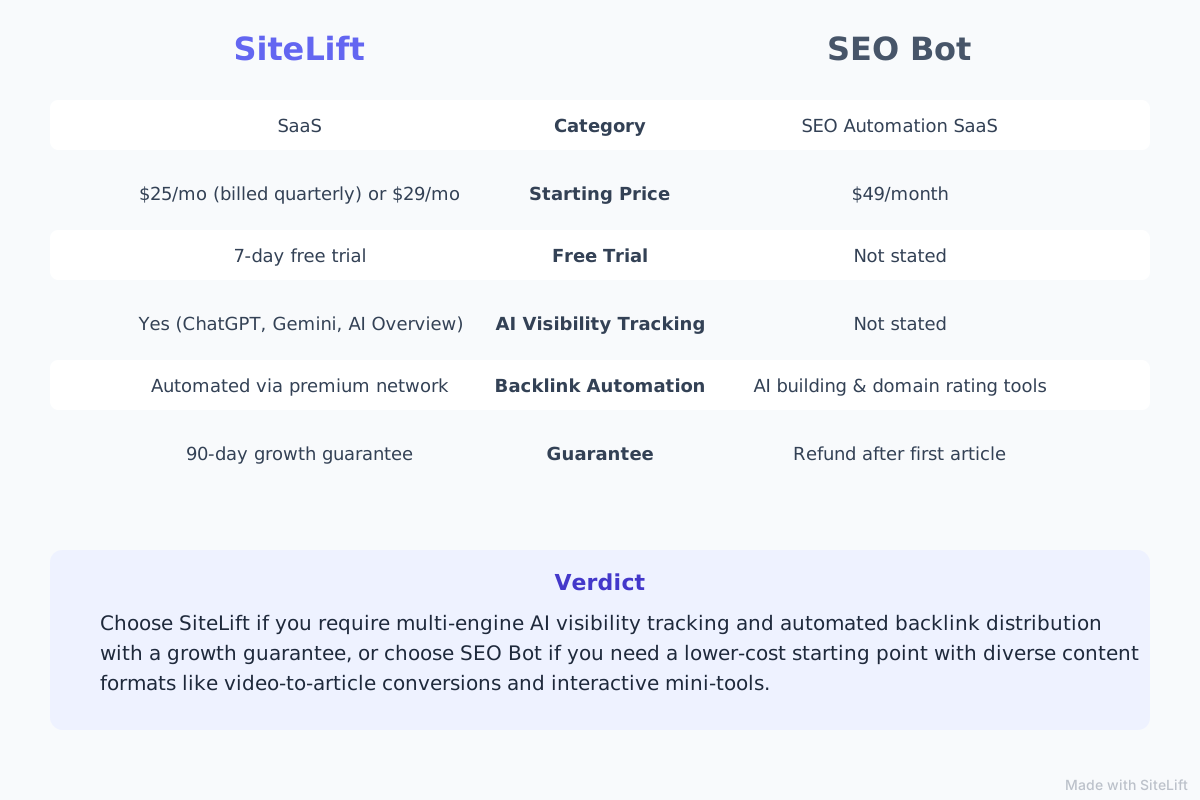
Choose SiteLift if you want multi-engine AI visibility tracking, automated backlink distribution, auto-updating competitor comparison pages, and a 90-day growth guarantee at a lower starting price; choose SEObot if you want diverse content formats like video-to-article conversion, news articles, and interactive mini-tools, or a wider list of CMS integrations.
SiteLift vs SEObot at a glance
| SiteLift | SEObot | |
|---|---|---|
| Category | SaaS | SEO Automation SaaS |
| Best for | Businesses looking to automate their publishing pipeline, dominate search and AI engines, and grow organic authority without manual intervention. | Busy founders, indie makers, SaaS owners, and site operators looking to automate SEO content creation. |
| Starting price | $25/mo (billed $75 quarterly) or $29 month-to-month | $49/month |
| Free tier or trial | 7-day free trial | None; full refund after the first article if not satisfied |
| Platforms | Web, REST API, MCP | Web, REST API |
| Integrations | WordPress, Webflow, Shopify, Next.js, SiteLift Hosted, REST API, webhooks, MCP server | Framer, Ghost, HubSpot, Notion, Shopify, Unicorn Platform, Webflow, Wix, WordPress, Next.js, Zapier, Make, Squarespace, Webhooks |
SiteLift overview
SiteLift is an autonomous SEO and AI visibility growth platform tailored for businesses looking to automate their publishing pipeline and scale organic authority without manual intervention. Designed as a technology SaaS solution, it handles everything from autonomous keyword discovery and niche targeting to content generation and tracking keyword momentum in real-time.
The platform supports two core pricing tiers: SiteLift Starter at $25 per month when billed quarterly ($75 total) or $29 month-to-month, and SiteLift Growth at $59 per month billed quarterly ($177 total) or $79 month-to-month. Features include autonomous AI content generation, automated backlink acquisition via Backlink+ on the Growth plan, an AI visibility tracker for GEO tracking, an autonomous Reddit marketing agent, technical SEO audits, and native CMS syncing with WordPress, Webflow, Shopify, Next.js, and SiteLift Hosted, plus a REST API, webhooks, and an MCP server. Its standout feature is automated competitor comparison pages: SiteLift writes "vs" and "alternatives" pages from competitors' own websites, re-verifies the facts on a schedule, and rewrites them when a competitor changes pricing or features, something SEObot does not offer.
SiteLift's primary strengths lie in its comprehensive end-to-end execution, its ability to track visibility across modern AI engines like ChatGPT, Gemini, and Google AI Overviews, and its automated backlink acquisition network. It also offers a 90-day growth guarantee, providing a full refund if traffic fails to grow. Potential limitations include the exclusion of the premium distribution network on the Starter plan, monthly article limits capped at 30 articles on the Growth plan, and the requirement of a 90-day runway to qualify for refund guarantees.
SEObot overview
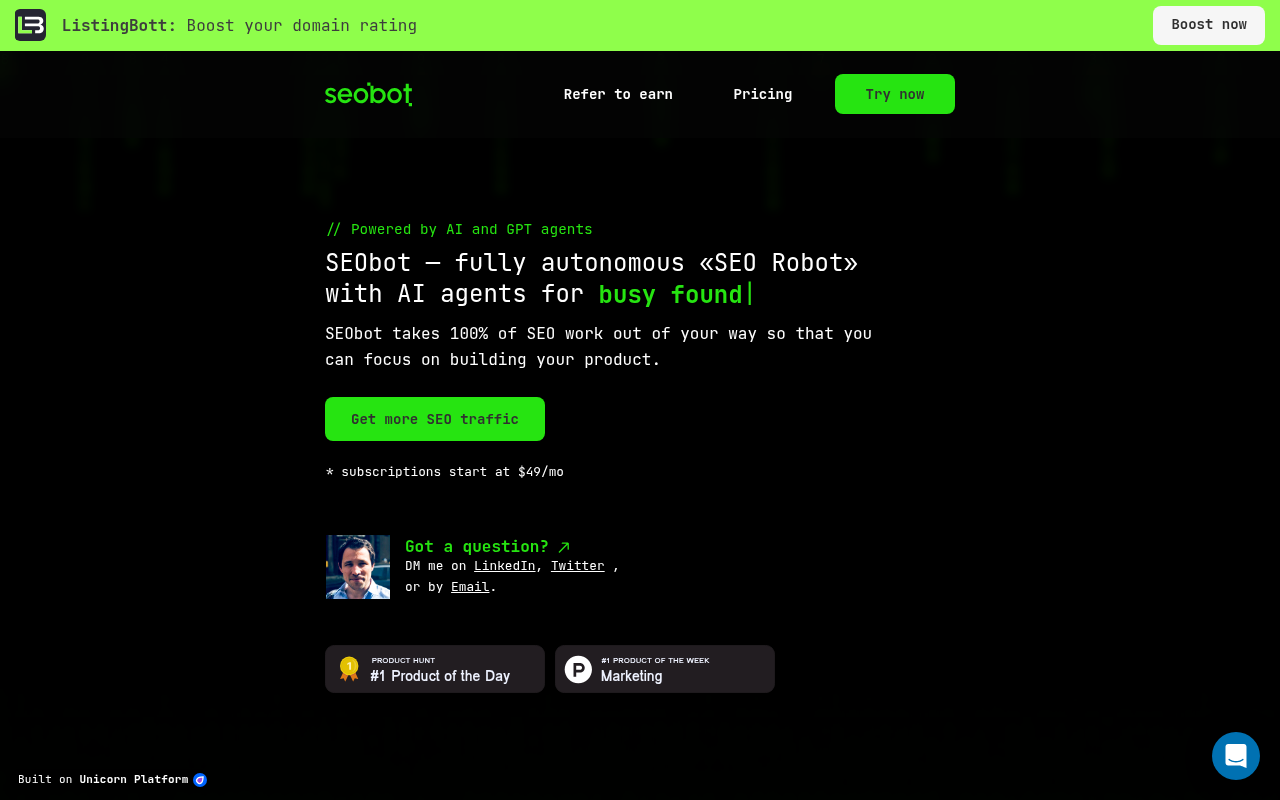
SEObot is an AI-powered SEO automation platform built specifically for busy founders, indie makers, SaaS owners, and site operators. Operating under the tagline of a fully autonomous SEO robot with AI agents, the platform automates keyword research, content creation, internal linking, and AI backlink building to drive organic traffic directly to a connected CMS.
The service starts at $49 per month for its base subscription, which includes full automated onboarding, content strategy creation, weekly publishing, and internal linking. SEObot's feature set is expansive, including automated keyword research, content plan creation, article generation up to 4,000 words, YouTube video to article conversion, AI backlink building tools, automated internal and external link insertion, a fact-checking and source citation system, an AI news article generation module, an interactive SEO mini-tool builder, and free standalone technical SEO tools.
Strengths of SEObot include its hands-free automation workflow, extensive CMS and tool integrations including Ghost, HubSpot, Framer, Notion, Wix, Unicorn Platform, and Zapier, support for over 50 languages, and versatile content modules like video conversions and mini-tools. Trade-offs include the absence of a free trial, no AI visibility tracking, and article quality that, by its own FAQ, varies compared to professional human writers.
Pricing compared
When comparing the cost of SiteLift and SEObot, pricing structures differ in both entry points and billing flexibility. SiteLift offers a more budget-friendly entry tier starting at $25 per month when billed quarterly ($75 total) or $29 month-to-month on its Starter plan, which includes 15 AI articles, 10 comparison pages, and 5 tracked AI prompts. Its Growth plan is priced at $59 per month billed quarterly ($177 total) or $79 month-to-month, with 30 AI articles, 20 comparison pages, 15 tracked prompts, GEO analysis, and the Backlink+ distribution network. Furthermore, SiteLift provides a 7-day free trial and backs its service with a 90-day growth guarantee that issues a full refund if traffic does not grow, though qualifying requires maintaining a minimum 90-day runway.
SEObot starts at a higher baseline price of $49 per month for its base subscription. This tier includes automated onboarding, content strategy creation, weekly publishing, and internal linking; SEObot does not publish article counts per tier. Unlike SiteLift, SEObot does not offer a free trial, though it offers a full refund on the $49 plan after the first published article if the user is not satisfied.
For budget-conscious buyers or those wanting to test a platform commitment-free, SiteLift's lower starting price and 7-day trial offer an accessible entry point. Founders who want SEObot's content formats and are comfortable paying before seeing output will find its refund-after-first-article policy a reasonable safety net.
Features compared
Feature sets across both platforms focus heavily on autonomous SEO execution, but they diverge in their specialized capabilities. SiteLift stands out with its AI visibility tracking (GEO tracking) across modern AI engines like ChatGPT, Gemini, and Google AI Overviews. It also provides automated backlink acquisition through a curated premium distribution network (Backlink+), auto-generated and auto-updated competitor comparison pages, an autonomous Reddit marketing agent, and technical SEO audits. SiteLift integrates natively with WordPress, Webflow, Shopify, Next.js, and SiteLift Hosted, and exposes a REST API, webhooks, and an MCP server to connect with Claude, ChatGPT, Gemini, Claude Code, Cursor, or any MCP client.
SEObot focuses heavily on content versatility and CMS extensibility. It supports article generation up to 4,000 words, converts YouTube videos into search-optimized articles, generates AI news modules, and includes an interactive SEO mini-tool builder alongside free standalone technical SEO tools. Every article passes through an anti-hallucination fact-checking step with cited sources. Its integration ecosystem is broad, supporting WordPress, Webflow, Shopify, Ghost, HubSpot, Framer, Notion, Wix, Unicorn Platform, Next.js, Zapier, Make, Squarespace, and Webhooks.
While SiteLift leans into AI engine visibility, network distribution, and competitor pages, SEObot provides broader native publishing formats such as video-to-article conversions and mini-tools alongside extensive workflow app integrations.
SiteLift vs SEObot feature by feature
| Feature | SiteLift | SEObot |
|---|---|---|
| Starting Price | $25/mo (billed quarterly) or $29/mo | $49/month |
| Free Trial / Tier | 7-day free trial | None; refund after first article |
| Guarantee Policy | 90-day growth guarantee (full refund if traffic doesn't grow) | Full refund available after the first article if not satisfied |
| AI Visibility Tracking | Yes (tracks prompts & keywords on ChatGPT, Gemini, Google AI Overviews) | Not offered |
| Backlink Automation | Automated backlink acquisition via premium network (Growth plan) | AI backlink building and domain rating tools |
| Competitor Comparison Pages | Auto-generated and auto-updated "vs" and "alternatives" pages | Not offered |
| Content Formats | SEO articles, comparison pages | Articles up to 4,000 words, YouTube video to article, news articles, SEO mini-tools |
| Fact-Checking | Not published | Anti-hallucination fact-checking with cited sources |
| Supported Languages | 50+ languages | 50+ languages |
| Platforms & CMS Integrations | WordPress, Webflow, Shopify, Next.js, SiteLift Hosted, REST API, webhooks, MCP server | WordPress, Webflow, Shopify, Ghost, HubSpot, Framer, Notion, Wix, Unicorn Platform, Next.js, Zapier, Make, Squarespace, Webhooks |
| Target Audience | Businesses automating publishing and AI/search engine domination | Busy founders, indie makers, SaaS owners, and site operators |
| Support Channels | Priority support (Growth plan), email (support@sitelift.io) | Email (support@seobotai.com), Twitter/X DMs, LinkedIn DMs |
Support, onboarding and ease of use
Both platforms are designed to minimize manual effort, offering hands-free publishing pipelines that require little ongoing user intervention after setup. SiteLift provides priority support on its Growth plan and direct email assistance via support@sitelift.io, alongside an intuitive web platform, automated setup routines, and an MCP server so you can drive the platform from Claude, ChatGPT, or Cursor. Onboarding is paired with a 7-day free trial to allow users to evaluate the workflow.
SEObot emphasizes automated onboarding as part of its base subscription, guiding users quickly from site profiling to strategy creation and weekly publishing. Support is delivered via email at support@seobotai.com, as well as through Twitter/X DMs and LinkedIn DMs to the founders. Additionally, SEObot includes article editing and moderation controls before publishing, giving users an extra layer of quality oversight.
Users who prefer direct social channel access and built-in article moderation will find SEObot's approach convenient. Those looking for structured priority support backed by a formal traffic growth guarantee will find SiteLift's framework aligned with enterprise accountability.
Who each one is really for
Choosing between SiteLift and SEObot depends on your specific publishing goals, budget, and content requirements. SiteLift is best suited for businesses wanting to dominate search and AI engines on autopilot, particularly those who value tracking visibility across emerging AI search environments like ChatGPT, Gemini, and Google AI Overviews. It fits organizations that want automated backlink distribution and auto-updating competitor comparison pages, and are comfortable operating within monthly article caps of up to 30 articles on the Growth tier in exchange for a 90-day growth guarantee.
SEObot is best suited for busy founders, indie makers, SaaS owners, and site operators who want hands-free SEO automation with a high degree of content format flexibility. It is an ideal pick if you regularly produce YouTube videos that you want converted into text content, wish to build interactive SEO mini-tools to drive engagement, or require extensive CMS integrations like Ghost, HubSpot, Framer, Notion, or Wix. Reviewing your primary publishing channels and budget will clarify which tool integrates best into your tech stack.
Pros and cons
SiteLift
Pros
- Fully autonomous end-to-end SEO execution from research to publishing.
- Tracks visibility across modern AI engines like ChatGPT, Gemini, and Google AI Overviews.
- Automated backlink acquisition via a curated premium distribution network on the Growth plan.
- Generates and auto-updates competitor comparison pages, which SEObot does not offer.
- Offers a 90-day growth guarantee with a full refund if traffic doesn't grow.
- Ships an MCP server, REST API, and webhooks for developer and AI-assistant workflows.
Cons
- Starter plan does not include access to the premium distribution network.
- Relatively low monthly article limits on standard plans, capping at 30 articles per month on Growth.
- Requires a minimum 90-day runway to qualify for the growth guarantee refund.
SEObot
Pros
- Fully autonomous end-to-end SEO workflow requiring minimal ongoing manual input.
- Anti-hallucination fact-checking with cited sources on every article.
- Direct native integrations with a wide range of CMS and workflow platforms.
- Supports article generation and optimization in over 50 languages.
- Diverse content creation options including news articles, video conversions, and mini-tools.
Cons
- No free trial; you pay $49 before seeing output (refund available after the first article).
- No AI visibility tracking and no competitor comparison pages.
- Article quality varies compared to professional human writers, per its own FAQ.
- Restricted support for adult or NSFW niches due to underlying LLM safety filters.
Which one should you choose?
Choose SiteLift if…
- You want to track your visibility across modern AI engines like ChatGPT, Gemini, and Google AI Overviews.
- You need automated backlink acquisition via a curated premium distribution network on higher tiers.
- You want the safety net of a 90-day growth guarantee offering a full refund if traffic does not grow.
- You require dedicated competitor comparison pages that dynamically generate and update.
- You want a lower entry price of $25 per month and a 7-day free trial before paying.
- You want to connect with AI agents using the SiteLift MCP server.
Choose SEObot if…
- You want to convert YouTube videos into search-optimized articles automatically.
- You want every article fact-checked with cited sources before it is published.
- You need to build interactive SEO mini-tools as part of your content strategy.
- You prefer a wider selection of native CMS integrations like Ghost, HubSpot, Framer, Notion, and Wix.
- You want built-in article editing and moderation controls before content goes live.
Frequently asked questions
What is the price difference between SiteLift and SEObot?
SiteLift starts at $25 per month when billed quarterly ($75 total) or $29 month-to-month on its Starter plan, with a Growth plan at $59 per month billed quarterly ($177 total) or $79 month-to-month. SEObot starts at $49 per month for its base subscription.
Do SiteLift and SEObot offer free trials?
SiteLift offers a 7-day free trial for users to test the platform. SEObot does not offer a free tier or a free trial, though it offers a full refund on the $49 plan after the first article if you are not satisfied.
How do their AI visibility and tracking features compare?
SiteLift includes an AI Visibility Tracker for GEO tracking across modern AI engines like ChatGPT, Gemini, and Google AI Overviews, alongside real-time keyword momentum tracking. SEObot focuses on automated keyword research, site profiling, and domain rating tools and does not offer AI visibility tracking.
Does either platform generate competitor comparison pages?
Only SiteLift. It generates "SiteLift vs X" and "X alternatives" pages from competitors' own websites, re-verifies the facts on a schedule, and rewrites the pages when a competitor changes pricing or features. SEObot does not offer this.
What CMS platforms do SiteLift and SEObot integrate with?
SiteLift integrates with WordPress, Webflow, Shopify, Next.js, SiteLift Hosted, a REST API, webhooks, and an MCP server. SEObot offers a broader array of integrations including WordPress, Webflow, Shopify, Ghost, HubSpot, Framer, Notion, Wix, Unicorn Platform, Next.js, Zapier, Make, Squarespace, and Webhooks.
What unique content formats does SEObot support compared to SiteLift?
SEObot supports YouTube video to article conversions, AI news article generation modules, and an interactive SEO mini-tool builder alongside articles up to 4,000 words. SiteLift focuses primarily on autonomous AI articles, comparison pages, and automated backlink acquisition.
Conclusion
Selecting the right platform between SiteLift and SEObot comes down to your primary traffic acquisition goals and preferred automation features. If your strategy relies on monitoring and ranking across modern AI visibility engines like ChatGPT, Gemini, and Google AI Overviews, alongside automated backlink distribution, auto-updating competitor comparison pages, and a 90-day traffic growth guarantee, SiteLift provides a specialized, value-priced entry point starting at $25/month with a 7-day free trial.
Conversely, if you are an indie founder or SaaS operator looking for flexible content types—such as converting YouTube videos into fact-checked articles, building interactive SEO mini-tools, or publishing via platforms like Ghost, HubSpot, Framer, or Wix—SEObot delivers a robust set of features starting at $49/month. Evaluate your technical stack, content format requirements, and budget to choose the autonomous SEO platform that fits your business.
Facts on this page were read from SiteLift's and SEO Bot's own websites and last verified on Oct 19, 2026. Prices and features change; check seobotai.com before buying.
More comparisons